GOP-dominated panel launches overhaul of Georgia’s voting system
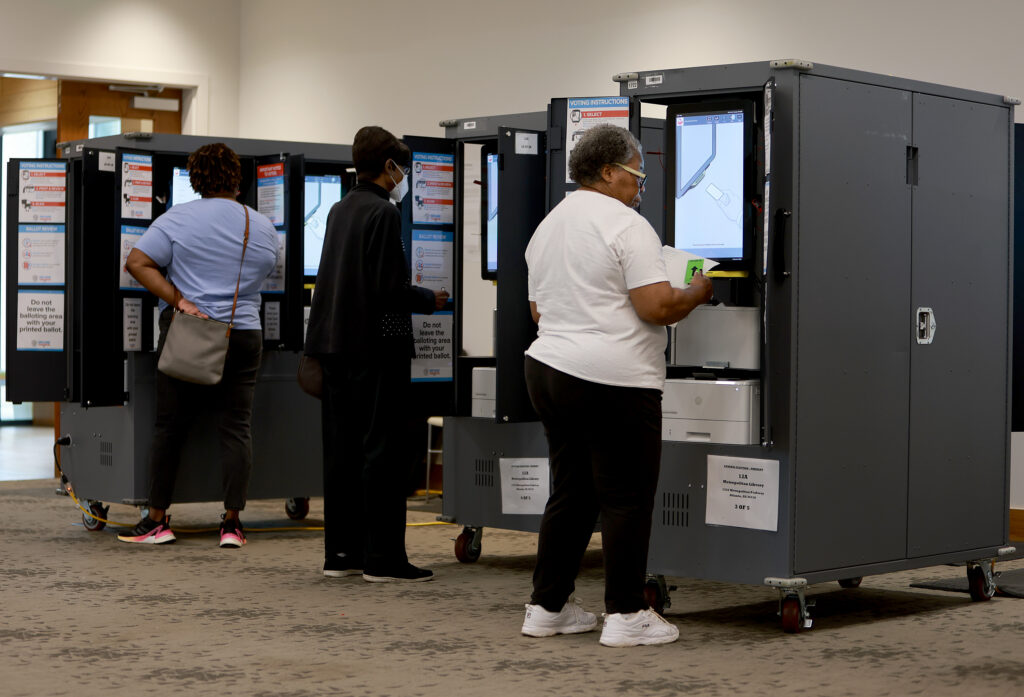
A Republican-dominated panel met for the first time Friday in Georgia to lay out the next steps in a monthslong process to propose a new voting system for the state.
The special committee, which was created by Republican lawmakers earlier this year, will ultimately make recommendations that will directly affect how voters in the crucial swing state cast ballots in future elections, potentially including the 2028 presidential election.
The committee’s process comes as President Donald Trump and prominent figures in the election denial movement continue to spread false conspiracy theories about voting systems — particularly in Georgia.
State Democrats have also criticized the panel — called the Election Equipment Specifications and Standards Committee — for its lack of racial, political and gender diversity. All nine of its members are white, only one is a Democrat and only one is a woman.
Get updates straight to your inbox — for free
Join 350,000 readers who rely on our daily and weekly newsletters for the latest in voting, elections and democracy.
Opening its meeting Friday morning, committee co-chair Georgia Rep. Victor Anderson (R) vowed an “open, deliberate and well-documented” process that’s informed by a range of voices.
“That includes county officials, cybersecurity professionals, accessibility experts, auditors, election workers, voters and companies that manufacture and support election technology,” Anderson said.
Currently, Georgia’s in-person voting system heavily relies on electronic ballot-marking devices that have voters select their choices on a touchscreen. After their choices are made, the machines print a paper ballot containing a QR code that’s scanned by tabulators when the state counts votes.
Republicans are hoping to switch to a new system that has most people who vote in person fill out hand-marked ballots. How those ballots are tabulated will be one of the committee’s key recommendations.
In a majority of U.S. voting precincts, hand-marked paper ballots are counted by optical scanning systems. During Friday’s meeting, Rep. Scott Holcomb (D) indicated that Georgia’s new system would involve optical tabulators, too.
For several years, voting technology experts have recommended that states move away from machines that encode votes in QR or barcodes because voters can’t interpret what’s in the encoding and because they believe that votes should be counted from human-readable text that voters can verify.
However, the experts also advocate for ballot-marking devices to still be made available, particularly for voters with disabilities who may not be able to fill out a hand-marked ballot without assistance. In fact, federal law stipulates that all precincts have machines to accommodate voters with disabilities.
Since the 2020 election, Trump and election deniers have repeatedly and baselessly attacked Georgia’s election machines, manufactured by Dominion Voting Systems, which has since been acquired by Liberty Vote.
Trump and his allies’ fixation on Georgia has less to do with the state’s machines than the fact it’s a swing state that the president lost in the 2020 election, which he claims was stolen from him.
They have spent little time targeting similar voting systems in Republican-dominated states, such as Louisiana. It uses electronic voting machines that do not produce paper ballots and is considering switching to machines that are similar to Georgia’s current system.
In a March 2025 executive order, Trump tried to unilaterally do away with QR- or bar-encoding voting machines by directing the U.S. Election Assistance Commission (EAC) to decertify any machine with those features. Several court orders barred the EAC from going forward with that directive.
The special committee will next meet on Sept. 3. It hopes to meet at least four times before it makes its final recommendations to state lawmakers by Jan. 31, 2027. Georgia lawmakers are hoping to have the new system in place before the state holds its presidential primary election in March 2028.