Florida Republicans urge court to greenlight gerrymander — and nix constitution’s gerrymandering ban
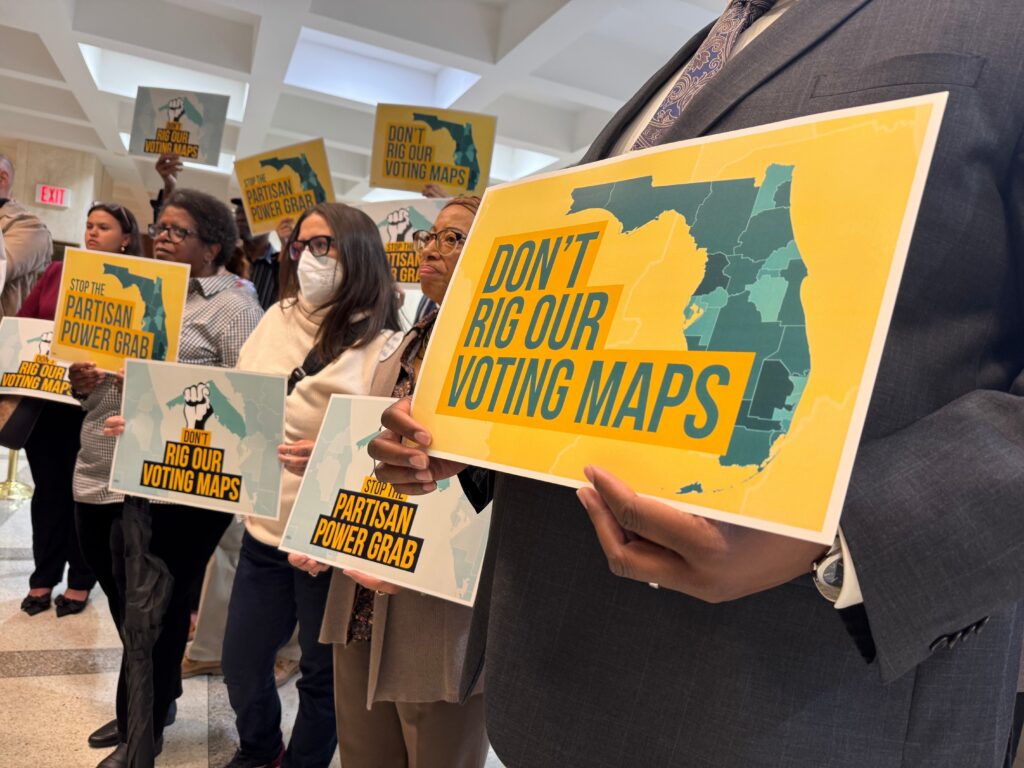
Republican lawmakers and the state of Florida filed briefs Monday ahead of an imminent Florida Supreme Court ruling that could clear the way for the GOP to use a gerrymandered congressional map this year — and invalidate the state’s voter-approved ban on gerrymandering.
Florida voters and voting advocates are challenging the new map — which could net four more GOP seats in Congress — arguing that it violates Florida’s voter-approved Fair Districts Amendment (FDA).
But in their latest court filing, Republican state representatives argued the court should find the FDA unconstitutional and strike down the amendment, which was passed by voters in 2010, in its entirety.
Get updates straight to your inbox — for free
Join 350,000 readers who rely on our daily and weekly newsletters for the latest in voting, elections and democracy.
Pro-voters have argued that even if the court strikes down the racial gerrymandering prohibition that Republicans now claim violates the U.S. Constitution in light of the U.S. Supreme Court’s ruling in Louisiana v. Callais, it could still uphold the provisions of the FDA that ban partisan gerrymanders.
But Republican lawmakers insisted Monday that the court should invalidate the whole amendment, arguing “(t)he removal of one standard alters the recipe the voters approved.”
Civil rights groups fired back in an amicus brief Monday, arguing that a challenge to one provision of the FDA does not invalidate the entire voter-approved amendment. “Florida courts are required to construe [the FDA] in a manner that renders it constitutional, if possible,” they wrote.
The state filed a separate brief Monday focused on defending the map itself. It argued that it’s too close to the election for the court to order the state to use its 2022 map. It also argued that plaintiffs have failed to prove the map was drawn with partisan intent — despite what plaintiffs have described as “staggering” evidence of partisanship.
A Florida circuit judge appointed by Gov. Ron DeSantis (R) already denied plaintiffs’ request to temporarily block the map this year. Notably, he did not reject plaintiffs’ arguments that the map is a partisan gerrymander. But he concluded that the new map was the “lesser of two evils” because of its compliance with Callais, which gutted protections for minority voters.
Plaintiffs filed their own briefs to the state Supreme Court Monday. The court agreed to expedite the case, and its ruling could come quickly.
This story has been updated.
*The Elias Law Group (ELG) is representing plaintiffs in the case. ELG Firm Chair Marc Elias is the founder of Democracy Docket.