Fair Elections — and Perhaps Control of Congress — at Stake as SCOTUS Hears Challenge to VRA
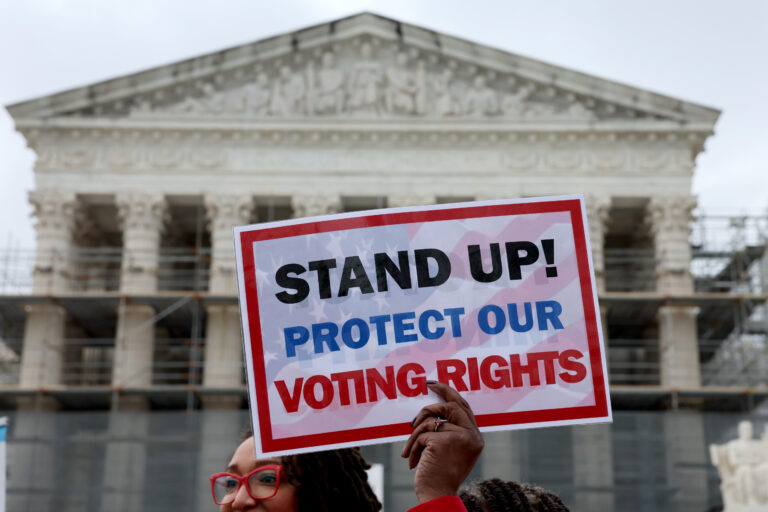
Among some voting rights advocates, the approaching oral arguments in Louisiana v. Callais, where the U.S. Supreme Court will hear a conservative challenge to the most important plank of the Voting Rights Act (VRA), feels like watching a condemned prisoner shuffling into his final pardon board hearing while the guards power up the electric chair next door.
“This is it. I would bet my left arm that they will tell us that Section 2 is in violation of the Fifteenth Amendment,” Luis Fuentes-Rohwer, a law professor at Indiana University Bloomington, told Democracy Docket earlier this year, referring to the law’s ban on racial discrimination in voting.
The stakes could hardly be higher. A ruling that strikes down or significantly weakens Section 2 wouldn’t just deal a crippling blow to what’s left of the most successful civil-rights law in our history, giving states virtually free rein to draw district lines in ways that undercut the political power of minority voters. It also could give Republicans a major edge in the fight for control of Congress next year. By allowing for the dismantling of minority districts held by Democrats, a ruling against the VRA could give President Donald Trump and the GOP enough additional seats to lock in the party’s control of the House for a generation.
Passed in 1965, the VRA finally codified the 15th Amendment’s guarantee that no government shall deny or abridge the right to vote on account of race. For decades, plaintiffs have used Section 2, which bans racially discriminatory voting laws, to challenge electoral maps that dilute minority voting power.
But come Wednesday, the Supreme Court will hear arguments that the VRA, enacted to enforce the 15th Amendment, actually violates it instead.
If the court agrees, its conservatives will finish a job they began in 2013, when Chief Justice John Roberts wrote a 5-4 opinion in Shelby County v. Holder striking down the VRA’s “preclearance” provisions, which required certain jurisdictions with discriminatory pasts to get the federal government’s ok before changing election laws. Shelby cleared the way for Southern states to implement a host of electoral changes making it harder to cast a ballot, like voter ID laws — as well as more local changes that often flew below the media radar.
Roberts has long eyed the VRA with suspicion. As a young Department of Justice lawyer, he wrote a now-infamous 1982 memo opposing crucial efforts to strengthen Section 2, which ultimately were passed by Congress and signed into law by President Ronald Reagan.
In short, Section 2 of the VRA says minorities must have equal opportunity to elect representatives of their choice, and it bans state laws that prevent that — whether intentionally or not. Because voting is so often racially polarized, the only way to do that is to make sure minority voters can form the majority in a proportionate number of districts to their population size.
After Louisiana drew maps in 2022 that packed Black voters in just one of the state’s six districts — even though they make up roughly a third of voters — a group of Black voters sued. A court eventually ordered state lawmakers to redraw maps with two majority-Black districts.
Conservative anti-VRA activists then recruited a group of “non-African American voters,” and sued Louisiana, arguing that the map, drawn to fix an unconstitutional racial gerrymander, was itself an unconstitutional racial gerrymander.
Under the 14th Amendment, the courts have required that the government can only consider race if it does so in a “narrowly tailored” way in furtherance of a “compelling state interest.” For years, the Supreme Court has said that fixing a racial gerrymander is a pretty compelling reason to retailor an electoral map.
The court had a chance to reconsider that doctrine in a nearly identical case two years ago in Allen v. Milligan. In a 5-4 decision, it ultimately upheld Section 2. But in a concurrence, Justice Brett Kavanaugh suggested he might be open to a “temporal argument,” like the one used by plaintiffs in Shelby County – in other words, that racism isn’t the problem it once was and no longer justifies the VRA’s extraordinary measures to combat it.
Still, when the court first heard oral arguments in Callais back in March, it seemed as though it would rule on the existing standard, questioning only whether Louisiana erred in how it applied the VRA.
But then the court scheduled a rare rehearing on the question of whether Section 2 of the VRA violates the 14th or 15th Amendment. Given Kavanaugh’s suggestive concurrence in Milligan and Robert’s long-held hostility to the VRA, the question among most observers is how, not whether, this court will eviscerate the law.
Racing to the right
Voting rights isn’t the only area where the Roberts Court has tacked to the right on questions of race. It also blocked affirmative action in college admissions, and the forced integration of school districts, with Roberts himself writing in one 2007 case, “The way to stop discrimination on the basis of race is to stop discriminating based on race.”
“This Supreme Court has, frankly, a hostility to recognizing that race plays a central role or an important role in our community today, and that we are not yet a race blind society,” said John C. Yang, president of the Asian Americans Advancing Justice – AAJC.
There is at least one area where the court hasn’t pretended to be colorblind. In a shadow docket decision last month, the Supreme Court blocked a temporary restraining order that forbade federal immigration officers from stopping people based on factors like their apparent ethnicity, the language they were speaking, and type of work. While the majority’s order was not accompanied by an opinion, Kavanaugh wrote a concurrence defending the explicit reliance on race in deciding whether someone is suspicious enough for police to stop and question.
The last levee left holding back a gerrymandering deluge
The VRA took on added importance in 2019, after SCOTUS’ decision in Rucho v. Common Cause. While the court maintained that partisan gerrymandering was illegal, the majority concluded it was a nonjusticiable question the courts, on their own, were unable to resolve. By essentially declaring partisan gerrymandering to be beyond the reach of federal courts, Rucho paved the way for today’s spate of mid-decade redistricting efforts.
Section 2’s prohibition on racially discriminatory maps has until now served as a check on some of the worst partisan impulses out there. If it goes, though, a recent analysis by Fair Fight Action and Black Voters Matter suggests that Republicans could remap states across the country, and particularly in the South, to effectively hand the GOP 19 new safe U.S. House seats, all but eliminating minority representation in the process. If you add the seats that the GOP may gain thanks to the Trump-driven push to gerrymander as many states as possible, the report found, the total number of new GOP seats rises to 27 — perhaps enough to cement one-party control of the chamber for decades.
Yang noted the dark irony. “The whole notion of the Voting Rights Act was to enfranchise millions of voters that typically have been disenfranchised,” he said. “It gives meat to the 14th Amendment and — depending on what the court does — we could see this resulting in a situation where, again, vulnerable communities, typically communities of color, are going to be disenfranchised.”
There is a chance that Roberts and Kavanaugh end up siding with the court’s liberals to preserve the VRA. Voting-rights advocates were similarly worried that the Supreme Court would gut the VRA ahead of Milligan, only to be pleasantly surprised by the 5-4 outcome there. And unlike university admission guidelines or school district policies, the VRA is a law passed by Congress, which the Supreme Court may hesitate to set aside.
Moreover, Roberts has often cast himself as a defender of the Supreme Court’s legitimacy, which is under its fiercest questioning right now, thanks in large part to the institution’s reliance on the shadow docket to support the Trump administration’s aggressive expansion of executive power. Federal judges have taken the unprecedented step of publicly criticizing the court’s reliance on the shadow docket as opprobrium from the upper echelons of the law, including from many prominent conservative lawyers, has poured forth.
This isn’t the Supreme Court’s only chance to weaken the VRA. Cases out of the 5th and 8th Circuit Courts of Appeals have split on the question of whether Section 2 allows private individuals — and not just the U.S. Attorney General — to bring lawsuits. Given that private plaintiffs bring the vast majority of Section 2 cases, ruling there is no private right of action would gravely wound the provision.
Overturning Section 2 of the VRA outright as Republicans push aggressive mid-decade gerrymanders to tilt the scales in their favor in the 2026 midterms would likely spark a furor, as UCLA Law professor Rick Hasen noted recently. But the court’s conservatives could write a facially narrower opinion that could amount to much the same thing in effect.
“Given how high profile it would be for the Court to strike down Section 2, and given how at least some of the Justices consider the politics of their decisions, there’s a far more likely path to achieve this same purpose without an opinion explicitly striking down Section 2—interpret Section 2 so that it has no power,” Hasen wrote, adding that this court did something similar in 2021 with Brnovich v. Common Cause.*
In that case, Justice Samuel Alito “ignored text, history, precedent, and congressional intent,” to weaken the VRA’s power for challenging state election laws that make it harder for minorities to register or vote, Hasen argued, by coming up with convoluted new “guideposts” that operate more like roadblocks to voting rights plaintiffs.
Just what a similar “Alito Treatment,” would look like in Callais isn’t clear, Hasen noted. He suggested that the court might overturn Thornburg v. Gingles — the 1986 case that the court used to lay out the conditions that must be met for a finding of racial discrimination when there’s no clear evidence of racial intent — and replace its standard with something all but impossible for plaintiffs challenging racial gerrymanders to meet.
In an amicus brief, the U.S. Justice Department argues for a similar approach, as Harvard Law’s Nicholas Stephanopoulos has noted. A ruling like this would be lengthy and convoluted, Hasen noted, leading many to read it as upholding Section 2 even as it weakens it into oblivion.
“Because it’s so hard to explain technical voting rights rulings to the general public,” Hasen wrote, “and because it won’t be immediately clear to journalists and others that this is essentially a denuding of Section 2, the Justices just might be able to get away with it.”
*Democracy Docket founder Marc Elias represented the respondents in Brnovich v. Common Cause.