Republicans are using Callais to defend voter suppression laws, not just gerrymanders
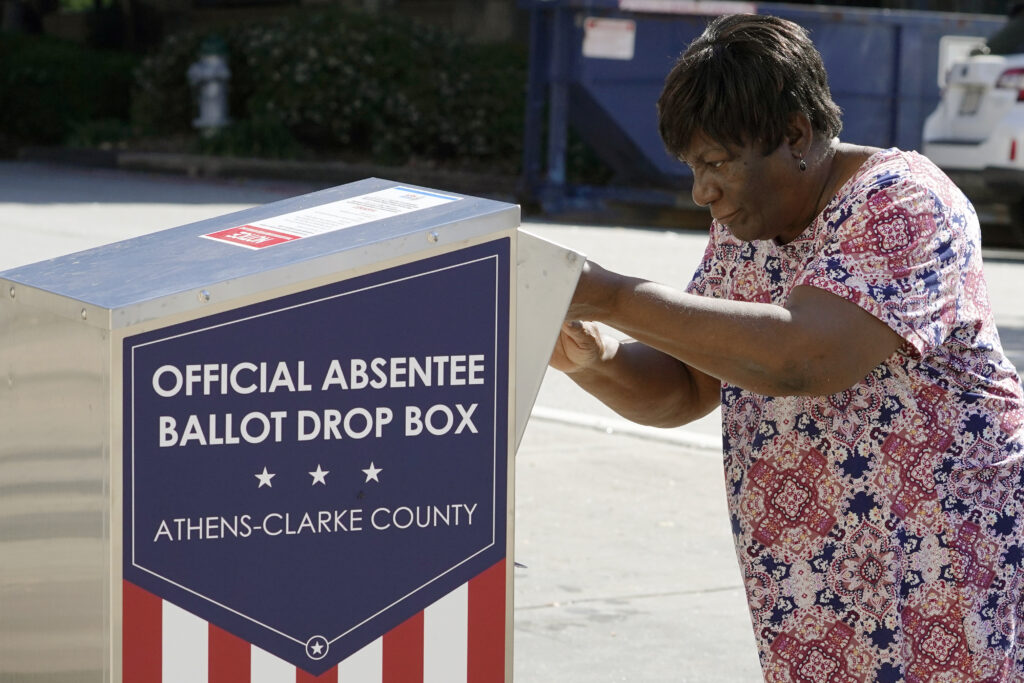
A new Republican legal brief underscores how the party is trying to use the U.S. Supreme Court’s ruling in Louisiana v. Callais to make it harder for minority voters not only to get fair representation, but also to cast a ballot at all.
In a filing made in an ongoing case against Georgia’s restrictive 2021 voting law, the Republican National Committee (RNC) argued that Callais requires voters challenging certain restrictions to show intentional discrimination. That’s a much higher bar — and one that could shield laws that disenfranchise voters based on their race.
The filing is an early sign that Republicans are trying to expand Callais far beyond district maps and turn the ruling into a broader weapon against federal voting protections.
Get updates straight to your inbox — for free
Join 350,000 readers who rely on our daily and weekly newsletters for the latest in voting, elections and democracy.
The Georgia case centers on Senate Bill 202, the sweeping voter suppression law Republicans enacted after Democrats won the state in the 2020 presidential election and two U.S. Senate runoffs.
Among other extreme provisions, pro-voting groups are challenging a birthdate requirement that allows election officials to reject an absentee ballot if the birthdate written on the outer ballot envelope does not match the voter’s registration record.
The groups argue that the rule violates the Civil Rights Act’s Materiality Provision, which prohibits states from denying someone the right to vote because of an error or omission that is not actually relevant to whether they are qualified to vote.
But in a filing last month before the 11th Circuit Court of Appeals, the RNC argued that Callais undercuts that claim.
“Callais shows that Plaintiffs’ reading of the Materiality Provision of the Civil Rights Act does not fit with the Fifteenth Amendment,” Republican appellants wrote. “Plaintiffs’ Fifteenth Amendment argument can’t survive Callais.”
The argument marks a major attempted expansion of Callais.
The Supreme Court case was about Louisiana’s congressional map and whether the state relied too heavily on race when it created a second majority-Black congressional district to comply with the Voting Rights Act. The conservative majority sided with white voters who challenged the map, ruling to create a new standard for redistricting claims.
Now, Republicans are invoking that redistricting ruling in a case about whether voters can challenge ballot rejection rules.
The Materiality Provision of the Civil Rights Act prohibits states from denying someone the right to vote because of a paperwork error or omission that is not relevant to whether they are qualified to vote. Pro-voting groups say Georgia’s SB 202 violates that protection because it allows officials to reject absentee ballots over birthdate errors that have nothing to do with whether someone is eligible to vote.
Their argument is straightforward and sweeping, that because Callais said certain voting rights claims must be tied to intentional discrimination, courts should also require intentional discrimination in Materiality Provision cases. That would make it far harder for voters to challenge election rules that throw out ballots over minor mistakes, even when those rules disproportionately harm voters of color.
Pro-voting groups warned the 11th Circuit that the RNC’s logic would threaten far more than Georgia’s birthdate rule.
“Intervenors’ logic — sans briefing — would threaten Congress’s per se bans not only on immaterial paperwork, but also on literacy tests, differential election practices and voter intimidation, in the voter registration phase as well as voting and ballot counting,” the groups wrote. “The Court’s constitutional analysis of Section 2 of the Voting Rights Act was derived from the Equal Protection Clause’s prohibition on racial discrimination in the redistricting context, which is inapplicable to the CRA’s protection of all voters against disenfranchisement due to immaterial paperwork errors”
The Georgia filing fits into a broader conservative effort to treat Callais as a sweeping “race-blind” constitutional command, not just a redistricting decision.
This week, the Trump Justice Department’s Office of Legal Counsel also cited Callais in an opinion attacking disparate-impact liability under Title VII of the Civil Rights Act — a legal tool used to challenge policies that disproportionately harm protected groups without needing direct proof of intentional discrimination.
Together, the filings show Republicans and the Trump administration trying to use Callais as a new legal weapon against federal voting and civil rights protections. If courts accept that theory, voting rights groups could face a much higher burden when challenging laws that disenfranchise minority voters.