Amid new GOP-led restrictions, North Carolina students lead a fight to vote during the midterm primary
Olu Rouse clearly remembers the first time he voted.
He was a freshman at North Carolina Agricultural and Technical State University (NC A&T), and he meticulously researched candidates before he cast his ballot at his on-campus voting site in the 2024 presidential primary election.
Today, that voting site doesn’t exist.
Rouse, now a third-year student, is just one of the thousands of students in North Carolina who lack easy access to early voting sites on their college campuses — even as early voting for North Carolina’s primary election is underway.
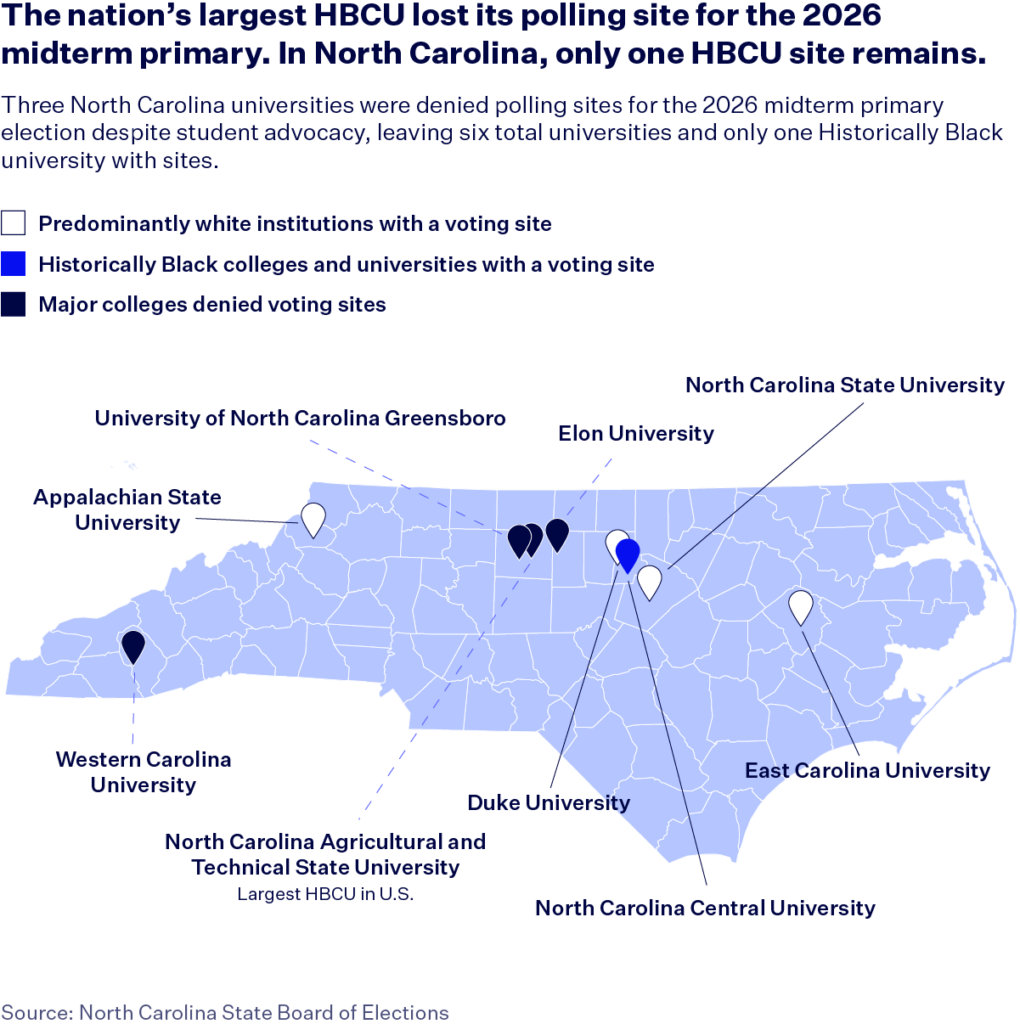
That’s because the GOP-controlled North Carolina State Board of Elections (NCSBE) last month rejected early voting sites at NC A&T, the nation’s largest historically Black college, and three other college campuses across the state: Western Carolina University (WCU), the University of North Carolina-Greensboro (UNC-G) and Elon University.
Student advocates and voting rights experts have warned that the board’s decision represents a major assault on student voting rights in the state. But it has since also catalyzed student advocacy efforts to get out the vote.
Brian Kennedy, a senior policy analyst for the nonpartisan advocacy organization Democracy North Carolina, told Democracy Docket that this newest blow is just one of several efforts to suppress the Black vote across the state and narrow student voting access in general across the country.
“I think we’ve seen the blueprint for what voter suppression across the nation can look like here in North Carolina,” he said.
The legal battle
Rouse was one of dozens of students present at the Jan. 13 NCSBE meeting in Raleigh, North Carolina, during which Republican state officials refused early voting sites at the four colleges, which together serve around 47,000 students.
Despite the objections of students who sent a letter to the board and showed up in person to protest the decision, the board denied two new midterm primary sites at UNC-G and NC A&T and rejected two existing sites at Elon University and WCU.
Several students from NC A&T, WCU and UNC-G, as well as the College Democrats of North Carolina, raised their concerns in a lawsuit* against the board.
Zach Powell, a student at WCU, joined the lawsuit to fight for his university’s long-standing early voting site, which prior to the board’s vote had operated since 2016. Powell is a first-generation college student and WCU is where he found his voice in political advocacy, according to his declaration.
After voting in the 2024 primary and general elections at his on-campus site, Powell had planned to do the same this year until the Republican-controlled county and state boards of elections voted to eliminate it.
Powell’s campus is located in the Appalachian Mountains and a majority of students, including him, don’t have cars. In fact, another plaintiff, Zayveon Davis who attends NC A&T, said that his university has a policy that bans freshmen from having cars on campus with limited exceptions.
A freshman at WCU and originally from Texas, Rose Daphne Yard is not yet registered to vote in North Carolina, but she also joined the lawsuit. As many North Carolina students do, she had planned to register in her new state during in-person early voting, which started Feb. 12.
Because same-day in-person registration is only available in North Carolina during early voting, transportation barriers serve as a compounding restriction on new registrations and, in turn, to voting itself. Students are generally more likely to utilize same-day registration than other voters.
For example, WCU’s on-campus early voting site yielded the highest proportion of same-day registrations in North Carolina and served the most Black voters in all of Jackson County in 2024, according to data analyzed by political scientist and WCU professor, Chris Cooper.
Because of the state board’s decision to strip WCU of its site, Yard said in her plaintiff declaration that if she cannot register and vote early, she does not know if she will be able to vote at all.
“Being able to vote where I live — early, accessibly, and without unnecessary obstacles — is essential to my safety, dignity, and belonging in this community,” Yard wrote in her declaration, where she underscored her identity and activism as a transgender woman.
Powell, Yard and two other student plaintiffs emphasized transportation, including the unreliability and cost of ride-booking apps like Uber and Lyft, as a barrier to voting.
In his declaration, Powell described one time when he waited 20 minutes for a driver in order to travel off-campus, before having to cancel the ride.
Students who attended the January meeting of the NCSBE didn’t just leave without polling sites. They were mocked, denied public comment and threatened with removal by the State Capitol Police, according to plaintiff declarations and a video recording of the meeting. And actions like these didn’t just occur at the meeting in January.
At a Jackson County Board of Elections meeting in November 2025, Powell said Chairman Bill Thompson dismissed student concerns of walking nearly two miles from campus to the Cullowhee Recreation Center because Thompson didn’t personally feel burdened by the walk.
How did we get here?
Because several counties, including Jackson and Guilford, failed to unanimously pass early voting plans for the 2026 midterm primary, the decision on the early voting sites at the four college campuses was brought to the NCSBE.
Both county and state officials claimed low turnout as a justification to not provide the early voting sites.
The student plaintiffs and the College Democrats of North Carolina challenged those claims in their lawsuit, which also argued that the board’s decision violated the Constitution in several different ways.
However, just four days before the start of early voting for North Carolina’s primary election, a federal judge issued an order denying repeated student pleas for polling sites at the universities.
U.S. District Judge William Osteen Jr., who was appointed by former President George W. Bush, rejected the plaintiffs’ motion to prevent the NCSBE’s denials of on-campus polling places from moving forward, claiming the restrictions did not pose a “severe burden” on students.
With little explanation, Osteen specifically rejected the students’ claim that the board’s denial of the sites violated the 26th Amendment by intentionally targeting student voters, particularly young Black voters.
Amid the battle over the sites, students and advocates have been alarmed by comments from election officials and other political figures that appear to undermine the right to vote, or in some cases, deny that right completely.
During a Guilford County Board of Elections meeting in November, County Chairman Eugene Lester did just that.
“Rights are those things we get automatically, like the right to be presumed innocent in a criminal trial. There’s nothing we have to do other than be born here and enjoy the Constitution to get that right,” Lester said. “Then there are privileges. Voting is a privilege.”
While the right to vote was not instituted in the original U.S. Constitution, the 14th, 15th, 17th, 19th, 24th and 26th Amendments established both the right to vote and numerous protections of this right in the nation’s supreme law.
What’s more, almost all state constitutions outline an explicit right to vote, including North Carolina.
North Carolina: “The national blueprint for voter suppression”
Although the recent escalation of voting restrictions in North Carolina has set off alarm bells, it’s not new.
While now an expert in democracy, Kennedy, the policy analyst from the advocacy group Democracy NC, was once a student advocate too.
While studying at North Carolina Central University from 2008 to 2012, Kennedy said he consistently sparred with state leaders who sought to eliminate his on-campus early voting site.
It’s only through student advocacy, Kennedy said, that the site has remained.
The board’s decision to strip the four sites came after an unprecedented move last year to transfer election administration from North Carolina’s Democratic governor to the Republican state auditor. Both the state elections board and several county boards are now controlled by the GOP.
Cleta Mitchell, a longtime GOP election attorney who has worked side-by-side with President Donald Trump to advance election conspiracies, has also long advocated increased restrictions on student voting in North Carolina.
“[Democrats] basically put the polling place next to the student dorm, so [students] just have to roll out of bed, vote, and go back to bed,” Mitchell said at a retreat for Republican National Committee donors in 2023.
Mitchell’s role in the passage of Senate Bill 747 (SB 747), which changed rules in the state for same-day voter registration, cannot be overstated. It reflects a national focus on purple states like North Carolina among those who seek to limit voting accessibility.
Kennedy said what’s happening in North Carolina isn’t just a stark reality; it’s a warning for the entire country, and it isn’t occurring in isolation.
Like others, Kennedy emphasized that the state board’s decision on the four early voting sites stemmed from North Carolina’s history of suppressing Black student voters.
Regardless of the intentions of the voting site denials and eliminations, their impact remains the same — to disenfranchise or at least make it increasingly difficult for over 15,000 Black student voters to cast their ballots.
In addition to the college campus decisions, the number of counties in the state with Sunday voting shrank from 29 in 2022 to 20 in 2026, with nine counties voting to eliminate it.
Black voters and Democrats were more likely to vote on Sunday than white voters and Republicans in the 2022 North Carolina primary, according to Cooper, the WCU political scientist.
Beyond North Carolina, congressional Republicans’ newest attack on voting rights, the Safeguard American Voter Eligibility (SAVE) America Act, would also greatly affect student voters.
If it became law, the SAVE America Act would erect especially high requirements for student voters by mandating voter identification in federal elections but explicitly barring student IDs as a valid form of identification.
However, 18- to 24-year-olds are most likely to lack a photo ID beyond a student ID, according to a 2024 study by the Center for Democracy and Civic Engagement. Young voters are also more likely to struggle to easily access their identification documents even when they do have them.
“The reality is that voter ID is a poll tax,” Kennedy said. “It is a poll tax because it costs not only money, but also time to ensure that you have the documents you need to vote.”
Students rally to get out the vote
After Osteen’s ruling, the student plaintiffs and the College Democrats of North Carolina dropped their legal attempt to reinstate the sites.
Despite that setback, students at the largest HBCU in the nation and other universities across the state will face barriers this primary election cycle, but they certainly won’t be going quietly.
The local and statewide advocacy communities have stepped up to help students get to the polls, Rouse said.
Alongside his co-lead, Shia Rozier, Rouse started a campaign called Protect Ours. With the mission of raising funds to rent shuttles and transport students to their closest off-campus voting site, Rouse said Protect Ours also seeks to educate students so that they don’t feel intimidated by comments that undermine their right to vote and they better understand the complexities of the electoral process.
On Feb. 17, the group’s Instagram account posted a graphic with a shuttle schedule from 2 p.m. to 7 p.m. from Monday to Thursday of this week.
“There’s nothing that the board of elections is going to do to stop me from voting,” Rouse said. “We want to make sure that we’re doing outreach efforts to every single college so that we can really grow this movement, and make it more than just a moment and more of a movement.”
Protect Ours has been getting help from organizations like Democracy NC and the Andrew Goodman Foundation to reach its goal of around $5,000 for transportation funding.
But the fight doesn’t end here. Rouse said he hopes to expand the mission of Protect Ours and inspire students across the nation to do their part. He also underscored that just because a decision has been made for this primary election, it does not rule out future legal challenges to get voting sites for the general election.
Students are organizing at other colleges too. Led by the College Democrats at WCU, students marched for 40 minutes to the polls, on the grass alongside a busy highway, to vote at the Cullowhee Recreation Center Feb. 13.
As noted in student court declarations, as well as by Rouse and Kennedy, there is a deep-seated tradition in North Carolina of Black students changing undemocratic policies through their advocacy.
For example, the four students who spearheaded the Greensboro sit-ins in the fight for racial integration, including the late civil rights legend Rev. Jesse Jackson, attended NC A&T.
“We’ve run into this issue before in North Carolina and we’ve been persistent,” Kennedy said. “And when people are on the side of justice, justice does prevail.”
*The Elias Law Group (ELG) represented the plaintiffs in the case. ELG Firm Chair Marc Elias is the founder of Democracy Docket, which is editorially independent from ELG.