Despite Trump’s efforts to kneecap it, a key federal election agency is still at work
 Prefer us on Google
to see more of our voting rights news coverage when you search.
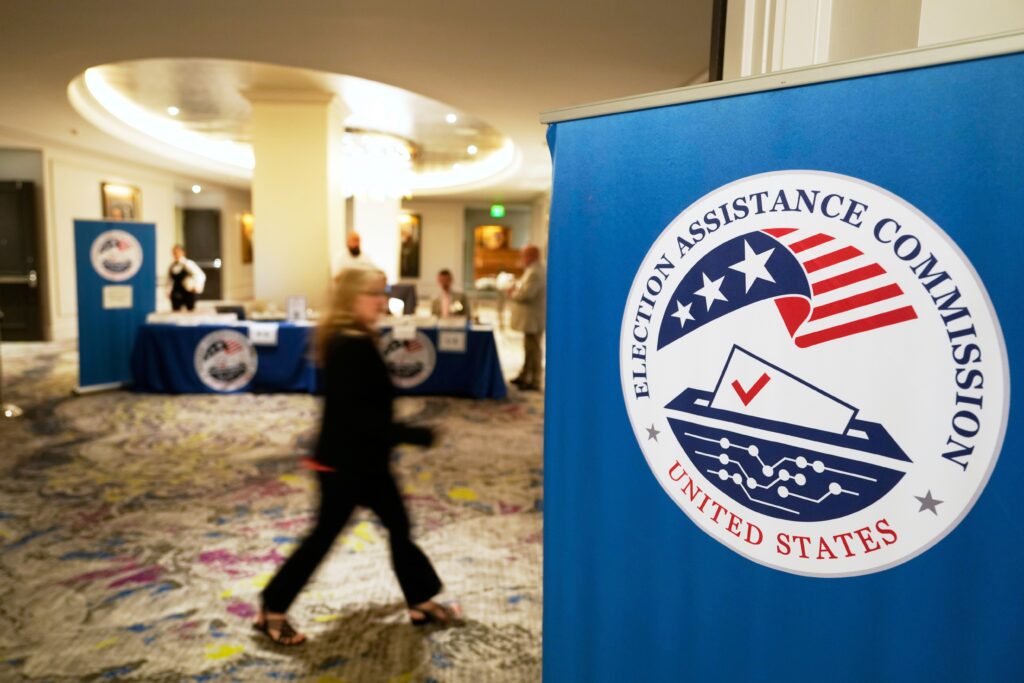
When President Donald Trump in July fired the independent commissioners responsible for assisting states with elections and certifying voting machines, experts feared the move would defang the federal agency.
But since then, the U.S. Election Assistance Commission (EAC) has managed to maintain much of its core elections work despite the Trump administration’s attacks.
For some experts, the agency’s continuity demonstrates the resilience of independent agencies and federal structures designed to ensure voters’ confidence in elections.
Ben Hovland, one of the EAC commissioners Trump fired, said the EAC’s work is essential to protect election security.
“The EAC and its structure is one of those places where you have that bipartisan collaboration that allows for us to come together and identify those common ground areas that we can work on — ultimately in support of the voters,” Hovland said.
Get updates straight to your inbox — for free
Join 350,000 readers who rely on our daily and weekly newsletters for the latest in voting, elections and democracy.
Four presidentially appointed commissioners, split evenly between Democrats and Republicans, typically run the EAC, which is charged with accrediting national testing laboratories, certifying voting systems and maintaining the national mail voting registration form.
Without them, the commission cannot create new policy, adjust certification requirements or hold public hearings — but it can still certify voting systems and disburse election security grants, according to an August document.
Hovland said that work can carry on because the agency’s staff remains largely intact.
“That’s a core part of the mission of the agency, and we took very active steps as commissioners to try to put in place procedures that would allow the agency to function in the absence of a quorum,” Hovland said.
In mid-September, the commission approved the first-ever open-source voting machine, known as VotingWorks, after a nearly two-year certification process. The EAC has also maintained its prolific professional training program, which prepares local officials for election administration.
Ben Adida, VotingWorks’ executive director, said the EAC’s continued ability to verify voting systems is crucial for election security.
“The EAC is very hands-on in the entire testing process from beginning to middle to end,” Adida said. “You cannot get a voting system federally certified without the EAC being very deeply involved.”
“We can now offer our system in just about every state in the union, whereas before we could only offer it in a very small number of states,” Adida added.
Since Congress established the EAC in 2002, most states now require federal certification to adopt voting machines. In 2021, the commission published the latest certification rules, known as the Voluntary Voting System Guidelines (VVSG) 2.0, which was the first update to the federal standard since 2005. The agency certified the first system with VVSG 2.0 in 2025.
But without commissioners, the EAC cannot update those guidelines, said Barbara Simons, who has served on the commission’s board of advisors since 2008.
“Things change, technology changes, and we should be taking that into account with our voting systems,” Simons said. “And at the moment, we’re frozen in time until we have commissioners.”
Hovland said that because states’ participation in the EAC’s guidelines is voluntary, the commission functions as a “customer-service agency” — where the commissioners liaise with state and local officials to develop and adapt policy.
“A big part of the job of commissioners is identifying the areas where the agency can be most effective, where it can concentrate its work given those limited resources and have the most impact for state and local election officials,” Hovland said.
Lacking a central policy-making apparatus is the “biggest deal” when the EAC does not have commissioners, he added.
This is the third time the EAC has lacked a three-member quorum in its 24-year history. Between December 2011 and January 2015, all four seats were vacant as Senate Republicans tried to kill the agency. The commission also did not meet quorum from March 2018 to February 2019.
The seat Hovland filled when he joined the EAC in January 2019 had been vacant for a decade.
Adida said that while “very little changed” in the EAC’s day-to-day operations after Trump fired the commissioners, federal guidelines cannot respond to growing threats to election security or new technology.
“In the short term, not having the commissioners is fine,” Adida said. “In the medium to long term, we need those commissioners. Otherwise, the standard will not evolve, and the standard needs to continue to evolve.”