Explainer: Federal law that protects voters from last-minute removal is at the center of Trump’s anti-voting war
 Prefer us on Google
to see more of our voting rights news coverage when you search.
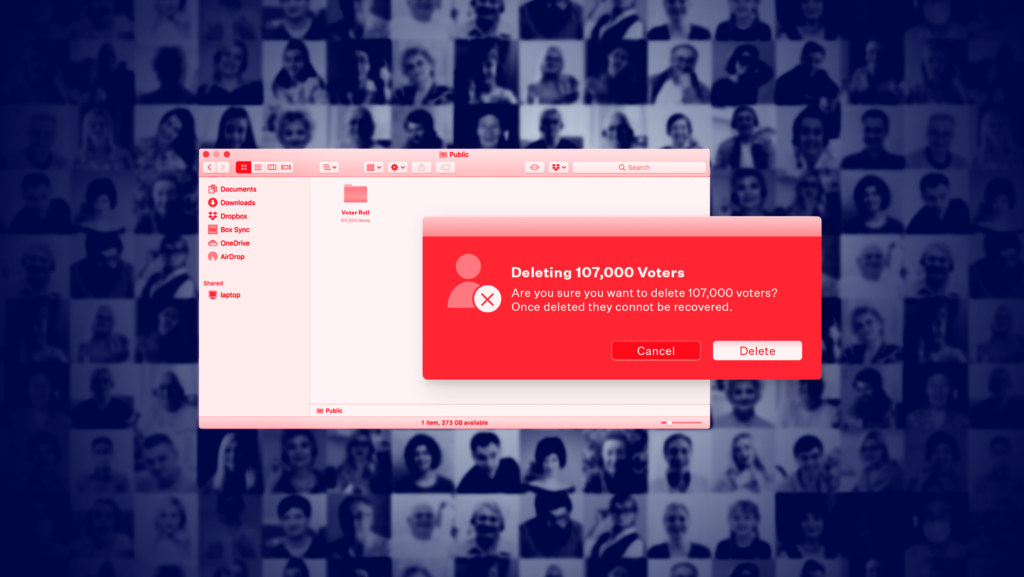
The U.S. Supreme Court recently agreed to hear Republican arguments in an Arizona case that could severely weaken the 90-day “quiet period” of the National Voter Registration Act (NVRA) — a safeguard meant to stop states from conducting mass voter removals too close to a federal election.
At the same time, President Donald Trump’s Department of Justice is pressing a related and dangerous theory in court, arguing that the administration can identify voters it claims are ineligible, send those names to state officials and have them remove those voters one by one right up to Election Day.
For voting rights advocates, this coordinated attack on the landmark federal protection is not abstract.
“Much like with its mass deportation agenda, the Department of Justice is asking for something unprecedented: the power to remove voters from the rolls based solely on suspicion that they are not citizens. Never before has the federal government claimed such authority over our elections, threatening the longstanding balance between state and federal responsibilities,” Hector Sanchez Barba, President and CEO of Mi Familia Vota, said after the Supreme Court agreed to hear the case. “We have already seen eligible citizens wrongly removed from voter rolls and forced through burdensome bureaucratic hurdles to restore their voting rights. That is not election integrity — it’s disenfranchisement.”
The fight over the NVRA’s quiet period goes beyond one state law or lawsuit. It is a fight over whether eligible voters will have meaningful protection from being wrongly removed from the rolls at the moment when the consequences are hardest to undo.
Get updates straight to your inbox — for free
Join 350,000 readers who rely on our daily and weekly newsletters for the latest in voting, elections and democracy.
What is the NVRA’s quiet period?
The National Voter Registration Act, often called the “Motor Voter” law, was enacted in 1993 to boost voter registration nationwide by making it more accessible and to protect eligible voters from being wrongly pushed off the rolls.
One of its most important safeguards is the 90-day quiet period.
Under the law, states must complete any program meant to systematically remove ineligible voters from the official voter rolls no later than 90 days before a primary or general election for federal office. In other words, states cannot wait until the final stretch before an election to launch broad purge programs that could remove eligible voters by mistake.
That rule exists because voter purges are different from ordinary voter roll maintenance. When a voter is wrongly removed months before an election, there may still be time to discover the error, correct the record and cast a ballot. When that same mistake happens weeks or even days before Election Day, the damage can become impossible to undo.
“The 90-day quiet period exists because elections require stability, not chaos, in the run-up to Election Day. Congress recognized that if eligible voters are swept up in a large removal program shortly before an election, many won’t have enough time to discover the mistake and get it corrected,” Pamela Smith, president and CEO of the pro-voting nonprofit Verified Voting, told Democracy Docket. “Removing the 90-day buffer takes away the only structural safeguard between a bad data match and eligible voters’ ability to participate.”
The quiet period does not freeze voter rolls entirely, however.
It does not stop election officials from processing new registrations, correcting clerical errors or making routine updates. And it also does not prevent removals when a voter themselves asks to be removed, when a voter has died, when a voter is disqualified under state law because of a criminal conviction or mental incapacity, or when the state follows the NVRA’s procedures for confirming that a voter moved.
But those few exceptions do not give states a blank check to run mass purge programs at the last minute.
“That doesn’t mean voter registration lists stop being maintained. Election officials update them year-round, and individualized changes still happen during the quiet period — whether that’s processing a voter’s own request to cancel their registration, recording a death, or making other routine corrections permitted under state and federal law,” Smith said. “What the quiet period restricts is a systematic effort to remove a broad class of voters based on shared criteria.”
A truly individualized removal is based on specific, reliable information about a particular voter. A systematic purge uses a broader process — often a database match, list or set of criteria — to flag entire groups of voters for removal.
The danger is that states, the Trump administration or right-wing groups could try to collapse that distinction by building lists of alleged noncitizens and then treating each name as an individualized case. If courts accept that theory, the quiet period could become much easier to evade.
“Calling a large-scale removal effort ‘individualized’ doesn’t change how it functions if the same criteria are being applied across thousands of records. County election officials already routinely review and maintain voter registrations on an individual basis throughout the year,” Smith added. “Labeling a bulk removal program as a case-by-case review just before an election doesn’t change its substance. Doing so would still undermine the period’s purpose and risk disenfranchising those who have every right to cast their ballot.”
The point of the quiet period is simple: The government should not be able to use broad, error-prone purge programs to force eligible voters to prove they belong on the rolls at the very moment when it may be too late to fix a mistake.
Why are last-minute purges so dangerous?
Congress codified the quiet period into law because voter purges had long been used as a tool to suppress Black and minority voter participation, including in the Jim Crow South.
Before the NVRA, states and other political actors used a range of registration barriers to keep eligible voters off the rolls or force them to repeatedly prove their eligibility. Some states required voters to re-register when they failed to vote in one election. Others relied on selective purges that disproportionately targeted communities already facing barriers to the ballot.
One stark example came in New Jersey’s 1981 gubernatorial election, when the Republican National Committee (RNC) sent mailings to voters in predominantly Black and Latino neighborhoods using an outdated voter registration list. Tens of thousands of letters were returned as undeliverable, and those returned letters were used to compile a challenge list seeking to remove voters from the rolls. The RNC asked election supervisors to strike 45,000 voters from the rolls right before the election.
The effort led to a federal lawsuit and a consent decree limiting the RNC’s so-called ballot security operations for decades.
That history helps explain why Congress did not treat voter purges as a neutral state task. A purge can sound technical — a list update, a database match or a mailing — but in practice, those systems can be weaponized to target specific groups of voters, spread confusion and shift the burden onto eligible citizens to prove they belong on the rolls.
The timing makes the risks far more dangerous.
When a voter is wrongly removed months before an election, there may still be time to find out, contact election officials, provide documentation and restore their registration. But when a voter is purged weeks or even days before Election Day, the first notice may come at the polling place, when they are told they are no longer registered.
By then, the burden has shifted and the danger can quickly become real.
In 2024, Alabama Secretary of State Wes Allen (R) announced a purge program to remove alleged noncitizens from the state’s voter rolls just 84 days before the presidential election. The state flagged 3,251 registered voters based on records showing they had once been issued noncitizen identification numbers.
But the list swept in eligible voters, too. Alabama later acknowledged that thousands of the flagged voters were U.S. citizens, and a federal judge blocked the program before Election Day, finding that the state had missed the NVRA’s deadline for systematic removals despite claims by Republican officials that the purge was based on individualized evidence of ineligibility.
The Alabama case showed the quiet period doing exactly what it is supposed to do: stopping a broad, error-prone purge before eligible voters could be forced into last-minute bureaucratic fights over whether they could vote.
A mismatch can happen because of a typo, a name change, outdated records, inconsistent government data or confusion between people with similar names. For voters who move frequently, students, young voters, naturalized citizens and voters with less stable access to government paperwork, those errors can be especially hard to resolve quickly.
The government made the mistake, but the voter has to fix it — often under impossible time pressure.
The quiet period is meant to prevent the government from creating chaos at the worst possible time. It forces states to do broad list maintenance early enough that voters have a meaningful chance to catch mistakes, challenge removals and cast a ballot that counts. Without that protection, eligible voters could be forced to prove they belong on the rolls after the government has already put their registration in jeopardy — and after the clock has nearly run out.
Systematic vs. individualized: What happens if the quiet period is weakened?
The quiet period’s strength depends on an important distinction. The law bars broad purge programs close to federal elections, while truly individualized removals may still be allowed.
The Republican strategy for over a decade has been to blur that line.
In 2012, Florida GOP officials tried to remove alleged noncitizens from the rolls close to a federal election. The Eleventh Circuit Court of Appeals later held that the program violated the NVRA’s quiet period because it was a systematic effort to identify and remove suspected noncitizens. The court warned that eligible voters removed days or weeks before Election Day may not be able to correct the state’s mistake in time to vote.
The GOP’s playbook is not new. What is new is how aggressively that strategy is now being pushed at every level of government.
In 2024, Virginia Gov. Glenn Youngkin (R) signed an executive order directing officials to accelerate removals of alleged noncitizens from the rolls during the quiet period. Voting rights groups and the Justice Department under President Joe Biden sued, and a federal judge ordered Virginia to restore roughly 1,600 voters to the rolls after finding the program likely violated the NVRA.
But days before Election Day, the Supreme Court paused that lower court ruling and allowed Virginia’s purge program to remain in effect without explaining its reasoning.
Now the Supreme Court is taking up the issue again — not through an unexplained emergency order, but in a full case that could reshape how much protection the quiet period provides nationwide.
If the quiet period is weakened, citizenship-based purges could become easier to launch, harder to challenge and more dangerous for eligible voters. Naturalized citizens could be wrongly flagged because government records are outdated. Voters could receive confusing notices in the final weeks before an election. Some may not learn their registration has been questioned until they show up to vote.
It could also make purges easier to nationalize.
If DOJ obtains state voter files through its ongoing crusade, runs them through federal databases and sends states lists of alleged noncitizens, state officials could face pressure to act on those referrals close to Election Day — even if the data is flawed and even if voters have little time to respond.
That is the danger to democracy at the heart of the quiet period fight. The issue is not whether election officials can correct voter rolls. The issue is whether the government can wait until the eleventh hour of an election to force eligible voters to prove they belong on them.
The quiet period exists because Congress understood that timing can determine whether a voter’s rights are real or only theoretical. A voter wrongly removed months before Election Day may still have a chance to fix the error. A voter wrongly removed days before Election Day may never get that chance.
If the Supreme Court weakens the quiet period, that protection could be replaced by a dangerous rule under which last-minute purges are barred only when states call them purges.