DOJ preemptively challenges Alaska election results if Democrat wins Senate race
 Prefer us on Google
to see more of our voting rights news coverage when you search.
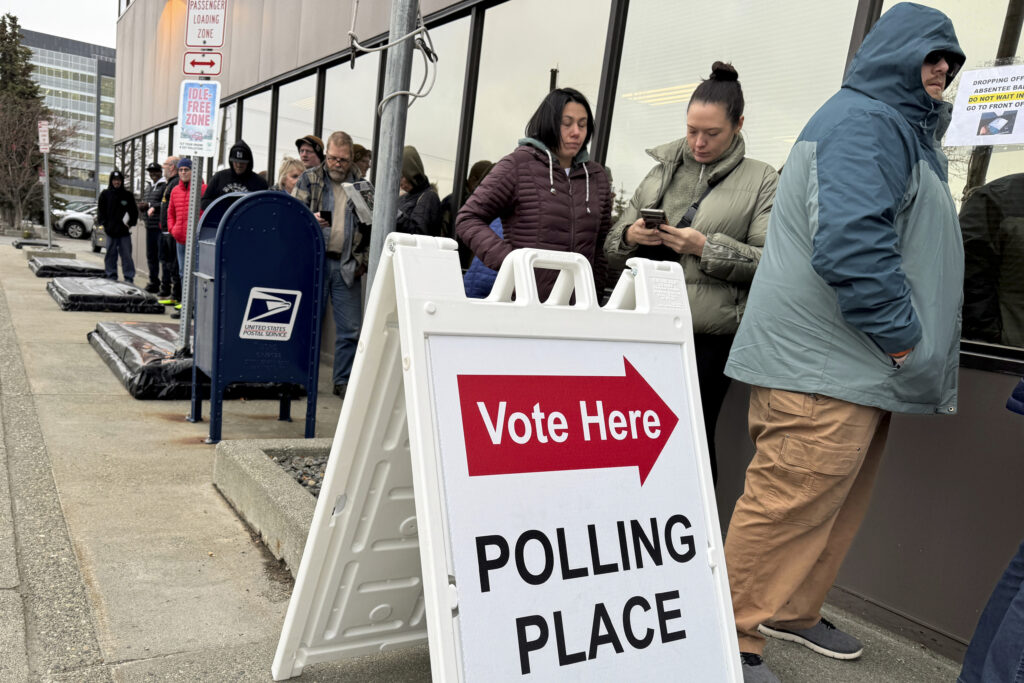
The Department of Justice (DOJ) filed an unprecedented lawsuit Thursday, effectively calling for Alaska’s Division of Elections to set aside the results of the Senate race if anyone other than incumbent Sen. Dan Sullivan (R) wins.
The lawsuit was filed the same day that Attorney General Todd Blanche downplayed concerns that the DOJ would sue states to block certification, suggesting that would only happen in a “doomsday scenario.”
Filed 12 days before Election Day, the suit claims that voters may be confused by the candidacy of Daniel J. Sullivan — another man running as a Republican — and that mistaken votes for him, rather than Sen. Sullivan, would undermine the election’s integrity.
The Division of Elections originally kicked the second Sullivan off of the ballot, saying his goal was simply to confuse voters. But the Alaska Supreme Court ordered the division to add him back over the summer. Despite registering as a Republican, Sullivan will show up on the ballot without a party affiliation.
Alaska’s ranked-choice voting system advances the top four vote-receivers in the primary to the general election.
Even though Alaska’s highest court has already approved Daniel J. Sullivan’s candidacy, the DOJ lawsuit claims that the potential confusion means Alaska’s Division of Elections would violate its duties under the National Voter Registration Act to “protect the integrity of the electoral process,” if it certifies the vote — but only if the Democratic candidate, former Rep. Mary Peltola, wins.
Get updates straight to your inbox — for free
Join 350,000 readers who rely on our daily and weekly newsletters for the latest in voting, elections and democracy.
“[I]t is vital that Defendants not certify any election result that may be impacted by voter confusion. An election result may be impacted by voter confusion if: (1) Senator Sullivan does not win the election; and (2) had all votes cast for Daniel J. Sullivan been cast instead for Senator Sullivan and Alaska’s rank-choice process played out accordingly, Senator Sullivan would have won the election,” the DOJ writes.
As of Friday morning, FiftyPlusOne’s polling average showed Peltola leading Sen. Sullivan by two points. The other Sullivan receives between two and five percentage points of support across the polls.
The lawsuit has been assigned to U.S. District Judge Sharon Gleason, who was appointed by President Barack Obama. It’s unclear whether it can survive motions to dismiss, given the speculative nature of the claims. It is unclear how election officials could distinguish between votes intentionally cast for Daniel J. Sullivan and those mistakenly cast for him.
As early voting begins across the nation, the DOJ has also targeted California with litigation preemptively challenging the vote count there. Beyond injecting uncertainty into the electoral process, such aggressive lawsuits could create a basis for attempts to set aside election results broadly in order to maintain the GOP’s control of Congress.
If the Division of Elections does not certify the results, Alaska will not send anyone to Washington D.C. to be sworn in as its next senator on Jan. 3, 2027, and the seat would remain unoccupied until a certification was issued.
Campaign tricks like running candidates with similar or identical names are nothing new. After popular Democratic Rep. Mike Doyle (Pa.) announced he would retire ahead of the 2022 election, Republicans nominated a man named Mike Doyle to run for the empty seat.
And in this year’s Alaska gubernatorial race, most Democrats dropped out of the primary to support independent Bill Hill — except for Eric Hafner, who now appears on the general ballot despite being a federal inmate in New York who may not have ever set foot in Alaska.