Election deniers bombarded Michigan with voting conspiracies during Democratic Senate primary
 Prefer us on Google
to see more of our voting rights news coverage when you search.
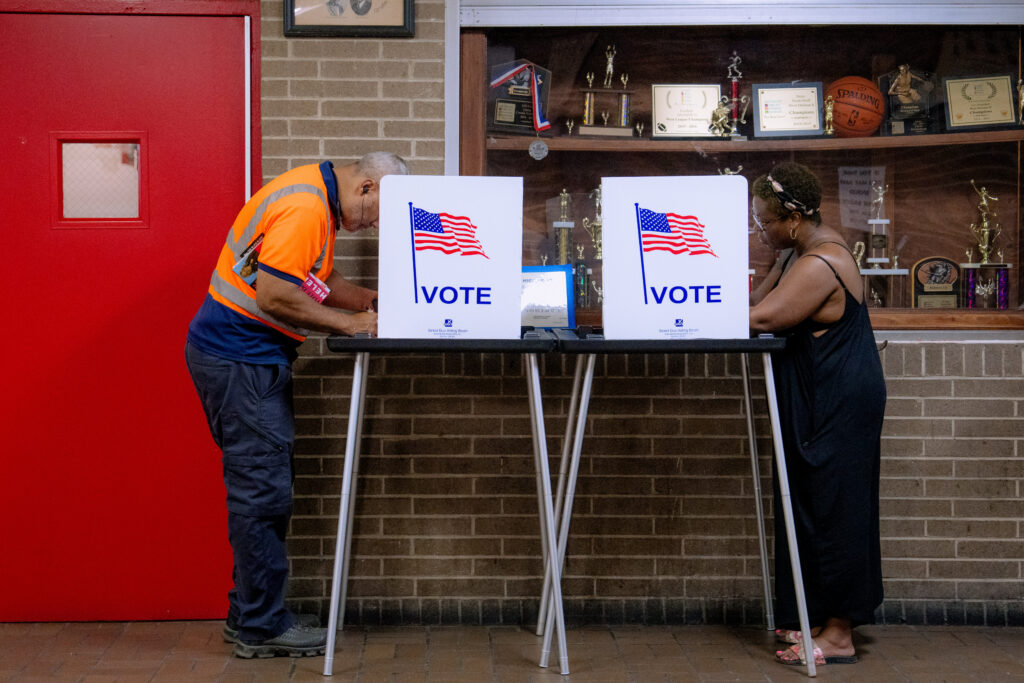
Weeks before Michigan voters headed to the polls in a closely watched primary, the Trump administration and prominent election deniers pounced on the key battleground state.
They quickly revived years-old, debunked conspiracy theories and began spreading false claims of fraudulent voter registrations, Democrats scheming to steal votes, and supposedly widespread Election Day irregularities in recent races.
And all these lies targeted cities and municipalities in the Great Lakes State that are majority-Black or Democratic strongholds.
It wasn’t a coincidence. Michigan’s U.S. Senate race — which pits progressive Abdul El-Sayed (D) against Trump-backed former U.S. congressman and election denier Mike Rogers (R) — is poised to be among the most important contests in November’s midterm election. And it’s one of many that will determine who controls Congress.
As primary season wraps up, cementing the key matchups in multiple battleground states, the wave of lies targeting Michigan is poised to grow larger. And it offers an example of how Trump, his administration, and prominent election deniers may target many other important races.
These are the most concerning conspiracy theories that are making the rounds.
Get updates straight to your inbox — for free
Join 350,000 readers who rely on our daily and weekly newsletters for the latest in voting, elections and democracy.
A scheme to steal votes in Detroit
True the Vote, the anti-voting group behind the widely debunked 2,000 Mules documentary, has a new film coming out that purports to blow the lid off a years-long Democratic scheme to steal votes in Detroit.
The documentary is reportedly based on false claims that Michigan Secretary of State Jocelyn Benson (D) and Detroit city clerk Janice Winfrey (D) schemed to fraudulently register former residents to vote and then cast ballots in their name during elections as far back as 2017. The conspiracy theory previously took center stage in a 2024 lawsuit filed by Ramon Jackson, a far-right Detroit-based activist. Predictably, the suit was dismissed for lack of standing and failure to produce sufficient evidence.
But the lies endured. Jackson and Lorenzo Sewell — an influential right-wing Detroit pastor — have continued to hound Michigan election officials over false allegations that they’re complicit in voter fraud schemes. Benson, in particular, has been a frequent target of Michigan election conspiracy theories fueled by election deniers and MAGA faithful.
True the Vote and its leader, Catherine Engelbrecht, are no strangers to controversy. In addition to its role in producing 2,000 Mules, the organization was at the center of a high-profile voter intimidation lawsuit after it launched the largest voter challenge effort in Georgia history targeting the eligibility of more than 364,000 voters.
Engelbrecht and Gregg Phillips — a former Trump-appointed FEMA official and co-leader of True the Vote who once claimed he teleported into a Waffle House — were sued for defamation for spreading lies about a small election software company.
Trump uses bully pulpit to target Michigan city
During Trump’s primetime address on elections last month, the president resurrected numerous unsubstantiated claims and made even more false statements about the 2020 race and vulnerabilities to U.S. elections.
But one long-debunked claim stood out: That a Tennessee-based voter registration company turned in a batch of registration forms in Muskegon, a Democratic stronghold, that authorities said were fraudulent.
In his speech, Trump alleged that canvassers “admitted to FBI agents that they signed voter registration forms in other people’s names, submitted fraudulent registrations for people who did not exist, and received gift cards tied to the number of applications they produced.”
The story isn’t a complete fabrication, but the facts have been heavily exaggerated and distorted to fit the president’s anti-voting agenda.
In reality, state authorities investigated the claim and turned the probe over to the FBI in 2021. Local law enforcement collected evidence that a low-level worker forged some voter registrations, likely to get more compensation. The FBI investigated the case but never filed any charges, since there was no evidence of any illegal ballots being sent out or illegal votes being cast.
Still, Trump directed FBI Director Kash Patel to reopen an investigation. Benson, Michigan’s election chief, called the claims “long-debunked and baseless.”
False claims of mail voter fraud
After progressive candidate El-Sayed defeated Rep. Haley Stevens (D) in a tight Democratic U.S. Senate primary race that caught national attention, Trump and other MAGA figures immediately boosted false claims of mail voter fraud.
“The Radical Left Socialist has a real shot, and don’t discount all of those fake mail-in ballots that will ‘surprisingly’ show up at the last moment,” Trump said, falsely labeling Stevens as a “socialist.” “Get ready for another Rigged Election.”
El-Sayed narrowly beat Stevens by less than 20,000 votes — much closer than most polls leading up to the election predicted. But for a few hours after voting concluded on Election Day, El-Sayed had a significant lead over Stevens, until mail ballots from key districts were counted and overwhelmingly favored the congresswoman.
That’s when the lies started rolling in.
“Dem establishment cheating its ass off in the mail to save themselves from the [Democratic Socialists of America] pick,” the anti-voting activist Seth Keshel wrote as votes were still being tallied. “It’s one thing to try and sell me on a +53% mail margin in a D vs R race. Don’t try me on D vs D.”
After enough votes were counted to declare El-Sayed the winner, Trump chimed in on social media to spread even more false claims.
“Wayne County (Detroit) in Michigan is one of the most corrupt voting areas in the United States, if not the World,” Trump said. “It is strictly Third World! Miracles happen in Wayne County, including more votes being cast than there are voters, by a lot.”
DOJ’s election monitor lies
Several weeks before Michigan’s primary election, the Department of Justice (DOJ) informed election chiefs in Detroit, Lansing, and East Lansing that it would send monitors for the primary election. It’s not unusual for the DOJ to send election monitors, but what stood out in this instance was the justification: Unsubstantiated reports of voting issues in the 2024 election.
In nearly identical letters sent to each municipality, the DOJ accused local election chiefs of failing to comply with federal voting laws and said that some precincts were marred by long lines due to a lack of provisional ballots. The DOJ also requested voter registration records, election worker training materials, and other voting documents from each municipality.
Clerks from each municipality pushed back against the DOJ’s claims.
“The City will gladly provide documents and information in response to all lawful requests,” Lansing Mayor Andy Schor (D) and City Clerk Chris Swope (D) said in a statement in response to the DOJ’s July letter. “However, as Lansing voters and the observers of Lansing elections know, claims in the letter to Lansing about difficult or abnormal voting practices are simply false. There were no delays at polling locations, the qualified voter file is the list we use for all elections, and provisional ballots are always available as provided by law.”
Winfrey, Detroit’s city clerk, similarly questioned the DOJ’s claims of voting errors in the last election.
“What makes me suspicious is that you say things that you can’t back up,” Winfrey said during a press conference last week. “We don’t have any proof that you were at any of our polling locations. When you say we ran out of provisional ballots, that lets me know you really don’t know because our provisionals are the regular ballots. It’s never happened.”