After brutal Illinois defeat, Trump DOJ’s voter roll crusade is 0 for 19
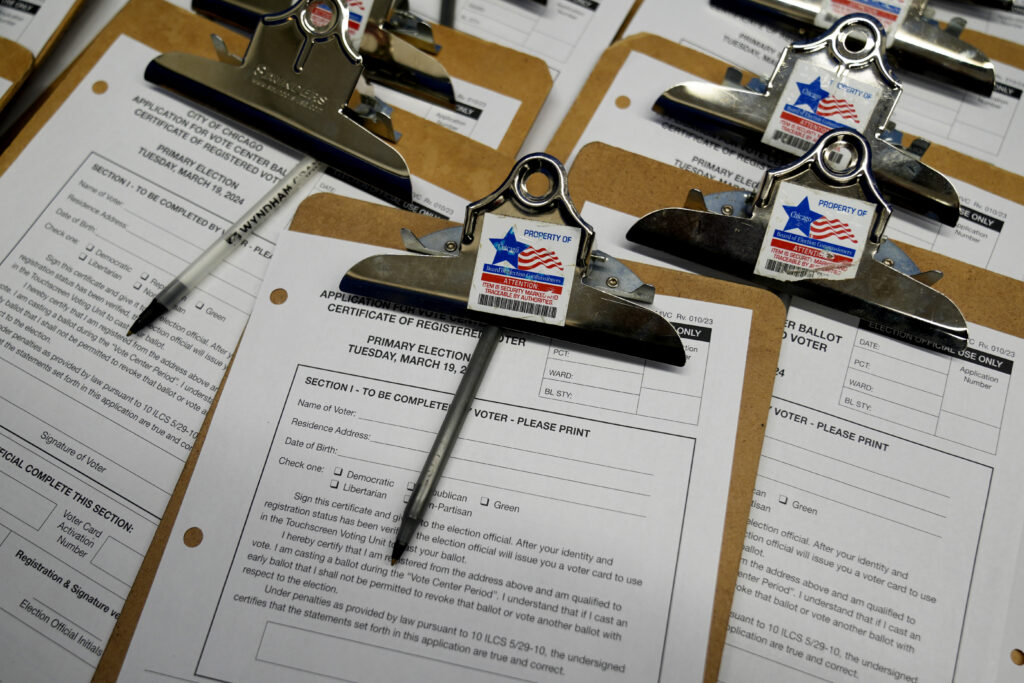
President Donald Trump’s Department of Justice suffered its 19th straight voter roll loss Friday, as a federal judge dismissed its Illinois lawsuit with prejudice and ruled the department lacks authority to seize the state’s unredacted voter database.
U.S. District Judge Colleen Lawless denied DOJ’s motion to compel Illinois to surrender its complete statewide voter registration list and granted motions to dismiss filed by state officials and intervenors.*
Because Lawless found that amending the complaint would be futile, the department cannot revive the same claim in district court, though it can appeal as it has of its other losses.
The ruling extends DOJ’s district court record in its nationwide voter-data crusade to brutal 0-19, just two days after a federal judge dismissed its New Jersey case.
Get updates straight to your inbox — for free
Join 350,000 readers who rely on our daily and weekly newsletters for the latest in voting, elections and democracy.
Illinois had already provided DOJ with a redacted version of its voter list. But the department demanded sensitive identifying information, including driver’s license and Social Security numbers.
Lawless held that Title III of the Civil Rights Act of 1960 does not authorize the attorney general to obtain a live voter database created and maintained by the state.
“The Board possesses the list by its own creation,” Lawless wrote. “The Board did not come into its possession.”
The judge also found that DOJ’s interpretation would put federal laws in direct conflict. The Civil Rights Act prohibits altering records that must be preserved, while the National Voter Registration Act and Help America Vote Act require states to update their voter lists regularly.
The opinion separately rejected DOJ’s claim that courts must treat its demands as abbreviated proceedings subject to only limited review. Lawless held that the ordinary federal rules apply and courts may assess whether the department has stated a legally sufficient claim.
DOJ also lost on the adequacy of its demand letter.
Title III requires the attorney general to state both the factual basis and purpose for requesting election records. Lawless found that DOJ offered no factual basis explaining why it needed Illinois voters’ sensitive information.
She also ruled that DOJ’s stated goal — determining whether Illinois complied with voter list maintenance requirements — was not a legitimate purpose under Title III.
“Congress did not confer a general auditing power to the DOJ over state election officials,” Lawless wrote.
The Illinois ruling follows the same core reasoning adopted by the Sixth Circuit Court of Appeals in DOJ’s Michigan loss and by federal judges appointed by presidents of both parties across the country.
DOJ has appealed nearly all of its voter roll defeats. Yet no court to date has ordered a state to provide the department with an unredacted statewide voter database.
*The Elias Law Group (ELG) represents the defendant-intervenors in this case. ELG firm chair Marc Elias is the founder of Democracy Docket.