Most of Trump DOJ’s voter roll losses have come from GOP-appointed judges
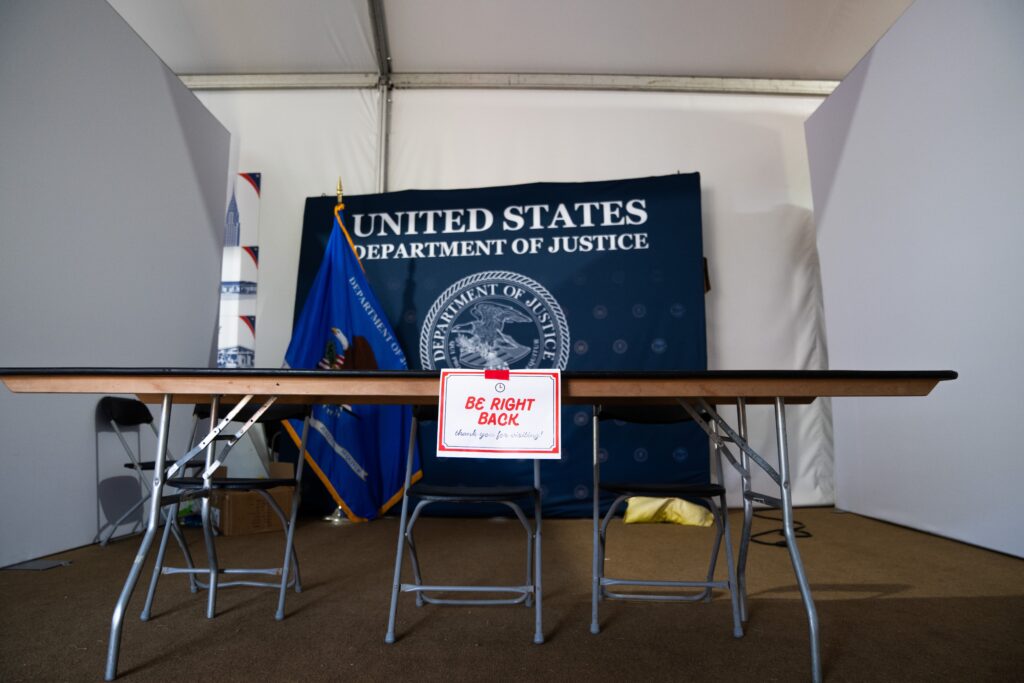
In an era of extraordinary partisan polarization, federal judges appointed by presidents of both parties have found common ground on at least one issue: President Donald Trump’s Department of Justice does not have a right to seize state voter rolls.
Trump’s DOJ has now lost all 15 of its district court cases to reach a ruling seeking statewide voter registration data, including a recent rapid succession of defeats in New York, West Virginia, Virginia and New Mexico.
No judge has ordered a state to hand over an unredacted statewide voter file. And those rulings have not come primarily from judges appointed by Democrats.
In fact, nine of the 15 losses — 60% — were handed down by Republican-appointed judges. Six were issued by Trump appointees and three by judges appointed by former President George W. Bush.
The other six rulings came from judges appointed by Democratic presidents: four Obama appointees, one Clinton appointee and one Biden appointee.
Get updates straight to your inbox — for free
Join 350,000 readers who rely on our daily and weekly newsletters for the latest in voting, elections and democracy.
The numbers make it difficult for DOJ to portray its perfect losing record as the product of liberal “activist” judges or hostile jurisdictions. Judges with vastly different backgrounds and appointing presidents have repeatedly identified the same fundamental defects in the department’s nationwide campaign.
Trump appointees rejected DOJ’s claims in Michigan, Arizona, Maine, Rhode Island, Maryland and Virginia. Bush appointees ruled against the department in New Hampshire, West Virginia and New Mexico.
In Michigan, U.S. District Judge Hala Jarbou, a Trump appointee, rejected all three statutes DOJ invoked to obtain the state’s voter file. She concluded that the Help America Vote Act contains no disclosure requirement, the National Voter Registration Act does not require production of voter lists themselves and Title III of the Civil Rights Act does not cover state-created voter databases.
“There is simply no basis in the Federal Rules of Civil Procedure for the United States’s suggestion that it can file a HAVA claim, allege no violations of HAVA, and obtain information to support its (as-yet-nonexistent) claim via discovery,” Jarbou wrote.
In Arizona, Trump-appointed U.S. District Judge Susan Brnovich dismissed DOJ’s lawsuit with prejudice, concluding that “Arizona’s SVRL is not a document subject to request by the Attorney General.”
Meanwhile, Trump-appointed U.S. District Judge Stephanie Gallagher reached the same conclusion in Maryland.
“This Court joins every court to have addressed this issue in concluding that an [statewide voter registration list] is not a record or paper that a state must produce to the United States under the CRA,” Gallagher wrote.
She also rejected a last-minute Justice Department legal opinion supporting its own position, writing “This Court will not interpret the CRA contrary to its text simply because an office of the party advancing that interpretation has adopted it.”
The bipartisan judicial wall has only hardened as more decisions arrive.
In Virginia this week, Trump-appointed U.S. District Judge Roderick Young said his dismissal and denial of DOJ’s motion to compel would be “fatal to the United States’s suit.”
Young held that Virginia’s voter list falls outside Title III because election officials created and maintain it rather than receiving it from an outside source. He dismissed the case with prejudice, meaning DOJ can’t simply refile the same claims.
Bush-appointed U.S. District Judge Thomas Johnston tossed the West Virginia case after finding that DOJ’s demand identified no factual reason to suspect the state was violating federal law. Johnston ended his analysis with an unusually pointed observation.
“Given the lack of an adequate basis or purpose, one is left to wonder what the real purpose was for the Justice Department to go to the trouble of filing civil actions like this one all around the nation,” he wrote.
The next day, Bush-appointed U.S. District Judge Judith Herrera threw out DOJ’s New Mexico case, also with prejudice. Herrera found the department’s demand “facially inadequate” because it failed to identify facts suggesting New Mexico had violated federal voter list laws.
“The DOJ offered no ‘basis’ whatsoever in its Demand Letter,” Herrera wrote. “Because Defendants’ first argument resolves the Motions to Dismiss, the Court does not reach the remaining contentions.”
Judges have generally converged on two reasons for rejecting DOJ’s crusade.
Some have held that Title III — enacted during the civil rights era to preserve voter-submitted records and investigate racial discrimination — does not authorize a federal takeover of modern, state-created voter databases. Others have found that DOJ’s demand letters failed to provide the factual “basis” and valid “purpose” expressly required by the law.
Many courts have embraced both conclusions. They have also rejected DOJ’s argument that its cases should be treated as special proceedings in which judges conduct only limited scrutiny of the department’s demands.
The cross-party agreement is not absolute, however. Six Trump-appointed judges have rejected DOJ’s claims, but one other Trump-appointee sided with DOJ in a dissenting opinion.
When the Sixth Circuit Court of Appeals upheld Michigan’s victory in a 2-1 decision, Trump-appointed Judge John Nalbandian dissented. Nalbandian argued that Title III covers at least some government-generated records, including Michigan’s voter file, and disagreed with the majority’s conclusion that DOJ failed to provide the required basis and purpose for its demand.
Still, Nalbandian remains the exception.
Six of the seven Trump appointees to rule on DOJ’s claims have rejected them, as have all three Bush-appointed district judges and all six Democratic-appointed district judges.
DOJ has appealed some of its losses and has asked the full Sixth Circuit to reconsider the Michigan ruling. But for now, the record is stark: 15 district court losses, one appellate loss and zero court orders compelling a state to surrender its unredacted voter rolls.
Democracy Docket Researcher Maya Bodinson contributed to this reporting.