GOP ballot measures target state voting protections under guise of noncitizen voting bans
 Prefer us on Google
to see more of our voting rights news coverage when you search.
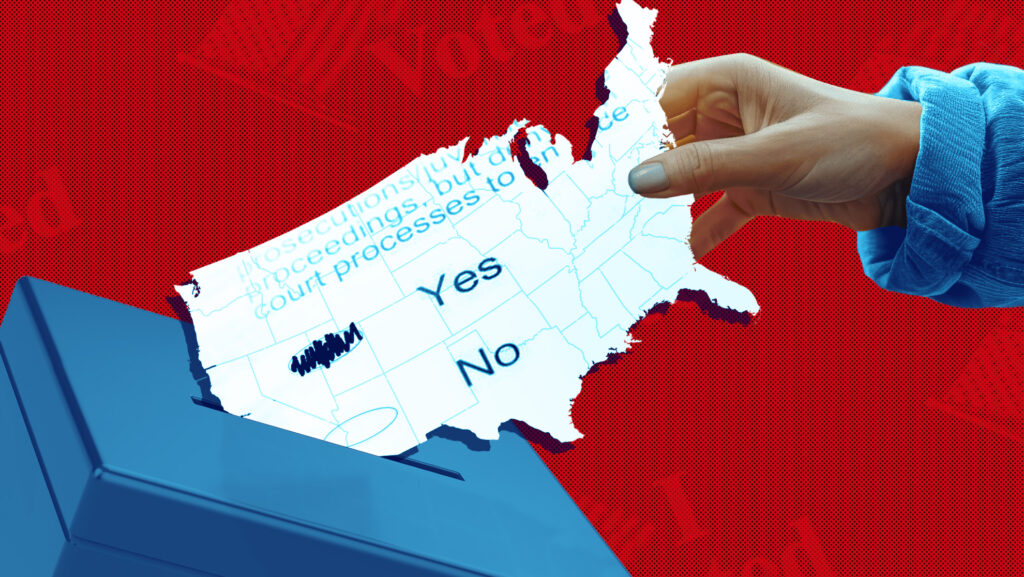
Five states have measures on the ballot this year that would amend their constitutions to ban noncitizens from voting. Because noncitizen voting is already illegal under both federal and state law, the measures have largely been seen as having little effect — other than perhaps boosting GOP turnout for the midterms.
But a new analysis by Democracy Docket suggests these measures — all of which were put on the ballot by Republican lawmakers — are more dangerous than they may appear: That’s because, under the guise of banning noncitizens from the polls, they also appear aimed in part at weakening voting rights protections in state constitutions via seemingly small changes in wording.
The result would be to undermine the franchise for everyone.
“I think courts are less likely to provide robust protection to voters under their state constitution, as a result,” Josh Douglas, a law professor at the University of Kentucky, told Democracy Docket.
Get updates straight to your inbox — for free
Join 350,000 readers who rely on our daily and weekly newsletters for the latest in voting, elections and democracy.
The proposed constitutional amendments, which are on the ballot in Arizona, Arkansas, Kansas, South Dakota and West Virginia, take advantage of a reality that would surprise many Americans: The U.S. Constitution doesn’t explicitly guarantee a right to vote. Instead, that affirmative guarantee exists in every state constitution except Arizona’s.
As the U.S. Supreme Court has become more hostile to voting rights and voter access, some advocates have started to look to state constitutions, with their stronger and clearer articulations of voting rights, as their best hope for defending the franchise.
Now, Republicans appear to be attempting to weaken those protections too — and they’re using the largely uncontroversial issue of banning noncitizen voting to disguise the goal.
How to attack the right to vote
Interest in noncitizen voting bans has exploded over the last decade. According to Ballotpedia, 15 states have amended their constitutions to include a noncitizen voting ban since 2018.
Most of these amendments followed a similar pattern: Initially, the state constitution explicitly guarantees that “every” or “all” citizens of the state who meet basic requirements like age, residency, and U.S. citizenship are entitled to vote in elections in the state. The amendments often rewrite that section to say that “only” those meeting those requirements may vote, weakening language that was previously a clear guarantee.
This follows the model promoted by the American Legislative Exchange Council (ALEC), a right-wing organization that advocates for conservative policies, including anti-voting laws.
But it doesn’t just affect noncitizen voting. The proposed change from “every” or “all” to “only” can be read not just to exclude those who don’t meet the requirements, but also to remove the affirmative right to vote for everyone else.
“[T]hese changes — from ‘every’ to ‘only’ — no longer make it an explicit conferral of the right to vote,” said Douglas.
Four of the states voting on noncitizen bans this year — Arkansas, Kansas, South Dakota and West Virginia — follow the trend of amending their constitutions’ explicit right-to-vote guarantee. That would change what was once a baseline guarantee of voting rights into a ceiling.
Arizona doesn’t have an explicit guarantee. (Alaskans also will vote on a noncitizen voting ban, but it would only change state law, not its constitution.)
For the four states, that shift is significant. With U.S. citizenship and being 18 years old as a baseline, states and municipalities can still expand the franchise to others in certain circumstances, Douglas explained.
For example, a few cities like San Francisco and Washington, D.C., have passed laws allowing lawful permanent residents to vote in local elections. And some have begun allowing 16- and 17-year-olds to vote in local elections as well. More commonly, 21 states and Washington, D.C., allow 17-year-olds to register and vote in primary elections if they will be 18 by the time of the general election.
Constitutional noncitizen voting bans often prevent these kinds of local experiments and statewide expansions of voting rights. And that’s often the goal of the bans’ sponsors.
“[Existing language] protects your right and my right as a citizen, but it’s insufficient because it leaves room for other people to be added to that list,” Arkansas state Rep. David Ray (R) told the Arkansas Senate, explaining why he sponsored his state’s amendment.
No cities in any of the states with these bans on the ballot have allowed noncitizen voting, and none are likely to do so any time soon.
“That’s never been proposed by anyone in Kansas and never would [be],” University of Kansas law professor Amii Castle told Democracy Docket. “We’re not San Francisco.”
Beyond that, states often do not need to amend their constitutions if they simply want to ban noncitizens from voting in their elections.
The amount of control state legislatures have over local governments varies by state, but in many cases a simple statute is enough. The ballot measure in Alaska, for example, is only a statute, not a constitutional amendment.
In states where a constitutional amendment may be required, there’s still no need to rewrite their constitution’s right to vote. A new clause or section could be added to the constitution stating that noncitizens may not vote in any elections in the state, without touching the language that creates a general right to vote.
Kansas’ constitution prohibits anyone convicted of a felony from voting until their civil rights have been restored. That ban is in a different section of the state constitution than the right to vote. A constitutional ban on noncitizen voting could have easily taken the same approach, without rewording the constitution’s right-to-vote guarantee.
What’s the end goal?
But, of course, the true goal doesn’t appear to be preventing noncitizen voting. And some advocates warn that the measures are a pretext to adopt new voting restrictions that stronger constitutional guarantees would prevent.
In an op-ed for the Kansas Reflector, Castle warned that the Kansas proposal aims to clear the way for a law requiring documented proof of citizenship (DPOC) to register to vote or update voter registration.
DPOC laws typically require a passport, birth certificate or naturalization certificate to register to vote. Most Kansans don’t have passports, and not everyone has easy access to their birth certificates, she noted.
These laws “disproportionately impact low-income, young and elderly voters,” as well as women, who are more likely to have changed their name due to marriage or divorce, Castle explained.
In fact, Kansas state Rep. Pat Proctor (R), who sponsored the measure and is now running to be the state’s top election official, has accused women of “stealing” an election “fair and square,” after a referendum to ban abortion in 2022 lost overwhelmingly.
Kansas passed a DPOC law in 2011, but a federal court blocked the law in 2016 and later found it violated the National Voter Registration Act (NVRA). Expert analysis determined that from 2013, when the law went into effect, to 2015, it prevented 35,000 people from registering to vote — over 14% of new registrants during that period.
Long-term impact
Kansas’ proposal, like the others on the ballot, would only change state law. It wouldn’t impact federal laws like NVRA or federal court decisions like the one that blocked the Kansas DPOC law.
But federal courts are much less reliable guardians of voting rights than they used to be.
The Supreme Court has taken a decidedly anti-voter turn, frequently upholding burdensome voter restrictions and rejecting attempts to protect voting rights. In December, it will hear a case with major implications for how federal courts apply the NVRA.
In addition, the NVRA, like many other federal voting laws, only applies to federal elections. As a result, some states have started requiring voters who can’t provide additional documentation beyond what the NVRA requires to be “federal only” voters — allowing them to vote in congressional and presidential races, but not in state elections or for ballot measures.
In that situation, the NVRA wouldn’t apply. The only serious obstacle would be the guarantees contained in the state constitution. South Dakota, one of the states with a noncitizen voting ban on the ballot this year, recently adopted this bifurcated voter registration system.
Perhaps the biggest danger of these proposals is that they warp and dilute the language granting the right to vote so much that it stops looking like a right at all.
Arizona — the only state whose constitution doesn’t include an explicit right to vote — provides a glimpse of the direction where diminished voting rights protections could lead.
The constitutional amendment there, Proposition 144, states: “The people and the legislature may enact laws governing elections, including early voting and mail voting, provided such laws are rationally connected to a legitimate state interest including timely and accurate election results, efficient election administration, election security, and preserving public confidence in the integrity of elections.”
This may sound reasonable, but to voting rights lawyers this language is terrifying.
The phrase “rationally connected to a legitimate state interest” refers to “rational basis” review, the lowest standard of review courts use when evaluating burdens on constitutional rights, and the easiest for restrictive laws to overcome. Laws and policies that could seriously burden fundamental rights like voting are generally subject to “strict scrutiny,” the highest standard.
If the amendment is adopted, it would limit Arizona state courts to applying only rational basis review when reviewing voting restrictions in the future.
That would make it significantly harder to overturn anti-voting laws, no matter how great an obstacle they present to voters.