Supreme Court must preserve protections against last-minute purges, advocates warn
 Prefer us on Google
to see more of our voting rights news coverage when you search.
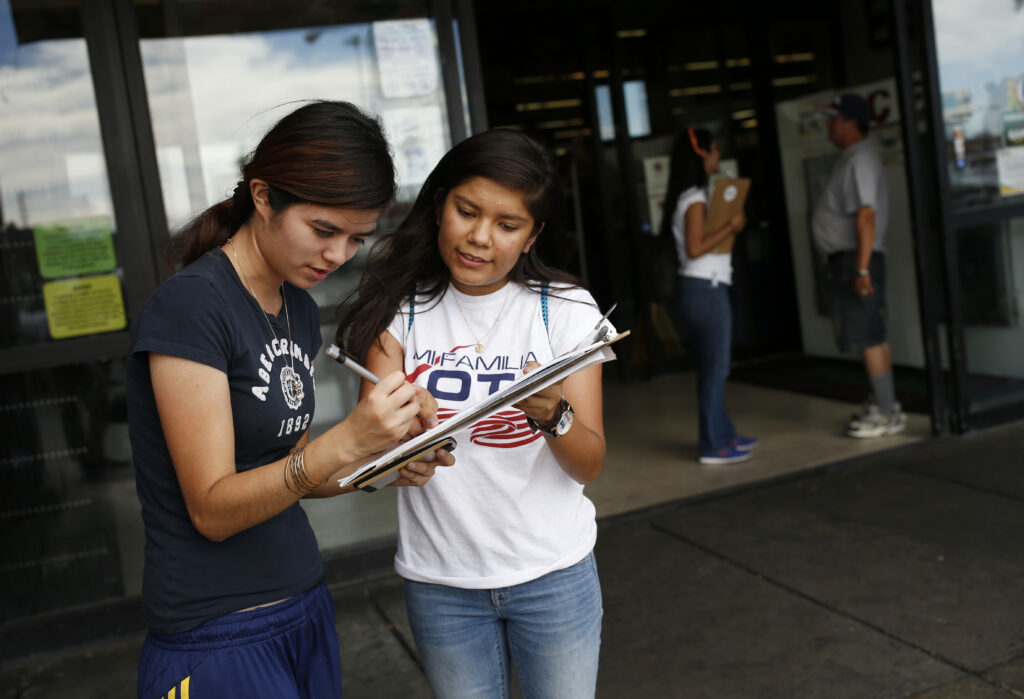
Voting rights groups urged the U.S. Supreme Court Tuesday to uphold federal protections against purges within 90 days of an election, warning that last-minute removals can disenfranchise eligible voters.
The filings by Mi Familia Vota and Voto Latino* came in Republican National Committee v. Mi Familia Vota, which could give the Supreme Court a chance, at the urging of the national GOP, to badly weaken a decades-old federal protection against late purges.
Get updates straight to your inbox — for free
Join 350,000 readers who rely on our daily and weekly newsletters for the latest in voting, elections and democracy.
The case presents two major questions: whether Arizona can require people using the state’s voter registration form to provide documentary proof of citizenship to register for federal elections; and whether the state can continue a database-driven program to systematically remove suspected noncitizens from the voter rolls during the 90-day “quiet period” ahead of a federal election mandated by the National Voter Registration Act (NVRA).
During the quiet period, the NVRA bars states from conducting systematic purges of the rolls.
The Democratic National Committee (DNC) and Arizona Democratic Party filed a separate brief focused entirely on the voter removal issue.
The RNC and the Department of Justice (DOJ) contend that citizenship-based removals fall outside the NVRA’s protection because people who are not U.S. citizens were never eligible voters in the first place. The voting rights groups responded Tuesday that the argument misconstrues both the text and purpose of the law.
Mi Familia Vota and Voto Latino emphasized that the dispute is not about whether noncitizens are allowed to vote. Instead, they argued, Congress restricted systematic purges too close to elections because broad database-driven programs can erroneously strike eligible citizens off the rolls.
“The point of the 90-day provision is not to protect ineligible voters from removal,” the pro-voting groups wrote. “But to protect eligible voters from being mistakenly swept up in a removal program.”
That distinction goes to the heart of a case that could affect voter-roll maintenance far beyond Arizona.
The NVRA says states must complete “any program” whose purpose is to “systematically remove the names of ineligible voters” no later than 90 days before a federal election. But the law also contains specific exceptions, including individualized removals prompted by a voter’s request, death, criminal conviction or mental incapacity.
It does not expressly exempt citizenship-based removal programs.
Arizona’s House Bill 2243 requires election officials to regularly compare voter rolls with government databases for information about citizenship. Officials must conduct certain checks each month and can begin a cancellation process for voters flagged by those searches.
The Ninth Circuit Court of Appeals held that Arizona cannot continue that systematic program during the NVRA’s quiet period. The RNC and Trump administration want the Supreme Court to reverse that ruling.
Mi Familia Vota and Voto Latino also contend that Arizona remains free to remove people who are actually ineligible. Systematic programs can operate outside the 90-day window and election officials can conduct individualized removals even during it, they allowed.
“Arizona has many other avenues to remove noncitizens on its rolls,” the groups wrote. “It can do so systematically at any time outside the 90-day period before an election, and it can do so on an individualized basis even on the eve of an election.”
What Arizona cannot do, they argued, is run a sweeping database-driven removal program immediately before a federal election and avoid the NVRA’s timing restriction simply because the program is supposedly aimed at suspected noncitizens.
The groups further pointed to the risk for naturalized citizens whose government records may be outdated or incomplete. A database can accurately reflect that a person was once a noncitizen without showing that the person subsequently became a U.S. citizen.
“Recent history is littered with examples of naturalized citizens being wrongly labeled as noncitizens by systematic reviews,” the groups wrote. “Naturalized citizens in particular are at heightened risk of errant last-minute removal due to the systematic use of databases containing stale citizenship information.”
The DNC and Arizona Democratic Party made that last-minute danger the centerpiece of their own response.
Their brief notes that the RNC and federal government do not dispute that Arizona’s program is systematic, relies on database matching and can operate within 90 days of a federal election. Instead, the dispute turns largely on whether people targeted as alleged noncitizens count as “ineligible voters” under the quiet-period provision.
Republicans and DOJ say that phrase only covers people who were properly eligible to vote and later lost their eligibility. The DNC rejects that narrower interpretation, arguing that Congress used the broader term “ineligible voters” and then explicitly identified the categories exempt from the 90-day rule.
“There is no similar exception for citizenship-based removals, confirming that the RNC’s and the United States’ atextual demand for such an exception should be rejected,” the Democrats wrote.
The Democratic groups also sought to draw a bright line between voter eligibility and voter-roll maintenance.
“The 90-day provision is a limit on the timing and method of list maintenance, not on who may vote,” they wrote. “The NVRA leaves States free to set voter qualifications and to enforce them.”
Mi Familia Vota and Voto Latino’s brief further addressed concerns over Arizona’s separate documentary proof of citizenship requirement, which the Supreme Court will also decide on.
Under House Bill 2492, people who use Arizona’s state voter registration form can be rejected if they fail to submit documents proving U.S. citizenship, even though people who use the federal registration form cannot be required to provide the same documents to register for federal elections.
Mi Familia Vota and Voto Latino argue that the NVRA prohibits that unequal treatment for federal registration. Federal law allows state-created registration forms to request only information that is “necessary” to assess eligibility, they say, and Arizona has failed to demonstrate that documentary proof is necessary when federal-form applicants can register for federal elections without it.
The filing defends a 2018 federal consent decree requiring Arizona officials to treat applicants using the state and federal forms similarly when they do not submit citizenship documents.
That issue exposed an unusual fracture among the parties supporting the RNC in August. Arizona Attorney General Kris Mayes (D) agreed that federal law permits the state to require documentary proof on its state form but maintained that the existing federal court order remains binding unless it is formally modified or vacated.
Mi Familia Vota and Voto Latino sided firmly with the procedural position that an existing federal judgment cannot simply be ignored.
“A consent decree is a binding judgment from a federal court,” the groups wrote. “Pretending that it does not exist does not diminish its effect on the parties bound by it.”
The Supreme Court will hear oral argument in December, when the Court will confront both the reach of Arizona’s proof-of-citizenship requirement and how much protection federal law gives eligible voters against systematic removals in the final weeks before an election.
The RNC will have an opportunity to file a reply before oral argument.
*The Elias Law Group (ELG) represents the Mi Familia Vota and Voto Latino parties in this case. ELG firm chair Marc Elias is the founder of Democracy Docket.