What to do when law enforcement demands ballots? Election officials are in the dark
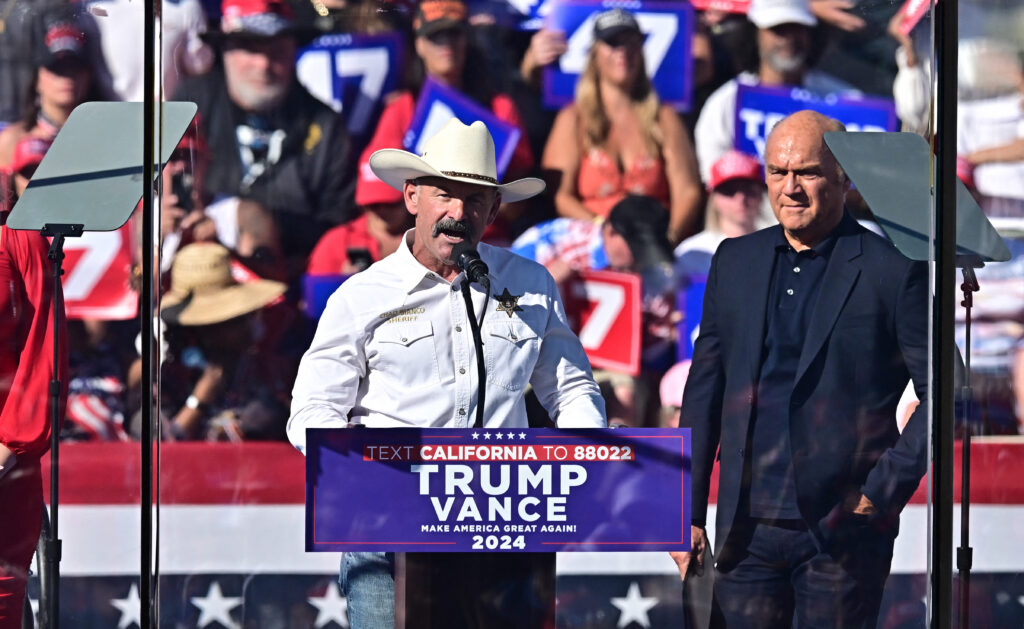
When a California sheriff seized 650,000 ballots from last year’s redistricting referendum, it raised an alarming question about what was previously almost a nightmare scenario: What must election officials do if law enforcement orders them to hand over ballots?
On paper, California law provides a straightforward answer — it explicitly prohibits election materials from leaving the custody of election officials, even during a criminal investigation.
But that didn’t stop Riverside County Sheriff Chad Bianco, a Republican who is running for California governor, from seizing the county’s ballots this February — or prevent the registrar of voters from handing them over.
When the sheriff’s department’s search warrant was unsealed, it revealed that the investigation followed the same types of conspiratorial anti-voting allegations used to justify the FBI’s unprecedented seizure of ballots cast in Georgia during the 2020 presidential election just a week earlier.
The Riverside County ballot seizure highlights the challenges faced by election officials, who can find themselves unsure what to do: protect the vote or obey a warrant?
Danielle Lang, an expert in voting rights at Campaign Legal Center, says it’s not their fault that they’re getting caught flatfooted.
“I have been working in elections for over a decade, and 2026 is the first year I’ve had to give thought to warrants for election materials and how election officials should respond,” she said.
Nonetheless, election officials need to be prepared for the Riverside County scenario to repeat elsewhere, Lang said.
That ballot seizure was “really dangerous,” Lang told Democracy Docket. But were it to happen during an election, that threat would be “existential.”
“This is a wake-up call, I think, for election officials and judges to make sure that they’re very well educated about the protections we have in law,” she said.
‘Learning as we go’
The challenge in responding to these threats is that they are — on the surface — legal.
Bianco seized the Riverside County ballots after obtaining search warrants signed by Superior Court Judge Jay Kiel. Bianco and Kiel appear to be political allies who have endorsed each other’s election bids.
The California Attorney General’s office filed a lawsuit accusing the sheriff of ignoring state oversight and launching an unlawful, amateur recount on flimsy legal grounds — search warrants that identified no crime or suspect and were based on claims of a vote discrepancy made by local anti-voting activists.
Riverside County voters, represented by the UCLA Voting Rights Project, also sued Bianco, arguing that the sheriff and Riverside County Registrar of Voters Art Tinoco violated Section 15551 of the California Elections Code, the provision requiring that ballots remain in the custody of election officials.
Get updates straight to your inbox — for free
Join 350,000 readers who rely on our daily and weekly newsletters for the latest in voting, elections and democracy.
Sonni Waknin, senior voting rights attorney at the UCLA Voting Rights Project, told Democracy Docket that California law provides clear processes for investigating possible vote discrepancies, but the sheriff seized ballots rather than following the proper procedures.
“There’s nowhere in the elections code that would give a sheriff this ability,” Waknin said.
For that reason, the UCLA lawsuit argues Tinoco failed at his duty to keep ballots in his office’s custody. In a declaration outlining his version of events, Tinoco made no mention of notifying the county counsel, county board of supervisors or state attorney general’s office about Bianco’s warrants, either before or after he decided to hand over the ballots.
Others are more sympathetic to Tinoco.
Jesse Salinas, president of the California Association of Clerks and Election Officials and the voter registrar of Yolo County, told Democracy Docket that Tinoco found himself in uncharted territory, faced with an unprecedented warrant served by his own sheriff’s office.
As news of the Riverside County ballot seizure spread, other election officials began asking for guidance on what to do in a situation they hadn’t needed to plan for in the past, Salinas said.
When Salinas turned to his own county counsel for advice, he was told, “The response would be, ‘Contact us again right away. And then we would reach out to the courts, and really those documents should still remain with you, and there’s no reason they should be taken out.’”
“But we didn’t know this stuff when it was coming down,” Salinas added. “There are things we’re learning as we go. The basic thresholds that have existed in the past seem to be stretched beyond what anybody had ever imagined.”
Salinas said what concerns him most about the Riverside County case is that a judge signed off on a warrant based on election misinformation that Tinoco had already debunked in a public presentation.
Regardless, Salinas said, there’s not one clear answer for officials uncertain about how to respond to such a warrant — at least not yet. Every voter registrar should contact their county counsel immediately if presented with a warrant, but their responses could vary, he added.
“Some may want to be more cautious and say, ‘Give it to them, and then we’ll ask the courts to intervene.’ Others may say, ‘No, don’t give it to them, because this law is pretty straightforward’ in their interpretation of it,” Salinas said. “Just like anything, attorneys can have different interpretations of the law.”
“I wish I could say there was a clear answer, but there’s not,” he added. “And that makes it pretty difficult.”
Justin Levitt, an election law professor at Loyola Marymount University and a former deputy assistant attorney general in the U.S. Department of Justice’s Civil Rights Division, agreed with Salinas’ guidance.
“As misguided as that order may be, I think it’s the election official’s responsibility to obey an order from a judge,” Levitt said.
He blames the judge and sheriff for not following California’s ballot custody requirement. “This statute is a reason for the judge not to have approved the warrants,” Levitt said. “It’s not a reason for the registrar to fight what a judge tells him to do.”
Bob Page, Orange County’s registrar of voters, said he wasn’t previously aware of the requirement to retain custody of ballots. But if he were presented with a warrant to seize materials, his first move would be to call his county counsel for guidance. He added that the Riverside County case could help election officials prepare for a similar scenario.
“If there’s good to come from this, it will be a learning situation,” Page said.
What’s next
The risk of other attacks on elections — particularly as they are taking place — is not theoretical.
President Donald Trump has said he should have ordered the National Guard to seize ballot boxes in the 2020 election, which he lost to Joe Biden. The FBI has also subpoenaed an Arizona lawmaker to provide 2020 election materials related to Maricopa County, another place that has played a prominent role in Trump’s claims of fraud during that presidential race.
In February, Maricopa County Elections Director Scott Jarrett sent an email to staff directing them to give full access to federal agents looking to search the county’s elections center, should the situation arise. Jarrett wrote that his goal was to ensure that staff felt “informed and safe.”
And Bianco has warned he may seize ballots in the upcoming California GOP gubernatorial primary election — where he will be a candidate — if he believes there is a discrepancy in the count. He also says he has been contacted by officials and activists in other areas seeking to replicate the Riverside County ballot seizure.
With the 2026 election cycle already unfolding, local election officials urgently need clarity on what to do in this worst-case scenario, Campaign Legal Center’s Lang says.
“They’re definitely going to be clamoring for some really clear guidance at the state level,” she said. “And so where attorneys general and secretaries of state can provide guidance and education, they should absolutely do so.”
Democracy Docket reached out to the California Attorney General’s office and the California Secretary of State’s office to ask whether they plan to provide guidance on the issue. Neither provided a direct answer.
But with two Riverside County cases before the California Supreme Court, officials are looking to the state’s highest court for a clear message.
Levitt, the election law professor, said the timing of the Riverside County case is a silver lining in an otherwise terrible situation: It happened early enough to give the court an opportunity to weigh in before the general election.
“I strongly suspect that the California Supreme Court is going to say firmly and clearly: nobody gets to do this,” Levitt said. “And it’s going to say that well in advance in November.”
As for possible federal interference with ballots, the U.S. Constitution gives state and local election officials the responsibility of securing voting machines and ballots. And it does not authorize federal officials or agencies — including the president — to take possession of those election materials, according to the Brennan Center for Justice.
Levitt says he can think of no reason for the FBI to execute a warrant on ballots in an active election.
But that may not be as reassuring as it sounds: He doesn’t think the FBI’s search warrant in Georgia should have been signed either.