‘Akin to a natural disaster’: Election officials sound alarm over impending SCOTUS mail voting ruling
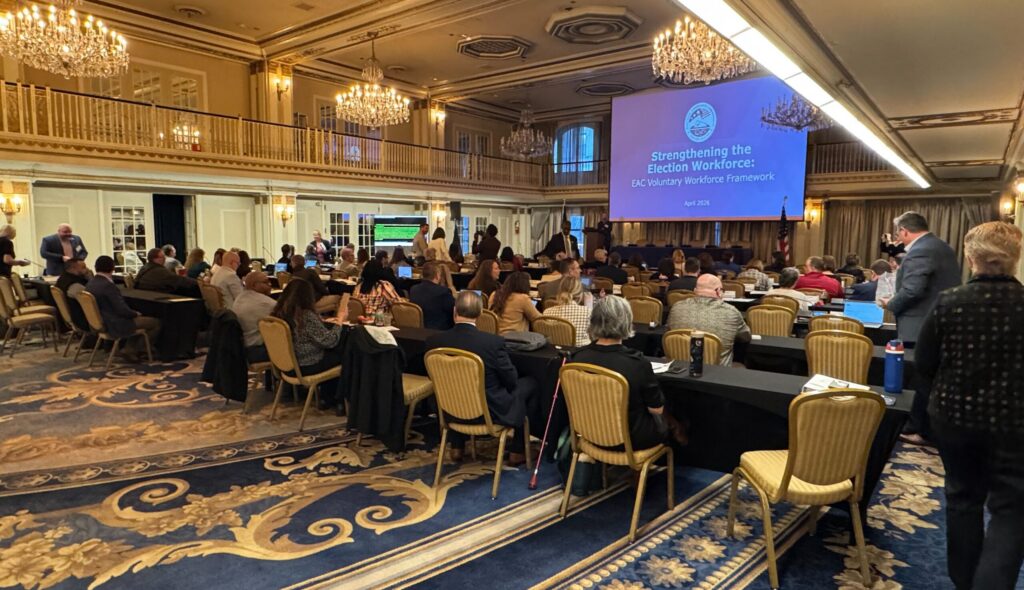
Chicago — Local election officials from across the country Tuesday warned that the Supreme Court’s pending decision on mail-in ballot grace periods could disrupt the upcoming 2026 midterms and asked a key federal elections agency for assistance.
“I just have to go on the record to say what a disaster that’s going to be during a midterm election,” Dustin Czarny, the election commissioner for Onondaga County, New York, said during an annual meeting between local election officials and the U.S. Election Assistance Commission (EAC) Tuesday.
“Hear, hear!” Mark Earley, supervisor of elections for Leon County, Florida, said in agreement.
Get updates straight to your inbox — for free
Join 350,000 readers who rely on our daily and weekly newsletters for the latest in voting, elections and democracy.
The EAC meeting, held in Chicago, was a chance for election officials from across the country to meet and discuss potentially seismic changes that may be coming for elections during President Donald Trump’s second term.
In oral arguments last month, several conservative-appointed justices appeared ready to side with Republicans and ban states from accepting mail ballots that arrive after election day. Currently, 14 states and D.C. will count ballots if they are postmarked on election day but received a handful of days afterwards.
The court’s ruling – which is expected by late June or early July – could scrap those grace periods for federal elections just weeks or months before states hold their primary races or their general midterm elections. That could put tens of millions of voters who rely on mail voting at risk of disenfranchisement.
In an interview with Democracy Docket, Czarny said that if the court strikes down grace periods, local election officials may suddenly communicate to voters that their ballots are at risk of not being counted just days before a race. They may also have to abruptly shift how they count ballots.
Czarny used New York’s upcoming June primary elections as an example. If the court rules just weeks before the primary, he may have to split ballots, as votes for state races may count, but those for federal elections may not.
“How am I going to communicate that part of your ballot will count and part of it will not?” Czarny asked. “These types of situations take time and procedures to prevent humans from making mistakes — because humans make mistakes — and there will be no time between June and November.”
“I guess it’s akin to a natural disaster. We don’t know what’s going to happen,” he added.
Earley told Democracy Docket that though Florida wouldn’t be affected by the court’s decision, he sympathised with election officials and voters in states that may be.
“Big changes to election law are best deployed with advanced notice so we can get the education out to voters and let them know,” Earley said.
The pending decision stems from the Republican National Committee’s (RNC) 2024 challenge against Mississippi’s grace period for late-arriving ballots. The RNC claims that federal statutes governing election day preempt the state’s election rules.
While Justices Neil Gorsuch, Samuel Alito and Clarence Thomas sounded eager to side with the RNC during oral arguments, Justices Amy Coney Barrett and Brett Kavanaugh and Chief Justice John Roberts didn’t tip their hand.
During the meeting, Czarny said the EAC, a bipartisan independent agency created to assist states in administering elections, would likely have to step in and help election administrators quickly inform voters about the court’s ruling.
In response, Camden Kelliher, the EAC’s general counsel, said the commission wouldn’t be able to act until the Department of Justice (DOJ) provided it with a legal interpretation of the decision.