‘We shall overcome (again)’: In powerful statehouse protests, Black voters and leaders decry GOP’s Southern gerrymanders
 Prefer us on Google
to see more of our voting rights news coverage when you search.
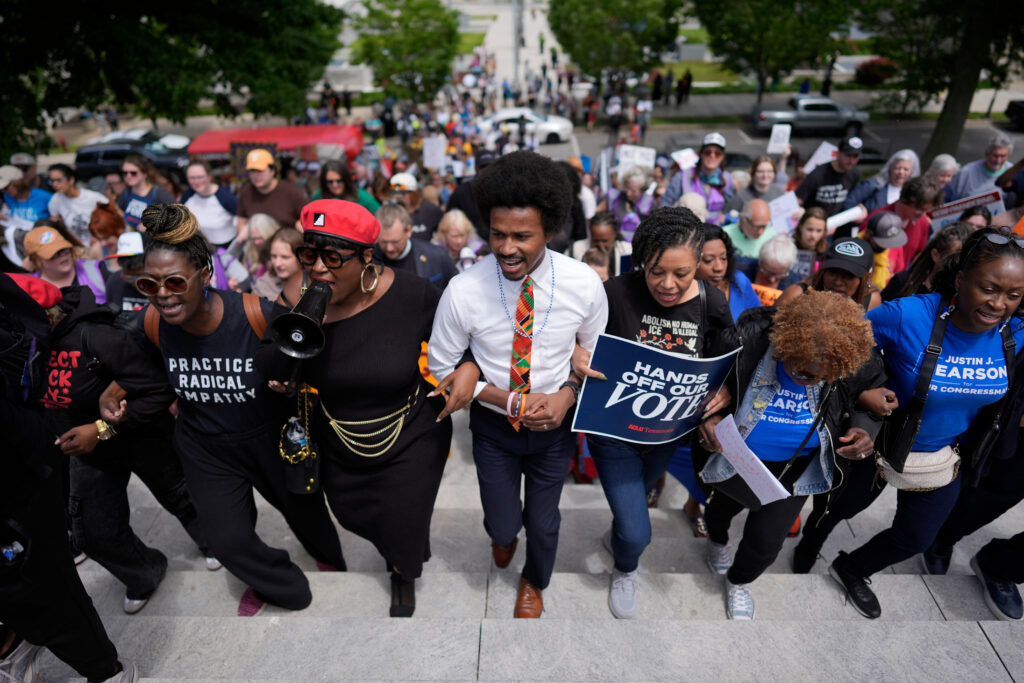
The Supreme Court’s decision to gut the Voting Rights Act (VRA) last week has spurred exactly what the landmark civil rights legislation was protecting against: A sweep of brutal GOP gerrymanders rushed through state legislatures across the South to eliminate minority political representation in the 2026 elections and beyond — even in states whose elections are already underway.
As lawmakers have rammed the unfair redraws through committees and floor votes, Black elected leaders and voters in Tennessee, Alabama, Louisiana and South Carolina have been trying to show the world how Republicans are rolling back their civil rights on President Donald Trump’s orders.
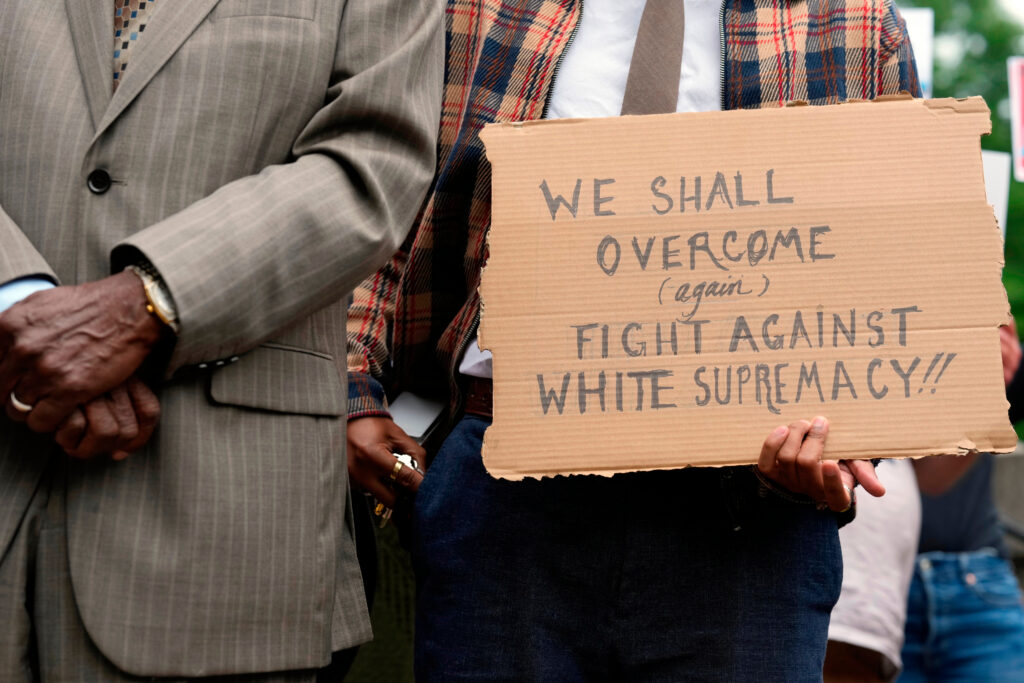
They have met this historic moment with speeches and protests highlighting the extremism and cruelty of the GOP’s gerrymander plan, grieving this generational setback and also vowing, as one protester’s sign read: “We shall overcome (again).”
Here are some of the most dramatic and powerful examples of how Black Americans — from elected officials to ordinary voters — have responded to the wave of GOP gerrymanders.
Tennessee
Tennessee became the first state to sign a gerrymander into law this week in direct response to the Supreme Court ruling. Republicans raced to repeal the state’s ban on mid-decade redistricting and pass a new congressional map eliminating the state’s only Black-majority district and its lone Democratic seat. The NAACP immediately sued, challenging the gerrymander in court.
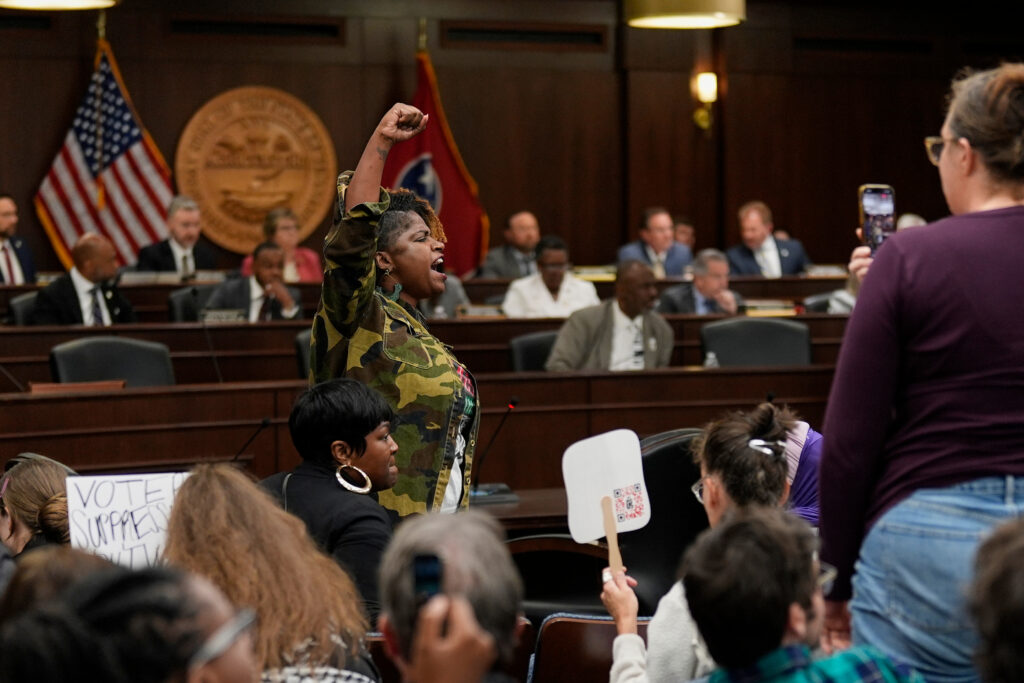
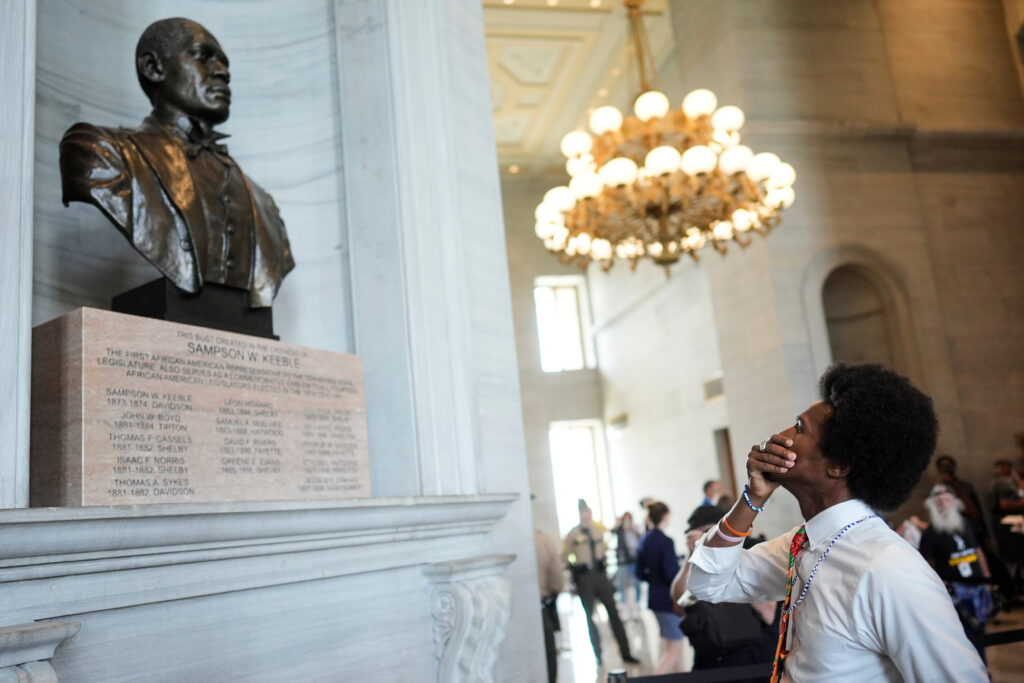
During the legislative session, Tennessee protesters showed up in force, with Black voters and elected officials sounding the alarm about the historic rollback of minority voting power.
State Sen. London Lamar (D), representing Memphis, delivered a powerful speech:
“I rise today not only as a senator, but as a daughter of Memphis, a daughter of the South, and a beneficiary of the blood, sacrifice and courage of Black people who fought for the right to vote. This is one of the most consequential votes any of us in this chamber will ever take in our lifetime. Not because of lines on a map, but because of what those lines are designed to do: erase representation, dilute Black voting power, and tell Memphis that our voice only matters when it is controlled.
“So let’s stop acting like this is ordinary redistricting. There hasn’t been any new census data. There is no emergency for the people. The only emergency here is [that] Republicans in this chamber saw a political opportunity after a Supreme Court Decision weakened the Voting Rights Act, that they moved immediately to attack Black voting power. This map does not reflect Memphis. It diminishes Memphis. It slices our city into pieces and stretches our communities hundreds of miles away to places of different needs, different economies, different histories and different lived realities.
“You cannot take a majority Black city, fracture its voting power and then tell us race has nothing to do with it. Racism does not become less racist because it’s called partisan. This is the same old playbook with new legal language behind it. When Black people gained the right to vote, they put in literacy tests. When we organized, they used poll taxes. When we built political power, they used gerrymandering. And when they are now — today, in 2026 — calling special sessions.
“Our ancestors did not march, bleed, get beaten, jailed and die for this legislature to use a court ruling as permission to gerrymander their grandchildren today. Black bodies lay in rivers and in fields all across this country because they dared to speak out for representation and the right to vote. And today, in 2026, we are standing here watching elected officials try to take our representation away, and those sacrifices made it possible for people like me to stand here and have a voice.
“I never imagined, as the youngest African-American to ever serve in this body in the history of this state, that I would be standing here debating the dilution of political [power] of my city and my community. I never thought as a mother of a child so many of you all love, that you refer to as “Baby Senator,” that my baby will have less rights than his grandmother. This is an insult to Memphis. This is an insult to the Black community. And it’s an insult to me as a mother.
“This is not about making Memphis matter. Memphis already mattered. Memphis matters in our economy. Memphis matters in the history of our country. And Memphis matters because we have a vote — and representation in Congress is being stripped today. You are not giving Memphis more representation by grouping them into communities that don’t look like them. Representation is not just about geography. It is about accountability. If my community cannot organize, vote and at least hold one member of congress accountable, then our representation has been weakened by design. Republicans, y’all, you’re not just going to weaken Memphis. Because Memphis will remain powerful. You are going to weaken your moral conscience. This an absolute powergrab.
“This past legislative session, you didn’t like our school board — took that over. You didn’t like our airport authority — took that over. And now you don’t like how Memphis votes, you’re going to take that away from us too. You cannot believe in local control while stripping Memphis voters from meaningful representation. You cannot claim to respect democracy while changing the rules after candidates have already qualified to run. You are creating chaos on purpose.
“This is not conservative. This is cowardly. If your agenda cannot survive Black voters have fair representation, then the problem isn’t us voting, it is your agenda.”
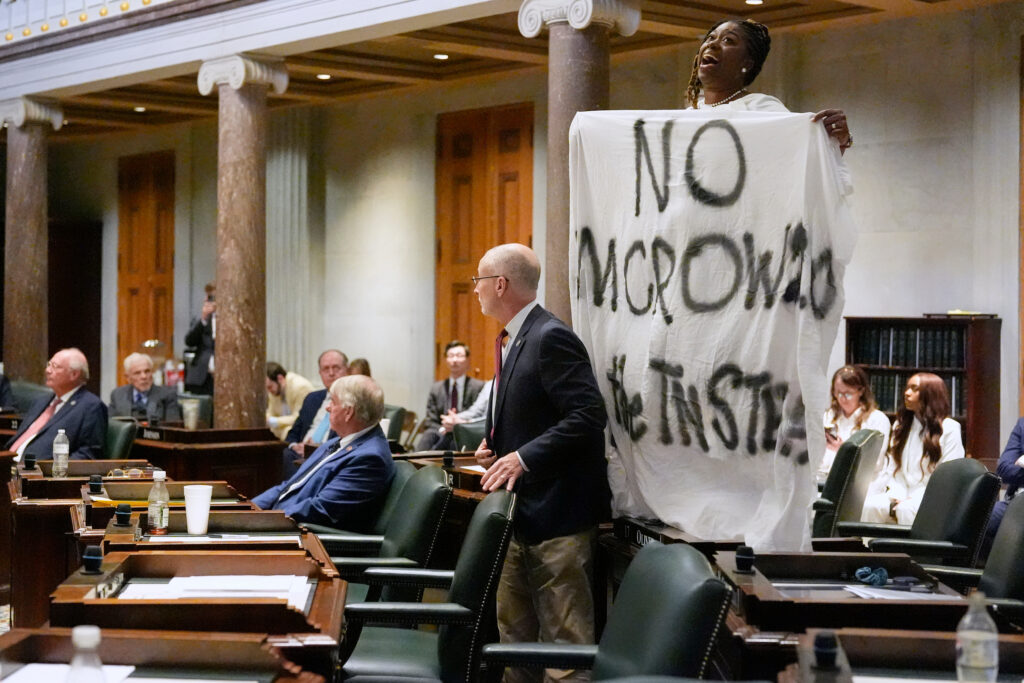
And state Sen. Charlane Oliver (D) rose in protest, standing on top of her desk on the Senate floor while holding up a banner that read: “No Jim Crow 2.0.”
Alabama
Despite an active primary election that’s already underway, Alabama Republicans raced to pass a pair of gerrymandered congressional and state senate maps this week, sending them to Gov. Kay Ivey (R), who is expected to sign them into law. However, they won’t immediately go into effect. Alabama is currently bound by a legal agreement to use its court-ordered congressional map until 2030, and it can only implement the redistricting legislation if federal courts lift the injunction.
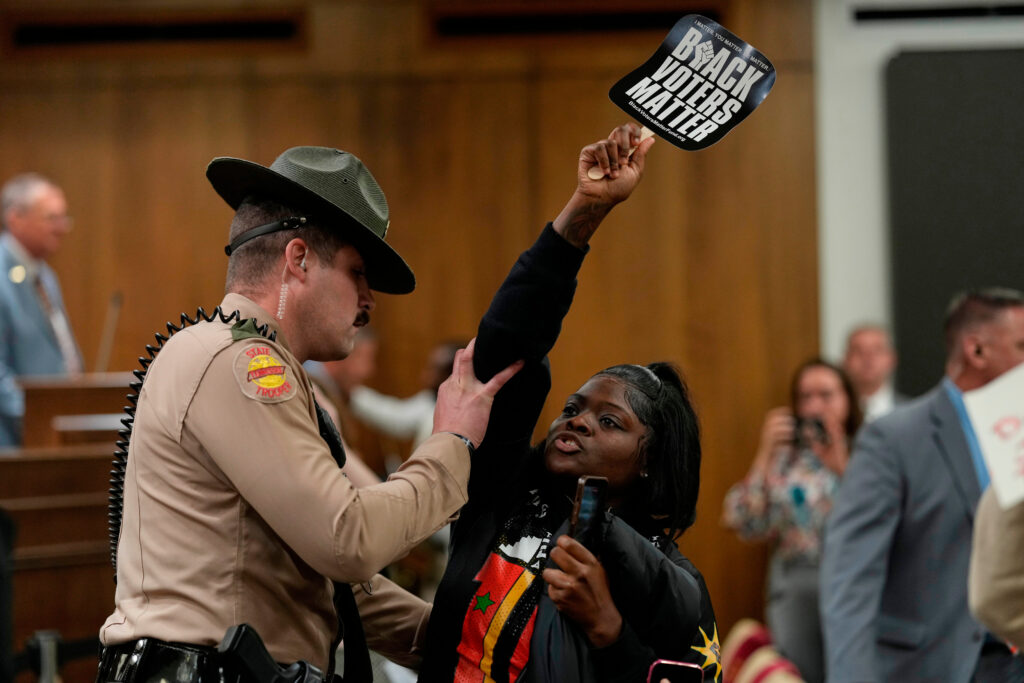
As Republicans took votes without any consideration for public input, Alabama protesters demanded to be heard. Videos posted by local journalists show they disrupted the state House, singing “We shall overcome” until they were removed from the chamber by law enforcement.
It’s chaos in the gallery after a protestor appeared to be restrained by state troopers.
— Austin Pratt (@austinpratt_tv) May 8, 2026
Security and Democratjc representatives calm down protestors and stop the chanting.
Multiple people were taken out.@abc3340 https://t.co/u1zfoLAn8P pic.twitter.com/WmbDwmxn1Z
State Sen. Linda Coleman-Madison (D), representing Birmingham, slammed Republicans’ efforts to roll back the clock on civil rights:
“I’m sick and tired of being sick and tired. How long are we going to have to repeat history before we realize that all people deserve to be respected and deserve to have the feeling that they are valued?… The people who believed in slavery and maybe still have those thoughts are not going to be here forever. We’ve got a new generation out there already. And like I said, I’m going to be here forever. It may not be this face, but it’s going to be one that looks like me and they’re just waiting right now.
“This is the new Jim Crow right here, putting it into law. That’s why I say: Young people, you’ve got to be ready. You’ve got to understand, and know it when you see it. It’s not the hoods. You’ve got to know it when you see it.”
Disruption in Alabama House as voting rights activist Dee Reed, protesting redistricting effort, is escorted out by security and state troopers. @aldotcom pic.twitter.com/BRaz0ZFg60
— Ruth Serven Smith (@RuthServenSmith) May 8, 2026
State Sen. Rodger Smitherman (D), who has represented Birmingham for more than 30 years, rose on the Alabama Senate floor to speak:
“You’re playing with people’s lives for the sake of politics…I can’t find anybody in here that’s got the courage to stand up for what’s right and wrong. We talk about partisanship. Partisanship has nothing to do with equal protection and people having an opportunity to have representation. It has nothing to do with that whatsoever… We ain’t ever operated like the way y’all are operating right now this week. I’ve been here 32 years…I’ve never seen it like this.”
“You get offended when people tell you what’s really going on. You don’t want people to say anything that’s going to hurt your feelings. But you want to destroy Black people’s whole existence. But you want to be sensitive if somebody uses certain words… You don’t want the truth to be told, no matter how good or bad it looks. You want to camouflage it.
“But the reality is, it is what it is. You can use any word that you want to use, but the action is that you are denying Black people an opportunity to participate who had to die to just have the right to vote and pick the person they want.”
Louisiana
Louisiana lawmakers took up redistricting at a Friday public hearing that quickly became heated. The committee will resume the matter Wednesday and could take a vote.
Louisiana has only had four Black congressmen since the 1870s — and all of them attended the hearing to testify.
The only Black Louisiana congressmen, total of 4 past and present since the 1870s, are speaking to the state Senate's SGA committee, asking the GOP to not eliminate the Black districts when they redraw the U.S. House map. pic.twitter.com/i66vNVXUno
— Wesley Muller (@WesleySMuller) May 8, 2026
U.S. Rep. Troy Carter appealed to the state senators to put morality over partisanship:
“At the close of the Constitutional Convention in 1787, Benjamin Franklin emerged from Independence Hall in Philadelphia. He was approached by a citizen who asked him a simple but profound question. He said, ‘Well, Dr. Franklin, what have we got? A republic or monarchy?’ Franklin’s response has echoed throughout the generations: ‘A republic, if we can keep it.’ A republic, if we can keep it. Those seven words may be among the most important words ever spoken about our American democracy, because Franklin understood something that remains true today: Democracy is not a self-sustaining function.
“It is fragile. It requires vigilance, it requires courage, it requires participation, and above all, it requires fairness. A republic cannot survive if people lose faith that their voices still do matter. A republic cannot endure if representation is manipulated to silence communities. A republic weakens when citizens begin to believe the system is rigged against them.
“Today, in Louisiana, we are being tested. And the whole world is watching. The question before us is not merely about lines on a map. The question before us is whether we will honor the principle that every citizen deserves equal protection under the law.
“Franklin warned us that keeping this republic would require each generation to defend it — not with empty rhetoric, but with true grit and action, with integrity, with moral courage, with moral tenacity, against the odds, against the voices, against the noise, — to simply do what’s right, that responsibility now rests with us.
“The decisions made in this legislature will say far more than who we are and how we draw districts. They will reveal whether we will stand and still believe in the promise of a representative democracy.”
And Leona Tate, who desegregated a New Orleans school as a child, also testified against redistricting:
“I went through something no child should go through to desegregate our state, and now, 65 years later, I’m watching as lawmakers attempt to go backwards and segregate us once again, through disgraceful voting maps… I walked through that mob once. I feel like I’m still walking through it.”
“I’m 71 years old, and I have spent my entire life in service to the idea that this country can be better than its worst impulses. I helped transform a school, I helped transform the city, and I have not given up on this state, but I need you to understand what it feels like to stand here, to have walked through that mob as a child, and to now watch elected officials do that same thing that the mob was trying to do, just with better suits and a parliamentary procedure… You have a choice In front of you. You can draw a map that reflects who Louisiana actually is, a state where Black voices belong in the halls of Congress. Or you can draw a map that tells my grandchildren that your votes don’t count, that their faces don’t matter, that the progress I helped build with my own two feet as a six-year-old girl can be erased at will.”
And Bishop Paul S. Morton told lawmakers, “Our white brothers and sisters now have a slave master. Racism in the white community has a slave master — that’s listening to a slave master, that’s making you change things that you believe in. You know it’s wrong… Come on, Louisiana has to wake up. There is too much racism in this state.”
1. 🧵"If you are taking seats from Black people…then you are a thief."
— Democracy Docket (@DemocracyDocket) May 8, 2026
Baton Rouge civil rights activist Gary Chambers said the quiet part out loud Friday as GOP lawmakers push to wipe out Louisiana’s majority-Black districts.
See the heated exchange👇 pic.twitter.com/EgSFXKgde2
Gary Chambers, a Louisiana civil rights activist, did not pull his punches.
“If you are taking seats from black people, which we are entitled to by the constitution of this country, then you are a thief, in my opinion,” he said. “And I’m entitled to that opinion. And any senator, if you’re offended by that, that’s on you, not me.”
When the Republican committee chair protested that he would not be called a thief, Chambers continued:
“Now, if that triggered you, Senator, then you should go to bed tonight, and when you go to bed tonight, talk to your God and ask your God to change your heart. Because that’s conviction.”
“Now, you may not care what history records you, as Bull Connor didn’t when he was running, either. Neither did George Wallace when he was the governor of Alabama. But 60 years later, nobody thinks George Wallace was a good white man — and nobody would think that you were good white men. They would think that you all were puppets who played a role for a president and got nothing out of it.
“So you try to limit us, you try to steal from us, and you think that we don’t understand it. Every one of the Black men we put up before you stand head and shoulders above every one of you on this committee. And you know it, and it does something in you that makes you feel inferior. So then you come with these white supremacist tactics, because you have the numbers, but you don’t have the courage, because if you were really visionary leaders, you’d run against these Black men with fair maps, and you get your asses whooped.”
South Carolina
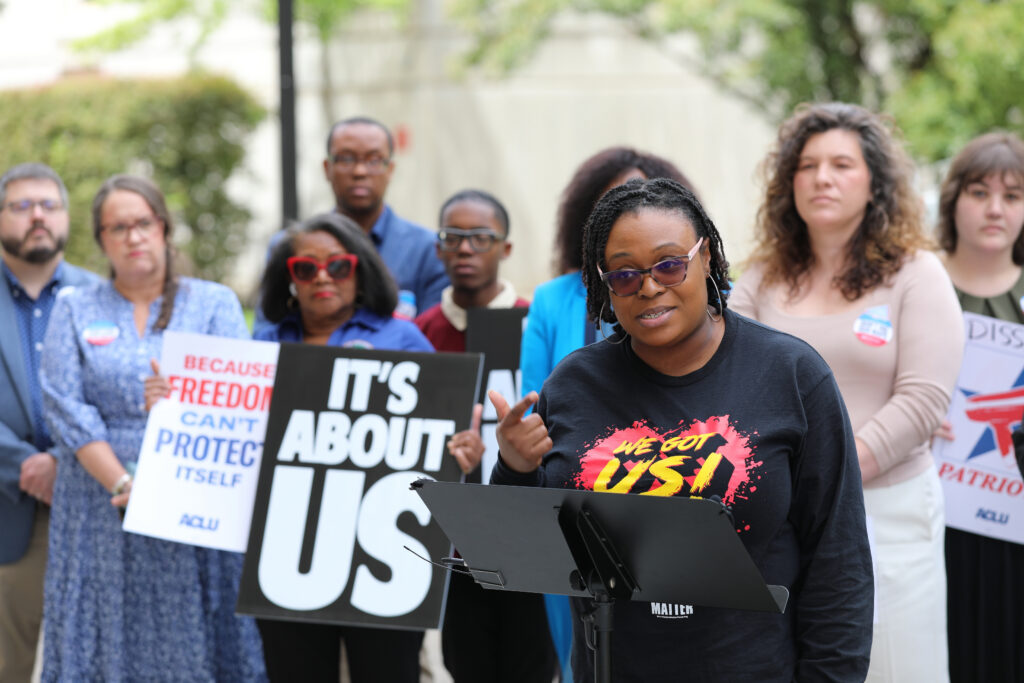
The South Carolina state House introduced a new congressional map this week and a measure that would postpone its primary election until August. Protesters packed a public hearing Friday, and not a single member of the public spoke in favor of the plan. The measure passed a House subcommittee. The state Senate will vote on redistricting next week.
SCDP Chair Christale Spain delivered powerful testimony at the hearing regarding Republicans’ effort to redraw congressional maps in the middle of an election year, reflecting on her mother’s experience living through Jim Crow in South Carolina
— South Carolina Democratic Party (@scdp) May 8, 2026
“We cannot go back.” #scpol pic.twitter.com/gxxKsntLib
South Carolina Rep. Kambrell Garvin (D) delivered a speech on the state House floor this week, warning that a GOP gerrymander would “take us back 100 years”:
”Anytime we’ve made progress, we have always experienced a backlash to that progress. And what we’re doing now, ladies and gentlemen, is we are now entering down the path of regression instead of progression…There is concern all over this country because the progress that people of color have made in this nation, with this act today, it’s the first step to roll that back…
“We will not go back and with every breath in my body I will make sure that my sons don’t grow up in a world like my grandparents.”
— Jaime Harrison (@harrisonjaime) May 8, 2026
My remarks today at a redistricting hearing in SC. #Redistricting #JimCrow #SouthCarolina pic.twitter.com/CiFSb6SFbn
“In Tennessee today, the legislature cut Memphis, cut Nashville and those communities no longer have a voice or somebody representing many of their interests. There is a concern that we will do the same thing here in South Carolina… For over 100 years, African Americans in this country did not have an opportunity to have a voice or have a say. It wasn’t until about 60 years ago — the lifetime of people in this very room, who fought for progress — that, for the first time since Reconstruction, African Americans had a voice and had a seat at the table. The first time in 60 years. Jim Clyburn, the sixth congressional district, that district was the first time in nearly 100 years that an African American was able to go to Congress…
“There are maps that are floating around. There’s a lot of speculation about what will or won’t happen. And I have a moral obligation…to say that what we are preparing to do does not move us forward, ladies and gentlemen. It moves us backwards…Let us not be like Tennessee. Let us not be like Alabama. Let us not be like Mississippi. Let us not be like Louisiana. We are better than that.
“We are better than that… I know that there are some Republicans in here that are not comfortable with what we’re doing. Because you know just as well as I know what’s getting ready to come down the pipeline. But it will take all of us, and a few good people of good will, to say that we will not go back. We will not go back…This is step one…We are better than what these other states are doing. We are better than taking orders from DC. We are better than that.”
Maya Bodinson, Matt Cohen, Jacob Knutson, Matthew Kupfer, Yunior Rivas, Jim Saksa and Adeline Tolle contributed to this reporting.