NAACP sues to stop Tennessee GOP gerrymander that dismantles majority-Black district
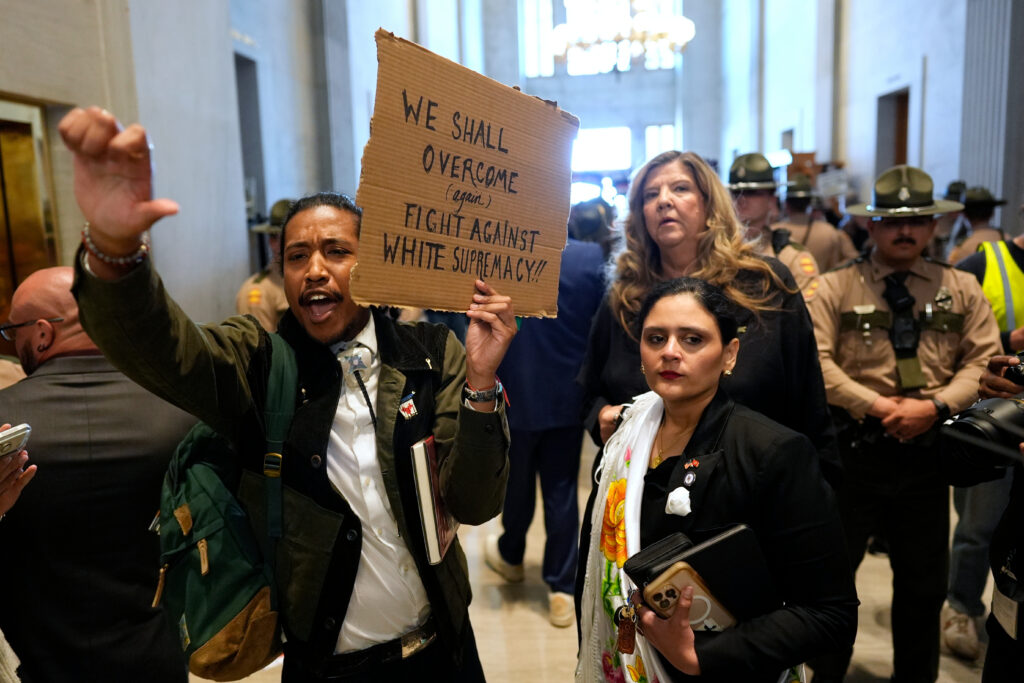
The NAACP filed an emergency lawsuit Thursday seeking to block Tennessee’s new congressional gerrymander, arguing the GOP’s rushed effort to dismantle the state’s lone majority-Black district was not only racist but outright illegal under Tennessee law and the state constitution.
The lawsuit — filed just after Gov. Bill Lee (R) signed the new map into law — marks one of the first major legal challenges to emerge since the Supreme Court gutted the Voting Rights Act.
“It is a direct attack on our democracy and our Constitution to dismantle majority-Black districts. A democracy without Black representation is not a democracy,” Kristen Clarke, NAACP General Counsel, said in a statement following the lawsuit. “We’re outraged that the State, rather than seeking a more just and fair system, is seeking to roll Tennessee back to a time when many of us didn’t have equal rights. We will fight this map, tooth and nail.”
Get updates straight to your inbox — for free
Join 350,000 readers who rely on our daily and weekly newsletters for the latest in voting, elections and democracy.
Instead of relying primarily on weakened federal voting rights protections, the NAACP’s lawsuit takes a different approach. It argues Tennessee Republicans violated their own state laws and constitutional limits in their rush to redraw the map.
“This case involves a decision by Respondents to engage in unlawful late-decade congressional redistricting in violation of clear and unambiguous Tennessee statutory law and the mandates of the Tennessee Constitution,” the complaint states.
The lawsuit claims Tennessee Republicans had no legal authority to redraw congressional districts in the first place.
For over five decades, Tennessee law explicitly prohibited congressional redistricting between census cycles.
Republicans repealed that prohibition this week in a special legislative session convened by Lee shortly after President Donald Trump ordered Tennessee Republicans to redraw the state’s map.
But the NAACP argues the repeal itself was unconstitutional because Lee’s proclamation calling lawmakers into special session never specifically authorized lawmakers to repeal the anti-redistricting statute.
Under the Tennessee Constitution, lawmakers in a special session may only consider issues specifically identified by the governor.
“The Proclamation does not specify the purpose of repealing Section 2-16-102,” the lawsuit states. “Thus, any actions dependent on such repeal or suspension are impermissible and should be enjoined. This case is staggeringly easy for this Court to decide.”
The challenge seeks to void the repeal, block the new congressional map and stop Tennessee from conducting elections under the newly drawn districts.
The lawsuit also targets another under-the-radar move Republicans made during the special session, suspending a one-year residency requirement for congressional candidates.
According to the complaint, the suspension “appears wholly to allow the election of candidates who have no history of living in the district they seek to represent.”
The GOP’s new map splits Memphis — one of the nation’s largest predominantly Black cities — into three separate congressional districts, effectively “cracking” Black voters apart to create a likely all-Republican congressional delegation.
The map is expected to eliminate Tennessee’s lone Democratic, majority-Black congressional seat currently represented by Rep. Steve Cohen (D.).
“The Tennessee State Conference of the NAACP will fight this attempt to silence Black voters through this unlawful redistricting process,” Gloria Sweet-Love, President of the Tennessee State Conference of the NAACP, said in a statement. “There is a long history and contemporary pattern of unfair redistricting practices in rural West Tennessee that have harmed Black political representation. We will stand up to make sure that Black voters retain their voting power.”
Republicans also quietly weakened voter notification requirements during the special session.
Before this week, Tennessee law required county election officials to directly notify voters by mail if redistricting changed their polling places or precincts. Republicans removed that requirement as part of the legislation they passed.
Democrats and voting rights advocates warned the move would create widespread confusion just months before the 2026 midterms.
“We’re not just redrawing the map,” state Sen. Heidi Campbell (D-Nashville) said during debate Thursday. “We’re making sure people don’t have to be told the map changed.”
The NAACP lawsuit argues the rushed timeline itself threatens chaos for voters and candidates alike.
The filing also notes candidates had already launched campaigns and voters could face changed precincts and compressed filing periods just months before the election.
The lawsuit lands as Tennessee becomes the first state to fully enact a congressional gerrymander directly tied to the Supreme Court’s devastating Callais ruling.
Republicans in Louisiana, Alabama, and other Southern states are already exploring similar redraws targeting majority-Black districts after the court effectively ended key federal protections for minority voters.