Maricopa County hands election denier control over early voting and drop boxes
 Prefer us on Google
to see more of our voting rights news coverage when you search.
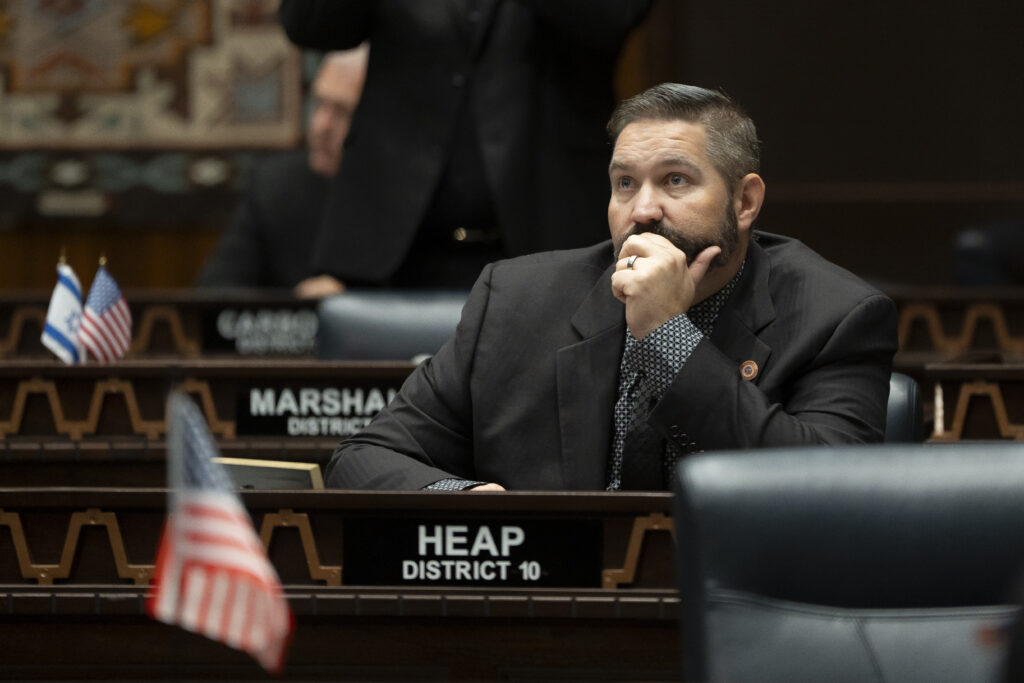
Maricopa County officials reached a settlement Tuesday, ending a yearlong fight over control of elections in Arizona’s most populous county. The agreement gives Recorder Justin Heap broad authority over early voting while leaving Election Day operations and ballot counting with the county Board of Supervisors.
The board approved the agreement and Heap signed it after three days of mediation. The settlement will govern November’s general election and later contests, while the upcoming July 21 primary will continue under an interim plan adopted by the Arizona Supreme Court.
Get updates straight to your inbox — for free
Join 350,000 readers who rely on our daily and weekly newsletters for the latest in voting, elections and democracy.
For voters, the most consequential provisions concern early voting sites and ballot drop boxes. Heap’s office will select early voting locations and oversee their setup, equipment and staff. But the board will determine and fund the maximum number of sites.
Through 2029, the county must provide at least one early voting site for every five Election Day polling locations.
The same split applies to drop boxes. Heap will choose where they go, while the board will decide how many it will fund. The offices will jointly collect and transport ballots deposited in them.
That structure settles who controls each function, but it does not guarantee how many early voting sites or drop boxes voters will have — or where they will be placed. The practical reach of early voting will depend on whether Heap and the board cooperate after months of escalating hostility.
“For the 2026 Election, early voting shall occur in locations that will also be used on Election Day,” the agreement states. “For future elections, the Board shall inform the Recorder whether Election Day voting will occur in the same location as early voting.”
Heap’s office will also handle voter registration, mailing early ballots, scanning returned envelopes, signature verification and helping voters fix — or “cure” — signature problems.
The board will retain bipartisan early election boards that process early ballots, Election Day and emergency voting, ballot tabulation and the official canvass of results.
The board will also fund 10 new early voting staff positions, 24 information technology positions and up to $15 million for a separate voter registration system controlled by the recorder. Until that system is deployed, the offices will jointly oversee the existing system.
The settlement follows more than a year of turmoil involving Heap, a prominent election denier who sued the Republican-controlled board after taking office.
Heap falsely claimed that Maricopa County’s 2020 election results were rigged against President Donald Trump. Heap has insisted without evidence that “inconsistencies and illegalities” have occurred in Arizona’s recent elections and that he does “not believe laws were followed.”
He has also promoted conspiracies about voting in Arizona, supported restrictive voting measures and welcomed federal intervention in the state.
The dispute threatened early voting sites and drop boxes ahead of the primary. An attorney from America First Legal — the group founded by Trump adviser Stephen Miller that represented Heap — threatened board officials and poll workers with possible criminal prosecution if they used locations Heap disputed.
The conflict escalated last month when the board accused Heap’s staff of improperly removing election scanners and provisional ballot envelopes from a secure facility during local vote counting, creating chain-of-custody concerns.
Heap maintained that the equipment belonged to his office.
The Arizona Supreme Court intervened last week, restoring more authority to Heap while adopting a 12-point plan intended to prevent last-minute disruption to next week’s primary. The settlement preserves that plan for the primary but establishes a different division of responsibilities for November and beyond.
The board approved the deal over the objection of Supervisor Steve Gallardo, its lone Democrat, who questioned whether voters could trust Heap and his hyperpartisan staff to administer elections fairly.
A superior court judge must still formally adopt the settlement.
The agreement would dismiss the lawsuit, vacate earlier court orders and appoint Judge Christopher Coury as a special master — a presumed neutral official empowered to resolve future disputes.