Top Trump appointee on key federal election panel to resign
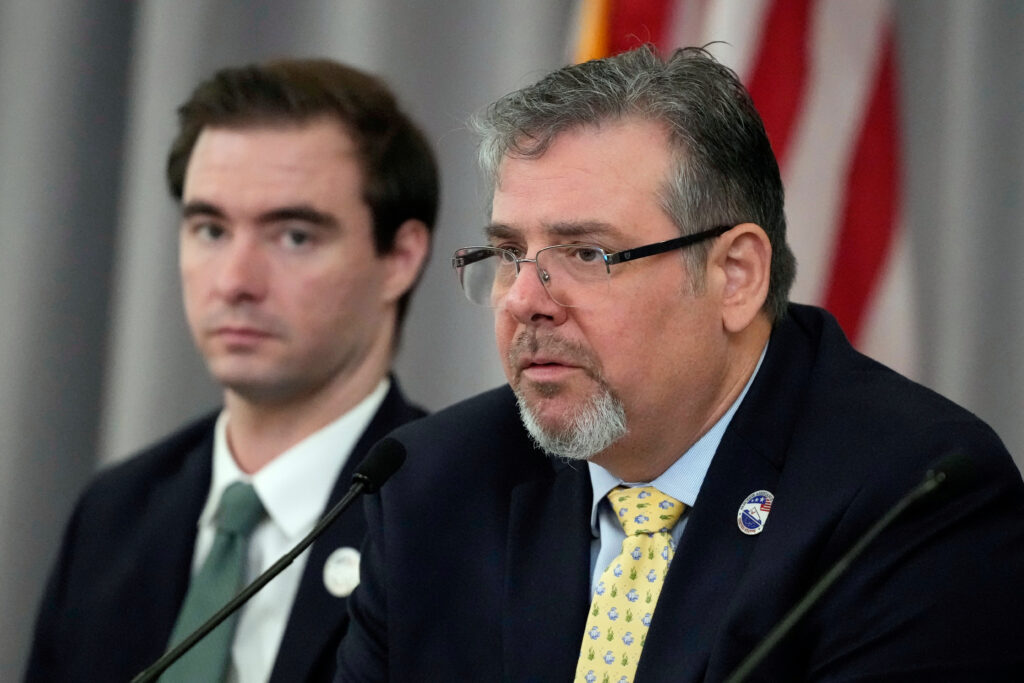
A top Republican official at the U.S. Election Assistance Commission (EAC) announced Wednesday that he would be leaving the commission by the end of the month, marking the first major shakeup of the commission’s leadership in over seven years.
EAC Commissioner Donald Palmer’s resignation gives President Donald Trump an opening to nominate a new official to the commission. Though the independent bipartisan commission was created to help states administer elections on a voluntary basis, Trump has attempted to use the commission in his efforts to assert control over U.S. elections.
Get updates straight to your inbox — for free
Join 350,000 readers who rely on our daily and weekly newsletters for the latest in voting, elections and democracy.
During his time on the commission, Palmer, who was appointed by Trump in 2019, has appeared with activists working to restrict voting, told Congress he supports a ban on mail ballot grace periods, and, as EAC chair last year, took steps to implement parts of Trump’s first anti-voting executive order.
He announced his departure Wednesday before the EAC’s Board of Advisors, a body of election officials and representatives from state and local government associations, federal agencies and Congress that was holding its annual meeting in Washington, D.C.
During the meeting, Palmer did not clarify why he was leaving the four-member commission. His term formally expired in December 2021, though all of the EAC’s current commissioners have continued serving beyond their term limits.
That’s because, since Trump’s appointment of Palmer and Commissioner Benjamin Hovland (D) in February 2019, no successors have been nominated by the president and confirmed by the Senate.
“It’s been a long, extended seven-year term. That’s the way things are,” Palmer said.
In a joint statement, the EAC’s other three commissioners said Palmer “has been an important part of the EAC’s leadership and contributed significantly to the agency’s growth.”
“Drawing on his experience as a state election official, he offered valuable insight as the agency worked to better serve administrators nationwide,” they said. “Throughout his tenure, he helped expand the agency’s work to strengthen the security of voting systems and election technology.”
Before joining the EAC, Palmer served as an election official in Virginia and Florida. As EAC chairman last year, Palmer moved to implement parts of Trump’s first anti-voting executive order, which the president signed in March 2025.
The order directed the commission to add a proof of citizenship requirement to a federal voter registration form, make changes to the standards it uses to certify the voting systems used in all U.S. elections, and withhold federal funds from states that did not comply with other requirements.
Most of Trump’s order, including its directives to the EAC, has been blocked through multiple court orders across the country.
Trump attempted to weaponize the EAC even though Congress designed it so that the president would have very little legal authority over it. Lawmakers defined the commission as an “independent entity” that must operate with partisan balance and limited control from the White House.
No more than two members from the same political party can serve on the commission at a given time, and while the president can nominate commissioners, congressional leaders can recommend potential appointees and the Senate ultimately confirms them.
Before a congressional committee last year, Palmer stated that he believes states should no longer accept and count ballots after Election Day, though he stressed he was speaking in his personal capacity and not on the EAC’s behalf.
Still, the comments, coming amid Trump and the GOP’s broad effort to hamstring voting by mail, were alarming.
In 2023, Palmer faced calls to resign after speaking at a private, confidential meeting with conservative groups advocating for new voting restrictions, including the Heritage Foundation.
Palmer’s departure will leave Christy McCormick, the EAC’s vice chair, as the only Republican appointee on the commission. Speaking in her official capacity last year, McCormick spread election conspiracies against Democrats. She told Democracy Docket earlier this month that her comments were under investigation.
Democracy Forward* (DF), a nonprofit pro-democracy legal organization, sued the EAC earlier this month to force the commission to turn over potential communications between its commissioners and election deniers or organizations that support restricting voting.
DF filed the suit after the EAC delayed its responses to multiple requests for key documents under the Freedom of Information Act.
*Democracy Docket Founder Marc Elias is the chair of the Democracy Forward board.