The election deniers influencing Trump’s anti-voting policy from the outside
 Prefer us on Google
to see more of our voting rights news coverage when you search.
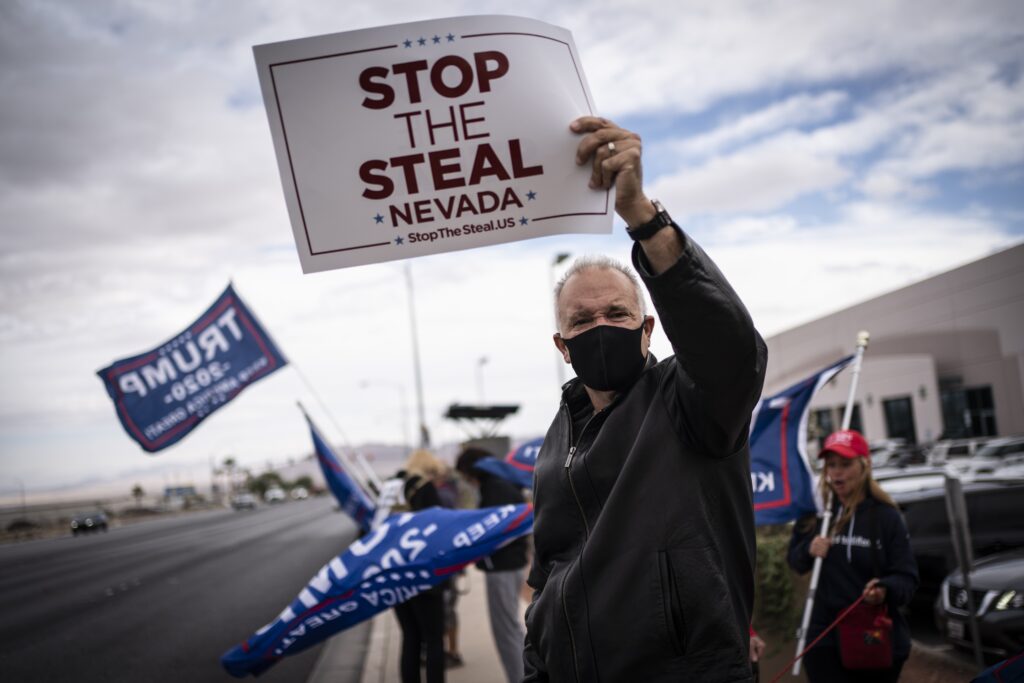
Since President Donald Trump returned to the White House last year, his administration has appointed an unprecedented number of election deniers and conspiracists to prominent government jobs.
There’s Heather Honey, a Pennsylvania-based anti-voting activist who was tapped for a newly created “election integrity” post at the U.S. Department of Homeland Security (DHS). Marci McCarthy, who led a lawsuit challenging Georgia’s use of voting machines, is the chief spokesperson for the nation’s top cybersecurity agency. And most recently, Trump tapped far-right journalist John Solomon — known for peddling voting conspiracies — for a special role in the White House focused on election integrity.
But the proverbial call isn’t just coming from inside the house. A group of anti-voting activists and election deniers operating outside the government, but very much plugged into Trumpworld, is directly influencing administration efforts to undermine elections.
In some cases, it’s not difficult to trace specific administration policies back to the individual activists who pushed them. But, unlike administration staff, these outside advisers lack any semblance of public accountability.
These are the leading anti-voting conspiracists, commentators and cranks exerting influence on the Trump administration and its attacks on free and fair elections.
Get updates straight to your inbox — for free
Join 350,000 readers who rely on our daily and weekly newsletters for the latest in voting, elections and democracy.
Cleta Mitchell
Cleta Mitchell — a prominent anti-voting activist — has been close with Trump for a long time. As an attorney for his campaign, Mitchell played an integral role in the president’s effort to overturn the 2020 election results in Georgia: She was even on the infamous call during which Trump pressed Georgia’s secretary of state to find him the votes needed to win the race.
Though Mitchell never joined the Trump administration, she appears to have maintained steady influence on Trump’s voting policies. Prior to the president’s disinformation-laden primetime address on election vulnerabilities last month, Mitchell reportedly convened a confab of prominent election deniers at the White House to brief key Trump advisers. Through her organization, the Election Integrity Network (EIN), Mitchell also pushes anti-voting policies on the state and federal level.
In May, EIN released its new “model laws” handbook, a roadmap for state and federal lawmakers to pass policies that severely restrict voting, like eliminating same-day voter registration, imposing rigorous ID requirements, and conducting mass voter challenges.
To get a sense of just how potent EIN is: In July, the organization released a fact sheet warning about vulnerabilities to voters in nursing homes.
“Staff, volunteers, political groups, and visitors must never pressure a nursing home residents to vote, suggest how the resident should vote, or mark a ballot without the voter’s express direction,” EIN said.
Days later, the Trump administration released guidance for nursing home staff on how to assist residents with voting, warning that staff “cannot engage in inappropriate coercion.”
Democratic senators warned that the guidance “may intimidate nursing home staff from helping residents exercise their constitutional right to vote and ultimately prevent nursing home residents from voting.”
Catherine Engelbrecht and True the Vote
Catherine Engelbrecht and her election-denial group True the Vote played a major role in popularizing election conspiracies after the 2020 election — particularly as the main source for the debunked film 2000 Mules. Gregg Phillips — who previously led True the Vote with Engelbrecht and claimed he once teleported into a Waffle House (don’t ask) — was tapped to lead FEMA’s Office of Response and Recovery, before stepping down in June.
But Engelbrecht and True the Vote remain an influential force shaping the Trump administration’s voting policy.
Phillips said on a podcast in March 2025 that True the Vote was working with the Department of Homeland Security (DHS) on collecting voter data.
Engelbrecht was also among the activists who joined a meeting with Mitchell at the White House before Trump’s election speech last month, MS NOW reported*. In that speech, Trump singled out purported election fraud in Michigan, which happens to be the focus of True the Vote’s new voter conspiracy documentary.
Kevin Moncla
When the FBI raided Fulton County, Georgia’s main elections hub in January, it raised several major questions. But the biggest: What evidence did the Trump administration have to convince a judge to grant a search warrant to seize election records?
As it turned out, the evidence was mostly tied to debunked claims about Fulton County’s 2020 election made by Kevin Moncla, a discredited anti-voting activist. Unsealed court records revealed that the FBI used a report by the Election Oversight Group, LLC (EOG) — of which Moncla was a lead author — to obtain its search warrant. Mitchell, the anti-voting lawyer, told ProPublica that various federal investigators and attorneys interviewed Moncla about his Fulton County 2020 investigation prior to the FBI’s raid.
But there’s a problem with Moncla’s report: Experts say it’s bullshit.
In April, conservative researchers working with the nonpartisan, nonprofit States United Democracy Center (SUDC) reviewed the report and concluded that it “provides no coherent theory or evidence of fraud.”
The SUDC review did not mince words about Moncla’s work: “The EOG Report suffers from extensive analytical and factual flaws,” the SUDC review states. “It is deeply concerning that its allegations appear to have served as the core of the affidavit supporting the Fulton County search warrant in January 2026.”
Seth Keshel
Seth Keshel — a former Army intelligence captain who made a career traveling the country to discuss conspiracy theories about the 2020 election — has earned Trump’s high praise for his methodical election forecasting and advocacy for restrictive anti-voting policies.
In May 2025, Keshel wrote in his newsletter that he briefed “one of President Trump’s most critical staff members and his own key staff” on “years of critical election research.”
Keshel didn’t get into the details of what he shared with the White House officials, but he said the meeting was serious.
“They asked many tough questions, contributed valuable insights, and gave me some to-dos,” Keshel noted to his readers. “I encourage all to choose patience when it seems like things are moving slow, or perhaps not moving at all.”
And Keshel said that it wouldn’t be his only visit to the White House.
On his blog, Keshel wrote last month that he was “part of a small group” who helped draft Trump’s big election speech.
“All five points of the speech unfolded exactly as we were told they would,” he said, listing alleged proof of foreign tampering, intelligence community cover-ups, voting machine vulnerabilities, voter registration fraud, and noncitizens on voter rolls as the topics that he was told Trump would discuss.
It’s unclear what level of influence Keshel has over the Trump administration, but he’s long advocated for a lot of its anti-voting policies, like abolishing mail voting.
James O’Keefe
Conservative commentator James O’Keefe’s whole shtick is to go undercover to “expose fraud” and then release deceptively edited videos to fit whatever right-wing narrative he’s trying to spread. O’Keefe isn’t exactly an avowed election denier in the vein of others on this list — he’s more of a general right-wing activist — but a lot of his work centers around trying to expose voter fraud.
Over the past several months, O’Keefe and his team have been rooting around for voter fraud in blue states and battleground states around the country. Most recently, he traveled to Minnesota, where a member of his team now faces a criminal probe for visiting polling places while pretending to be a Muslim woman in a burka in order to expose voter fraud. Seriously.
O’Keefe doesn’t have close ties to the president, but his team’s recent antics in Michigan caught the attention of at least one top Trump administration official. After Assistant Attorney General for Civil Rights Harmeet Dhillon posted on X last week that she was headed to Detroit, O’Keefe responded:
“Good to see the DOJ headed to Detroit just a few days after we released video of non citizens voting in Detroit…”
Dhillon reposted O’Keefe’s response to her followers.
Mike Lindell
It’s no secret that MyPillow founder and conspiracy theorist Mike Lindell has enjoyed a cozy relationship with Trump over the years. Lindell became a prominent figure in the election denier movement for pushing the false claim that compromised voting machines flipped votes from Trump to Joe Biden in 2020. That unsubstantiated allegation resulted in defamation lawsuits against the pillow magnate from two major election technology companies.
Since Trump’s return to the White House, Lindell has said that he occasionally meets with the president to discuss 2020 election conspiracies and plans to get rid of voting machines.
“I did just meet with the President — this is the third time now — about two weeks ago, and I’ll hopefully see him again next week,” Lindell said last year. “One of our biggest focuses is — you’ve heard about the special prosecutor, we need a team that goes back in time — and then we also have a team going forward, everybody, to get rid of these machines before the primaries.”
Weeks later, in a social media post, Trump called for getting rid of voting machines.
Lindell was also allegedly responsible for the Trump administration’s efforts to intervene in convicted election denier Tina Peters’ case to get her released from state prison, according to far-right podcaster Steve Stern.
But Lindell couldn’t leverage his close ties to Trump in his recent gubernatorial run in Minnesota. Despite the president’s backing, Lindell lost the GOP primary nomination by double digits. Lindell then refused to concede and claimed that his team found “irregularities” in the election data that originated with the state’s voting machines. Now, Lindell has announced he’s funding a full hand-count audit of the ballots that will cost close to $1 million.
Patrick Byrne
Before the 2020 election, Patrick Byrne was best known as the former CEO of Overstock.com. But he quickly became a prominent MAGA figure for promoting election conspiracy theories — and even ended up at a pivotal White House meeting in December 2020 as part of a team of conspiracy theorists assembled to help brainstorm ways for Trump to steal the election.
Today, Byrne is a crucial figure in the election denial movement who has remained in Trump’s orbit, pushing him to take action against voting machines. Notably, Byrne has long pushed the conspiracy theory that both Liberty Voting — formerly Dominion Voting Systems — and Smartmatic were secretly controlled by Venezuela.
Byrne’s not the only one who’s promoted that outlandish false claim; Lindell’s been vocal about it, as has far-right slopcaster Benny Johnson. But Byrne’s ties to Trump suggest that he may have had some influence on the Trump administration’s decision to abduct Venezuela’s leader Nicolás Maduro in January. Days after the military action in Venezuela, Byrne was supposed to appear on LindellTV host Emerald Robinson’s show but had to cancel at the last minute after being called into the White House for a meeting.
Tina Peters
It’s no secret that Peters’ plight behind bars became a priority for Trump — until Colorado Gov. Jared Polis (D) gave in to pressure from the president and commuted her sentence.
But the lengths to which the White House went to punish Colorado over her case show that Peters — the former GOP election clerk who was convicted for her role in a 2021 voting system breach spurred by conspiracies — holds immense influence over the president.
Since her release from prison, Peters has been on a nonstop far-right media tour spreading the same conspiracies about voting machines that helped land her in prison in the first place. More troublingly, she’s met with Trump and high-level Trump administration officials, including Assistant Attorney General for Civil Rights Harmeet Dhillon.
Peters has hinted in recent podcast interviews that she’s been meeting with federal officials about election matters — including a meeting with the Cybersecurity and Infrastructure Security Agency, which was facilitated by Honey, the DHS official.
So far, however, her clearest official role is a worrying job offer: assistant registrar of voters in ruby-red Shasta County, California.
*Update 8/21, 1:45pm ET: In an email to supporters sent Friday responding to this story, Engelbrecht denied attending the White House meeting. Democracy Docket’s assertion that she attended the meeting was based on a July 16 report by MS NOW, which has not been corrected.
Democracy Docket has reached out to Engelbrecht asking for comment.