Citing Brexit, Trump DOJ pushes ‘single day’ elections ahead of Supreme Court case attacking mail voting
The Trump administration is ramping up its push to turn U.S. elections into single-day affairs — just days before the Supreme Court hears a case that could prevent millions of legally cast mail ballots from being counted nationwide.
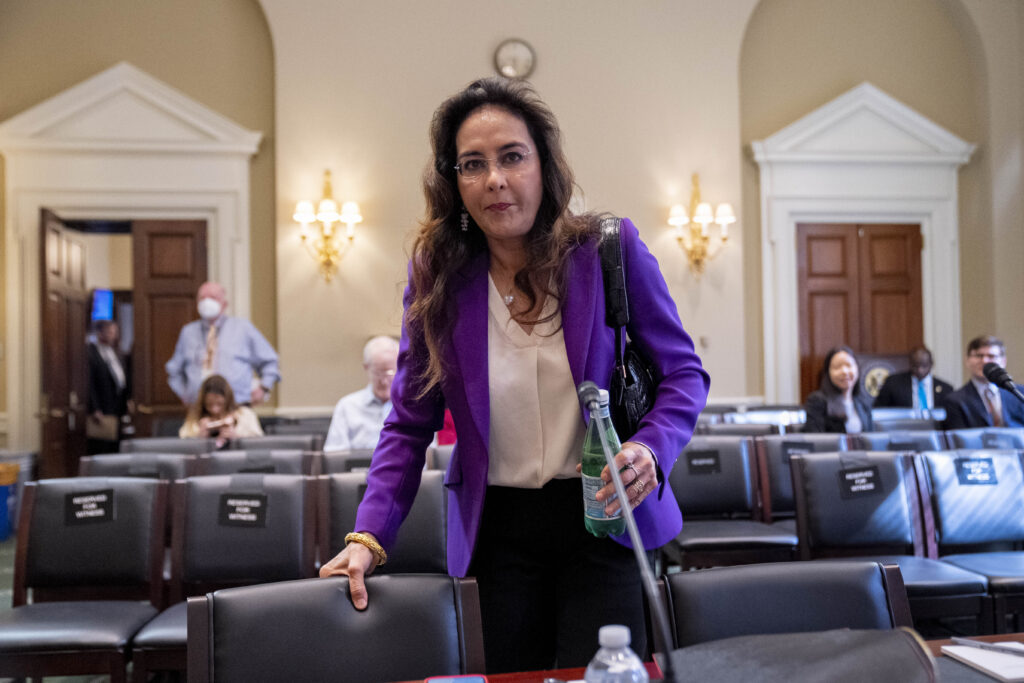
In a recent interview, Assistant Attorney General for Civil Rights Harmeet Dhillon framed the administration’s election agenda around two goals: seizing state voter rolls and moving American elections toward a single-day model.
“The rest of the world has elections and they occur on a single day and then they have the outcome later that day,” Dhillon said. “The U.K. determined Brexit in an election that took place in a single day with the outcome later that day. Why can’t America do it?”
Dhillon did not note that the entire United Kingdom is about the size of Oregon — meaning ballots there travel far shorter distances through the mail than across the United States, where mail voting plays a much more vital role.
Get updates straight to your inbox — for free
Join 350,000 readers who rely on our daily and weekly newsletters for the latest in voting, elections and democracy.
Dhillon tied the efforts to broader claims about the 2020 election that have repeatedly been debunked and rejected by courts.
“A lot of Americans have lost confidence in the sanctity of our elections after widespread violations of state election laws in the 2020 election,” she added. “I was an election lawyer during that time and I personally litigated cases and did fact finding in multiple jurisdictions including Pennsylvania.”
At the same time, the administration is backing a Republican lawsuit before the Supreme Court that could sharply restrict mail voting.
The justices are set to hear arguments in the case, Watson v. Republican National Committee, next week.
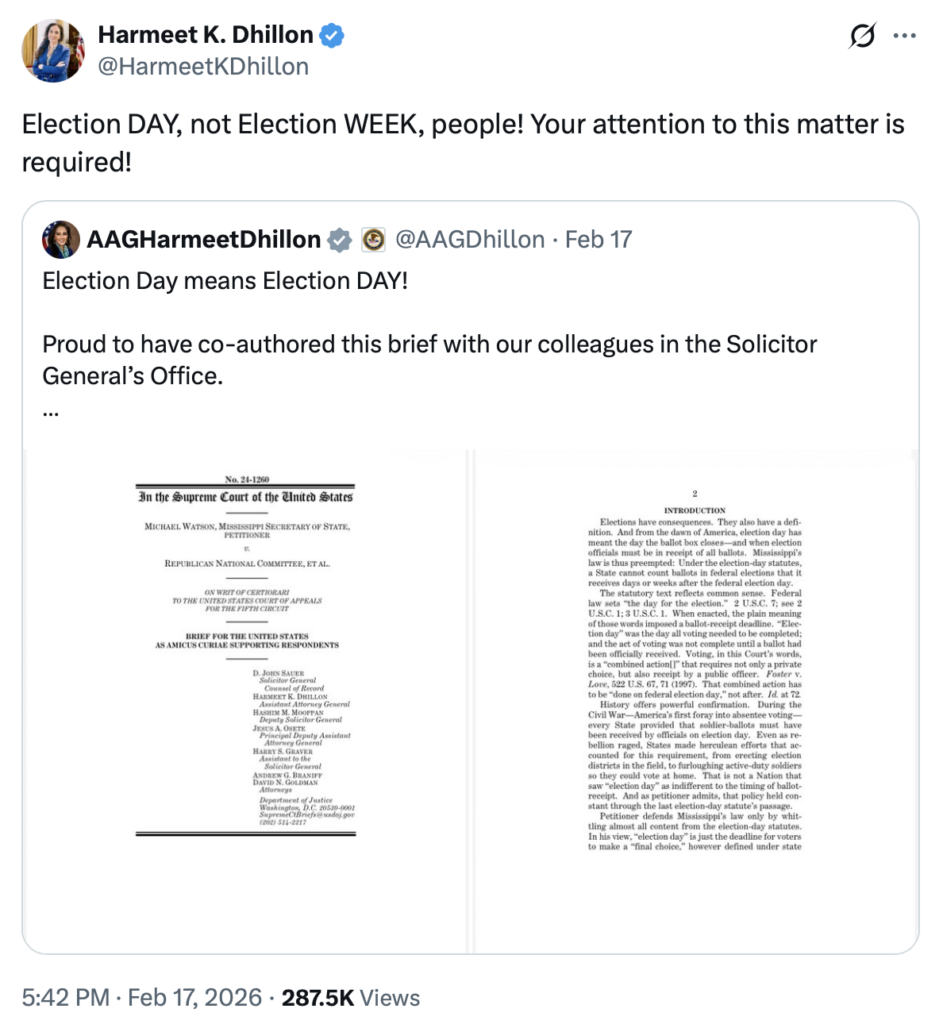
The case centers on a Mississippi law allowing mail ballots that are postmarked by Election Day to arrive up to five days later and still be counted. The Republican National Committee (RNC) challenged that policy, arguing federal law requires ballots to be received by Election Day.
Last year, the Fifth Circuit Court of Appeals sided with the RNC, ruling that federal laws establishing Election Day mean ballots must both be cast and counted by that day.
Mississippi appealed, sending the dispute* to the Supreme Court.
But the stakes extend far beyond Mississippi. If the high court upholds the Fifth Circuit’s ruling, it could invalidate mail ballot grace periods used in multiple states and disrupt longstanding practices for counting ballots, including those from military and overseas voters.
But the argument reflects a larger strategy among Trump allies to roll back further roll back and even early voting — policies that have expanded dramatically in recent decades to make it easier for citizens to vote.
Nearly every state now offers early in-person voting, and many allow voters to return absentee ballots by mail before or on Election Day.
Some conservative activists have openly advocated eliminating early and mail voting altogether.
Election denier Cleta Mitchell has urged allies to restructure elections so that most ballots are cast in person on Election Day at neighborhood precincts. Other right-wing figures, including Kari Lake and Patrick Byrne, have echoed calls for elections to return to a single day.
And even the DOJ has already begun pressuring states to eliminate mail ballot grace periods before a Supreme Court ruling.
In Ohio, Secretary of State Frank LaRose (R) told lawmakers that the department warned the state it could face “costly litigation” if it continued counting ballots that arrive after Election Day. LaRose said he received a letter from Dhillon urging Ohio to “take immediate action (legislative or otherwise)” to change the law — after which Republican lawmakers passed legislation that would end the state’s grace period.
The Supreme Court’s Mississippi ruling, expected by the end of its term this summer, could determine whether states can continue counting ballots that arrive after Election Day — and could shape future legal battles over early voting and other election practices that have expanded voting access.
*The intervenors in the case are represented by the Elias Law Group (ELG). ELG firm chair Marc Elias is the founder of Democracy Docket.