Exclusive: Cleta Mitchell, Activists Scheme to Bring Back One-Day Elections
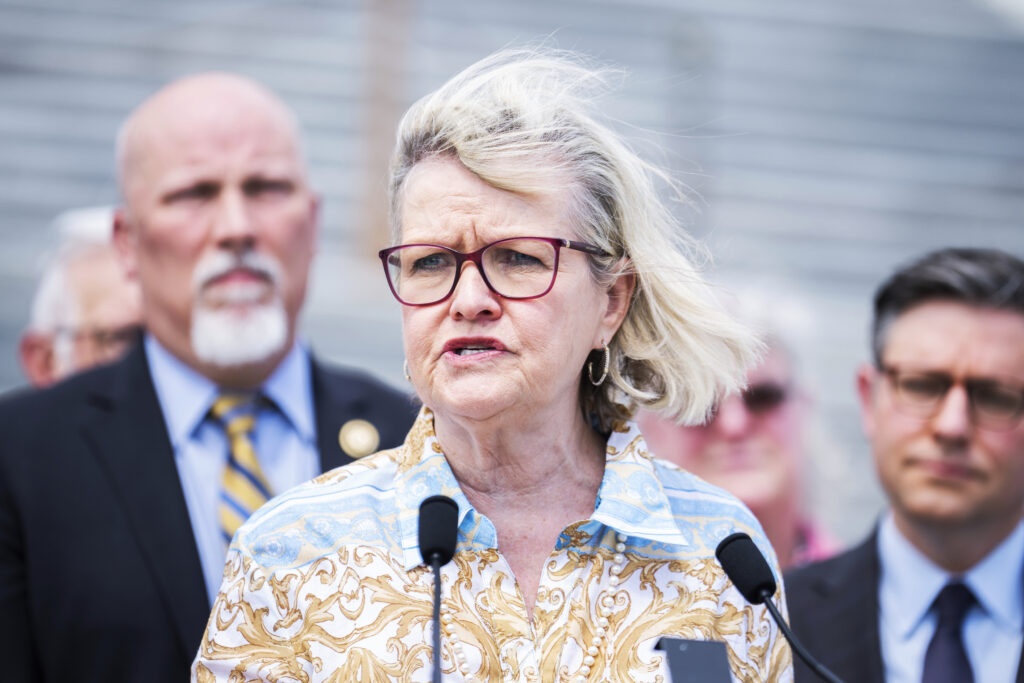
Cleta Mitchell and activists from a top anti-voting group with close ties to the White House met last week to discuss plans to push for severely limiting early and mail voting.
Those potential cutbacks, which are close to what President Donald Trump has called for, would radically curtail access to the ballot, taking the U.S. back decades to the era of one-day elections.
Mitchell told fellow activists that the group wants nearly all voting to take place in person on Election Day.
“In-person voting on Election Day should be primary,” she said.
The plan was discussed at a meeting of Mitchell’s influential Election Integrity Network (EIN), held Friday at a Worcester, Mass. hotel. Democracy Docket exclusively obtained notes from the meeting, and a copy of the agenda.
Two state lawmakers who support restrictive voting laws — including one Maine Republican who marched on the U.S. Capitol on January 6, 2021 — also spoke at the confab.
On a panel entitled “Restoring Election Day,” Mitchell said she has worked with state lawmakers to develop model legislation to ensure that most voting takes place in person on Election Day at voting precincts.
That plan would mean an end to the larger vote centers that states including Arizona and California use and that many election administrators say can help expand access by accepting voters from a wide area.
Get updates straight to your inbox — for free
Join 350,000 readers who rely on our daily and weekly newsletters for the latest in voting, elections and democracy.
It also would dramatically limit early in-person voting, which has helped make it easier for voters who work long hours or lack flexibility in their schedule to cast a ballot. Mitchell falsely claimed that early-voting polling places are more prone to voter fraud because they are less transparent.
Mail voting also would be curtailed, with voters needing an excuse to receive a mail ballot. Currently only 13 states require an excuse.
And not just any excuse would count, Mitchell suggested. Even being confined to a care home should not count, Mitchell said, falsely claiming that Service Employees International Union (SEIU) members who work at care homes for the elderly frequently steal ballots from their patients.
Mitchell added that states should bar local election officials from printing additional ballots if they run out on Election Day — which would allow voters to be disenfranchised because of poor planning by election administrators. She claimed that some polling sites in Pennsylvania ran out of ballots during Election Day, forcing poll workers to run to Staples to print more.
Mitchell, a veteran GOP election lawyer, played a key role in President Donald Trump’s attempt to overturn the 2020 election, joining the phone call in which Trump tried to pressure Georgia’s secretary of state to “find” him enough votes to win the state. Since then, as EIN’s founder, she has led the GOP effort to pull back access to the ballot. Mitchell “had a significant hand” earlier this year in the House passage of the SAVE Act, a major voter suppression measure, according to the bill’s sponsor. And she appeared alongside Speaker Mike Johnson at a Capitol Hill press conference to announce the legislation in 2024.
Mitchell’s push to end early and mail voting is aligned with a larger emerging GOP effort.
Trump, in a social media post last month, called for “no mail-in or ‘Early’ voting.” And after the Supreme Court announced last week it will hear a Republican lawsuit that aims to bar states from counting mail ballots that arrive after Election Day but are postmarked on time, several top GOP leaders appeared to call for requiring all voting to take place in person on Election Day.
“Election Day means Election DAY,” Harmeet Dhillon, the head of the Justice Department’s civil rights division, wrote on X. “Stay tuned!”
Also at Friday’s EIN meeting, Phani Mantravadi, a Michigan anti-voting activist who co-founded the group Check My Vote, discussed ways for citizens to take it upon themselves to hunt for voter fraud, according to the notes.
In addition to plugging Check My Vote, which uses incomplete or inaccurate public data to check voter registrations, Mantravadi encouraged attendees to drive by the homes of voters they suspect of fraud to check that their addresses are valid.
Two state lawmakers, Rep. Barbara Bagshaw of Maine (R) and Rep. Jon Brien of Rhode Island (I), appeared on a panel about “election reform,” moderated by Mitchell, according to the meeting’s agenda. Neither responded immediately to requests for comment about what they told the group.
Bagshaw attended the “Stop the Steal” rally in Washington, D.C. on January 6, 2021 and marched on the Capitol, though she has said she didn’t enter the building. Speaking on the floor of the Maine House, she falsely accused Capitol police officers of “trying to incite violence” by leaving weapons on the steps for protesters to use.
Brien introduced legislation in 2023, which did not pass, to shorten the timeline for receiving a mail ballot.