Vote centers have made it easier to vote. Cleta Mitchell is coming for them
 Prefer us on Google
to see more of our voting rights news coverage when you search.
Last month, Cleta Mitchell joined conservative podcaster Steve Stern to talk about strategies that her influential anti-voting group, the Election Integrity Network (EIN), is working on for the 2026 midterms.
“We have to change the dynamic of how we conduct elections and return to a time when accuracy and accountability and transparency were the rule of the day,” Mitchell said. “My main mission… is that all voting takes place locally.”
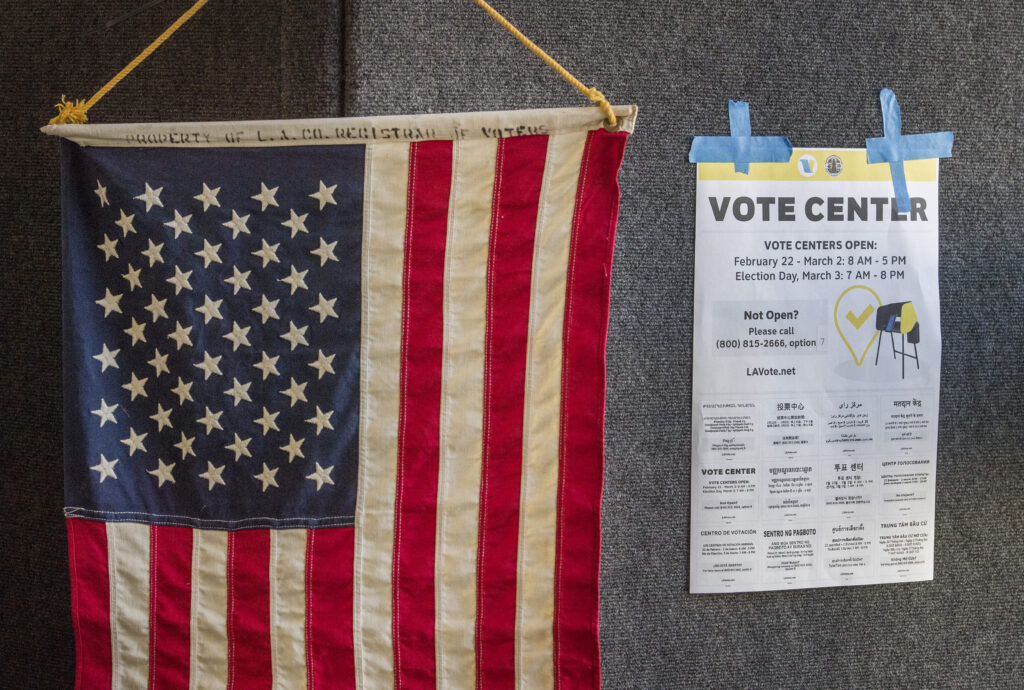
Mitchell and EIN are hoping to change the dynamic of the 2026 midterms by pressuring state and local election officials to only allow voting to take place in small neighborhood precincts, rather than the vote centers — usually large locations where anyone in a county can cast a ballot — that, in recent years, have greatly expanded access to the ballot box.
An EIN paper released January 9 made the case that vote centers have “distinct vulnerabilities” — like the “co‑mingling of ballots from across an entire county” — that could allow for election fraud to flourish.
Get updates straight to your inbox — for free
Join 350,000 readers who rely on our daily and weekly newsletters for the latest in voting, elections and democracy.
The strategy is championed by other influential right-wing figures — like former U.S. Agency for Global Media senior advisor Kari Lake and Overstock.com CEO and election conspiracy theorist Patrick Byrne — who’ve voiced their desire in recent months to see voting return to a single-day affair on Election Day at small precincts.
“PLEASE let’s reform elections,” Lake said in November. “Election Day NOT Election month, paper ballots, small precinct voting and counting and NO machines.
“This is consistent with the right’s desire to attack creative approaches to ensuring that more people can cast a ballot,” Dan Vicuna, the senior policy director for voting and fair representation at Common Cause, told Democracy Docket. “The President’s gone on a warpath to try to undermine vote by mail. And these vote centers are an innovation that are designed to ensure that people have a longer period to cast a vote.”
The battle over vote centers is currently playing out in Lake’s home state of Arizona, where Gov. Katie Hobbs (D) last year vetoed a GOP bill to abolish the use of them, as well as eliminate the state’s nearly month-long early in-person voting period.
The bill was authored by state Rep. Rachel Keshel (R), the wife of prominent anti-voting activist Seth Keshel.
Arizona currently only allows the use of vote centers at county offices or other county-approved locations. But state Democratic lawmakers introduced a bill this month to expand voting access by adopting vote centers statewide, along with several other pro-voting provisions.
“The use of vote centers is a proven election reform that simultaneously benefits voters and election officials by removing the risk of showing up at the wrong polling location in your county,” Arizona Secretary of State Adrian Fontes (D) said in a video endorsing the new bill. “This change has boosted voter participation and reduced the number of provisional ballots.”
Vote centers came to prominence in the mid-2000s as a way to expand voting access, with Colorado, Indiana, Iowa, and North Dakota as some of the first states to add larger venues for people from any jurisdiction to come and cast their vote. Twenty-one states, and Washington, D.C. now use vote centers for people to cast their ballot during the early voting period, or on Election Day.
“Vote centers have just proven to be a really effective way to get people flexibility in casting a ballot,” Dan Vicuna, the senior policy director for voting and fair representation at Common Cause, told Democracy Docket. “It allows them to do it for a longer period of time. Even if they may have an easier opportunity to vote on their lunch hour near their work, as long as it’s in the same county, generally, that is an approach they can use. And they’ll get the exact ballot with the races that they are going to be able to vote on. And it’s worked really well.”
Abolishing vote centers is part of EIN’s broader election strategy, including a push to end voting machines in favor of paper ballots. Experts fear this is a step for anti-voting activists to achieve their ultimate goal of nixing all early and mail voting in favor of one-day elections as a way for Republicans to hold onto power — even as support for Trump and the GOP continues to fall.
“You’re basically concentrating all of the potential points of failure into a single 12-hour period in a single place,” David Becker, the executive director of the Center for Election Innovation & Research and a former DOJ voting section attorney, told Democracy Docket. “Imagine if they told everyone grocery stores are going to be open only for 12 hours on one day a month, and you all have to go shopping there. It is a recipe for disaster.”
EIN’s push for precinct voting is an evolution of “precinct strategy” — an idea first popularized in 2020 by Dan Schultz, a Republican attorney, longtime Arizona precinct committeeman, and close ally of former Trump senior advisor Steve Bannon. At the time, the strategy was relatively simple: MAGA supporters could take control of the Republican party from the bottom up, by signing up — or running to be — committee men at local voting precincts.
“We can take over the party if we invade it,” Schultz said in a February 2021 appearance of Bannon’s podcast. “I can’t guarantee you that we’ll save the republic, but I can guarantee you this: We’ll lose it if we conservatives don’t take over the Republican Party.”
Many MAGA faithful took up Schultz’s call to action and embedded themselves into key positions where they could try to disrupt the election certification process. Prior to the 2024 election, nearly 70 pro-Trump conspiracy theorists reportedly held crucial election administration positions in key swing states.
In the aftermath of the 2020 and 2024 elections, precinct strategy evolved as more MAGA loyalists became involved with elections on the local level. Stern — who has Bannon and Mitchell as regular guests on his show — often preaches about Schultz’s precinct strategy.
On his website, Stern says precinct strategy “also advocates for better election security by working to pass election reform laws,” which includes replacing voting machines with paper ballots and “to make voting by mail the exception and not the rule.”
Mitchell’s EIN has made their version of precinct voting strategy the cornerstone of the group’s 2026 strategy — and released a detailed factsheet earlier this month explaining “why precinct voting is key to election integrity.”
EIN also released an “election bill of rights” advocating for in-person voting on Election Day, limiting early in-person voting to seven days, requiring all voting to occur at precinct polling places, restricting the size of voting precincts, and establishing specific criteria for eligibility to vote absentee by mail. EIN is working to implement these election changes through its vast network of state coalitions that push local lawmakers for state election law changes.
“These are people who dislike election outcomes and then try to manufacture these fake reasons why they’re not getting the outcomes they want,” Becker said. “These are people who appear to think power is more important than voters”
While anti-voting activists like Mitchell and Stern argue that implementing strict voting limitations helps to make elections more secure and transparent, Becker added that these policy proposals actually do the opposite.
“Anyone who has even the slightest knowledge about elections can tell you that, which makes you wonder if this is almost intended to create a less secure elections environment,” he said. “It would undoubtedly create longer lines. It would undoubtedly put more stress on the system, requiring more poll workers and more potential for problems.”
What’s most concerning to Becker about precinct voting strategy is the big target it would create for foreign adversaries seeking to interfere with the election process.
“If everyone’s voting in a single 12-hour period, you can imagine what would happen if this information is swarming, if there are attacks on our infrastructure, like the electrical grid,” Becker said. “If you were trying to make American elections more vulnerable, you’d have a hard time coming up with a better idea than precinct voting on a single day.”