Trump DOJ said some states ‘cooperated’ with voter roll grab by providing public information. It sued other states for doing the same
 Prefer us on Google
to see more of our voting rights news coverage when you search.
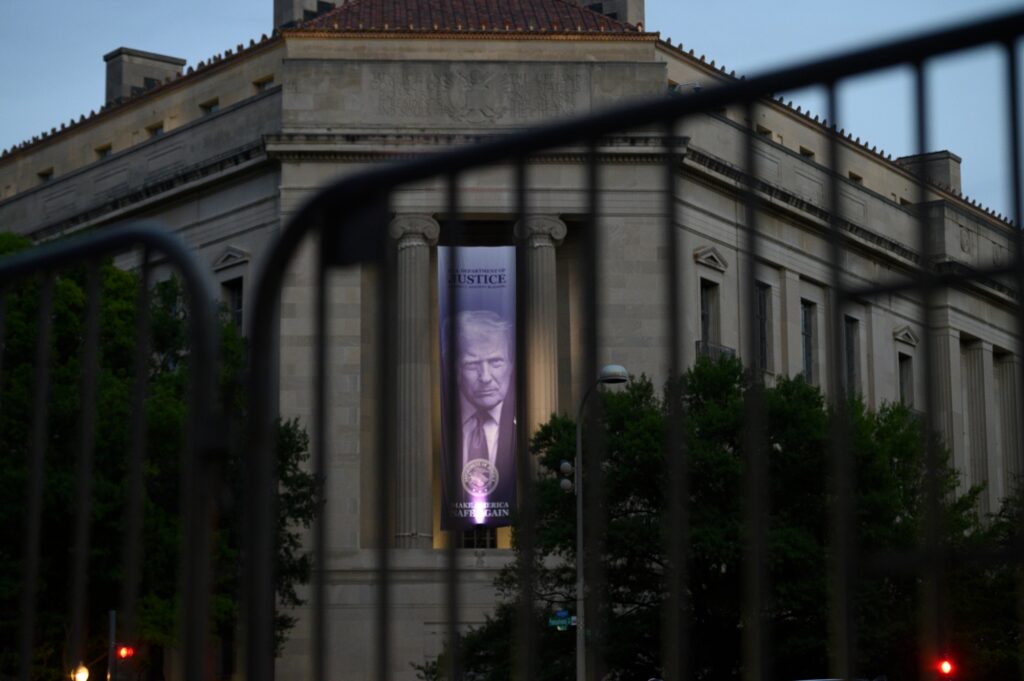
Since last September, President Donald Trump’s Department of Justice (DOJ) has sued 30 states and Washington, D.C. as part of its nationwide crusade to obtain state voter rolls. It has said the lawsuits are needed when a state won’t willingly hand over rolls, so that DOJ can assess compliance with federal voting law.
But records reviewed by Democracy Docket reveal no consistent standard used by DOJ for deciding which states have met the department’s demands and which should be sued.
Get updates straight to your inbox — for free
Join 350,000 readers who rely on our daily and weekly newsletters for the latest in voting, elections and democracy.
Publicly available voter registration lists appear to have been enough for Kansas and Montana to avoid litigation and even be labeled as cooperating.
The same kind of publicly available list was insufficient in Oregon, Minnesota, Colorado, Pennsylvania, Michigan, Utah, Idaho and other states. In those places, the department demanded unredacted voter lists containing sensitive voter information, and sued after states refused to surrender them.
The pattern undercuts DOJ’s claims, both in court and in public statements, to be engaged in a uniform federal enforcement effort.
It has led the department to make misleading, and sometimes outright false, public statements seemingly aimed at obscuring the double standard. And it casts doubt on DOJ’s frequent assertions to courts, in multiple cases, that it needs the unredacted records to ensure compliance with federal voting law.
On Friday, in a filing in its ongoing lawsuit over Colorado’s rolls, DOJ offered a clear rationale for why it believes publicly available lists aren’t sufficient — at least for some states. It acknowledged that Colorado had last year offered its public list, but it said it “needs the non-public portions of the [voter registration list], such as a voter’s driver’s license number or SSN4 … to ensure that a voter is not, for instance, deceased.”
Both Kansas and Montana did allow the administration to run their voter rolls through the flawed SAVE database run by the U.S. Citizenship and Immigration Services. But that does not seem to explain the difference either: Georgia and Idaho also touted their extensive use of SAVE in responses to DOJ. They were sued anyway.
What’s clear is that while DOJ says its lawsuits are necessary to conduct the same independent review nationwide, its own choices suggest otherwise: For some states, a public list was enough. For others, the same records became the basis for federal lawfare.
DOJ did not respond to Democracy Docket’s request for an explanation of how it decided which states to sue and which not to.
The Kansas contradiction
Kansas offers the clearest example of how the apparent double standard, and DOJ’s apparent efforts to obscure it, have tied the department in knots.
In an Aug. 21, 2025 letter to Assistant Attorney General Harmeet Dhillon, Secretary of State Scott Schwab (R) wrote that Kansas was only “providing publicly available voter data.”
“Only publicly available information was shared with the DOJ,” a spokesperson for the office, Thomas Treacy, confirmed to Democracy Docket this month.
But a website unveiled by DOJ this month to track its voting efforts lists Aug. 21, 2025 as the date it “Inspected Federal Election Records to Ensure Only Eligible Americans Vote With Kansas’ Support.”
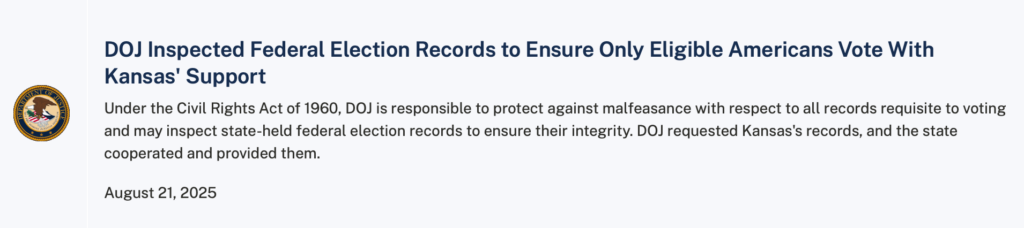
In court, the department has gone even further in claiming Kansas cooperated.
During a December hearing in DOJ’s lawsuit against California, which it has since lost, U.S. District Judge David Carter asked Eric Neff, the acting chief of DOJ’s voting section, which states had shared voters’ motor vehicle or Social Security information.
“What states are those that have shared either their DMV registrations or the social security numbers of voters?” Carter asked.
“Offhand, right now, off of memory I believe the states are Kansas, Indiana — there are four,” Neff responded.
Neff later identified the four states more definitively.
“Wyoming, Kansas, Indiana and Arkansas all complied voluntarily,” he said.
After Carter repeated the list, Neff doubled down: “Have already complied. Voluntarily.”
A DOJ spokesperson later said the department stood by Neff’s statement in court.
The state did sign a separate agreement on Aug. 26, 2025 allowing it to use the SAVE database to verify certain voters’ citizenship information. But that agreement established a process for Kansas officials to submit verification queries to USCIS — not for DOJ or any federal agency to receive the state’s complete, unredacted voter file.
Montana presents a similar mismatch.
In an Aug. 14, 2025 letter, DOJ acknowledged that it had already received Montana’s statewide voter registration list. But the department said that was not enough, demanding a complete version containing full dates of birth, driver’s license or Social Security numbers.
DOJ’s website now claims it inspected Montana’s federal election records “with Montana’s support” on Aug. 14 — the same day the department wrote that Montana’s existing production was incomplete.
“DOJ requested Montana’s records and the state cooperated and provided them,” the site claims.

Months later, Montana Secretary of State Christi Jacobsen (R) confirmed that the state had provided only its public list. In a Dec. 29 letter, Jacobsen said Montana had given DOJ “the public statewide voter registration list” in response to its initial request and enclosed another copy.
The letter also said Montana could not sign a proposed memorandum of understanding and would instead monitor voter roll litigation in other states for guidance about DOJ’s authority.
Montana did partner with USCIS the same year to use federal citizenship information for voter list maintenance.
DOJ did not sue Montana.
The treatment of Kansas and Montana contrasts sharply with that of other states that offered their public records — on the same day Kansas did — and were sued.
Oregon said on Aug. 21 that it would “securely produce the publicly available portions of its statewide voter-registration list” if the department followed Oregon’s standard process, complied with federal privacy requirements and paid the required fee, which is $500. DOJ sued less than a month later, alleging that withholding the full list prevented it from evaluating Oregon’s compliance with voting law.
Pennsylvania even offered its Full Voter Export, an extensive public dataset containing voters’ names, dates of birth, addresses, registration status, party affiliation, polling locations and voting histories. It withheld driver’s license and Social Security information. DOJ sued Pennsylvania anyway.
Minnesota also responded the same day and explained that public voter information was available under state law. But it refused to hand over protected identifiers without a valid legal justification and adequate privacy assurances. DOJ later sued Minnesota.
DOJ has repeatedly told courts that the protected identification information is essential for its project. In addition to last week’s statement in the Colorado case, it has strenuously made that argument in Michigan.
There, the department acknowledged in its original complaint that Secretary of State Jocelyn Benson (D) provided “the public version” of the voter file but wrote that it was “without crucial identifying information.” DOJ argued that full dates of birth, driver’s license numbers and partial Social Security numbers were necessary to determine Michigan’s compliance with federal law.
DOJ repeated the public vs. unredacted distinction recently while seeking full-court review of its appellate loss in Michigan.
DOJ has not explained how it completed successful inspections in Kansas and Montana when both states to date say they supplied only public lists.
No rhyme or reason
Meanwhile, the case of Idaho shows that SAVE participation alone is not enough to exempt a state from a lawsuit.
Secretary of State Phil McGrane (R) told DOJ that Idaho had developed an enhanced partnership with USCIS and helped improve the SAVE system. Idaho’s use of SAVE had allowed it to identify potential noncitizens, remove them from the rolls and refer cases to the U.S. attorney’s office, McGrane wrote.
Idaho also uploaded its publicly available voter file to DOJ’s secure system and invited further discussions.
Still, DOJ sued Idaho for its unredacted voter list.
Georgia, also, has said it has used SAVE but was sued nonetheless.
Differing treatment also cannot be explained simply by partisan politics. Kansas, Montana, Idaho, Georgia, and Utah are all Republican-led. DOJ treated the first two as cooperative but sued the latter three.
Utah offered its public voter data in July 2025. DOJ responded that the production was “insufficient” and renewed its demand for the complete file, including sensitive identifiers. The department later sued.
It’s worth noting that Utah’s chief election official, Lt. Gov. Deidre Henderson (R), has been relatively outspoken in her opposition to the Trump administration’s effort to exert control over voting.
In a recent social media post responding to a letter from DOJ about the voter rolls, Henderson wrote that she and other election officials were “being targeted for following state and federal laws by resisting DOJ’s demands for private voter data that have thus far been ruled illegal by at least a dozen courts.”
By contrast, when Montana denied DOJ’s request for its unredacted rolls, it took care to strike a notably conciliatory tone. Jacobsen, the secretary of state, thanked Dhillon and Trump for their “commitment to protecting the security and integrity of our elections,” and wrote that partnering with the Trump administration had been a priority.
Kansas, too, praised Trump’s executive order and described productive conversations with federal officials.
“I am grateful to President Trump for elevating information sharing for voter roll maintenance to a national priority, and for the President’s Executive Order,” Schwab wrote to DOJ. “This directive is a key step toward strengthening voter roll maintenance nationwide.”
But the record does not reveal one hard rule separating the states DOJ praised from those it sued. Public data were enough in some places and inadequate in others. SAVE participation may have helped some states, but did not protect Idaho. Republican officials were found on both sides. Even refusing DOJ’s proposed agreement did not trigger a Montana lawsuit.
The inconsistency is especially significant as DOJ appeals a mounting series of defeats. The department has lost all 17 voter roll cases decided by district courts and its first appeal. No judge has ordered a state to provide an unredacted statewide voter list.
Maya Bodinson contributed research