How Democrats are fighting back after Callais
 Prefer us on Google
to see more of our voting rights news coverage when you search.
Democrats are vowing to fight back after the Supreme Court’s six Republican-appointed justices gutted the Voting Rights Act (VRA), a landmark civil rights law that restricted racial gerrymandering and banned discrimination in voting.
With Republicans in Southern states already pursuing redistricting efforts in the aftermath of the 6-3 decision in Louisiana v. Callais, Democrats across the country have said they will respond with their own redistricting efforts and, eventually, new pro-voting laws.
Get updates straight to your inbox — for free
Join 350,000 readers who rely on our daily and weekly newsletters for the latest in voting, elections and democracy.
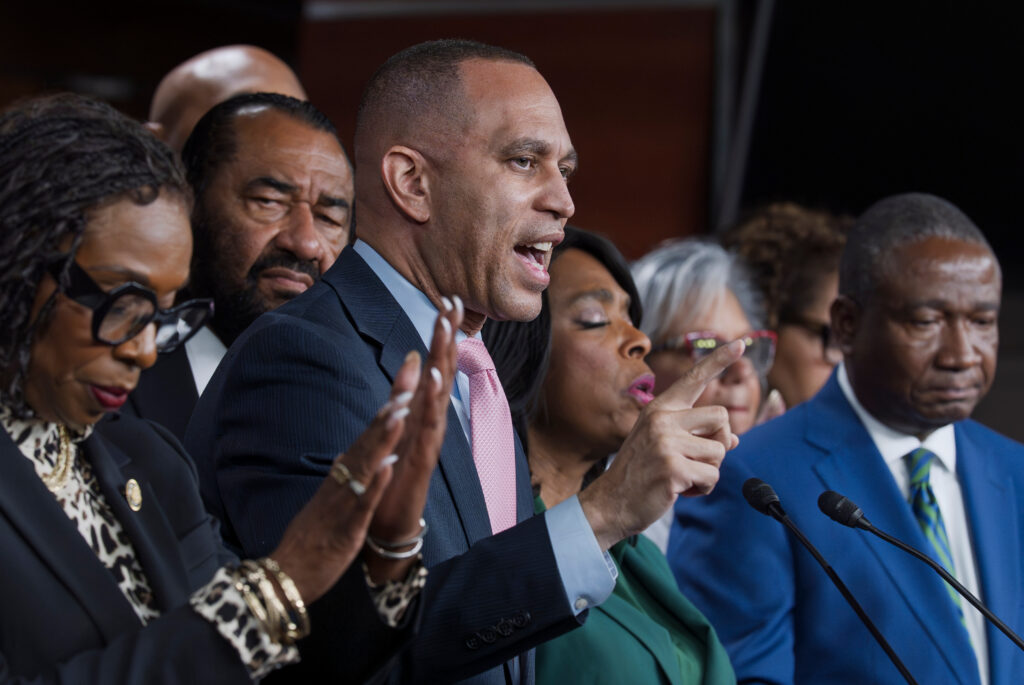
“Today’s decision by this illegitimate Supreme Court majority strikes a blow against the Voting Rights Act and is designed to undermine the ability of communities of color all over this country to elect their candidate of choice,” House Minority Leader Hakeem Jeffries (D-N.Y.), said in a press conference with the Congressional Black Caucus Wednesday.
“But we are not here to step back. We are here to fight back,” Jeffries added.
In an interview with Politico Thursday, Jeffries said states including New York, Illinois, Maryland and Colorado may pursue new congressional maps ahead of the 2028 elections.
“All options are on the table as we get through the 2026 election and look to the future,” he said.
After the court’s decision, Rep. Alexandria Ocasio-Cortez (D-N.Y.) called on her party to continue redrawing maps to favor Democrats to offset the Republican Party’s aggressive mid-decade gerrymanders.
“If they are going to redraw and gerrymander every one of their states, then unfortunately, we have to provide balance to that until we get to the day when we can all finally agree to put this behind us and pass nonpartisan gerrymandering federally,” Ocasio-Cortez said.
Unlike most Republican-led states, however, several Democratic states, including Ocasio-Cortez’s, have independent commissions that draw political maps to make the redistricting process more transparent and impartial.
Currently, an independent commission draws New York’s congressional and state legislative lines, though the state legislature can modify the maps with a supermajority vote.
New York Gov. Kathy Hochul (D) said in a social media post Wednesday that she would begin working with the legislature to change the state’s redistricting laws “so we can fight back against Washington’s attempts to rig our democracy.”
“The Supreme Court has been chipping away at our elections for years. It is clearly carrying out Donald Trump’s will with this decision,” Hochul said. “New York has always led the fight for voting rights and we’ll lead again.”
Lawmakers have proposed an amendment to the New York constitution that would allow the state legislature to draw maps for mid-decade redistricting, though voters in 2021 rejected a similar proposed change.
In response to the GOP’s aggressive political gerrymander in Texas last year, Hochul said she was open to disbanding the state’s independent redistricting commission, saying she was “tired of fighting this fight with my hand tied behind my back.”
Democrats in Colorado, which also has an independent redistricting commission, have supported temporarily returning map-drawing powers to the state legislature in response to the GOP gerrymandering that’s likely to follow the court’s decision.
“The Supreme Court today assaulted the Voting Rights Act,” Colorado Attorney General Phil Weiser (D), who is running for governor, said Wednesday.
Last October, Weiser supported a ballot initiative to approve maps drawn by the legislature for the 2028 and 2030 elections.
In a press conference, Illinois Gov. JB Pritzker (D) said he was also discussing ways to respond with legislative leaders, though he didn’t offer specifics.
“It is an attack on a crown jewel of our democracy,” Pritzker said, noting that Illinois voters have elected more Black members of Congress than in any other state. “We’re not going to stand for it in Illinois. We’re going to push back. We have options for pushing back.”
Currently, the Illinois Legislature is considering a proposed state constitutional amendment that, if passed by voters, would require race to be explicitly considered when congressional boundaries are drawn to ensure that people aren’t denied the ability to participate in politics because of their race.
State lawmakers specifically initiated the proposed amendment in anticipation of the Supreme Court gutting the VRA. The Illinois House passed the proposal last week. However, after Wednesday’s Supreme Court decision, the state Senate paused its consideration of it.
“We will dissect this decision, find a path forward and continue to protect the rights of all Illinoisans. I would ask for patience and time for our state’s top legal experts to work through this,” Illinois Senate President Don Harmon told Capitol News Illinois. “The worst thing that would happen is if we rushed and there were unintended consequences that undermine people’s voting rights.”
It’s currently unclear how the Supreme Court’s decision in Callais may affect state laws that are based on the VRA, such as the proposed amendment under consideration in Illinois or the California Voting Rights Act (CVRA).
Since its passage in 2001, the CVRA, which was the country’s first state-based VRA, has led to a dramatic increase in minority representation in local government. However, the Supreme Court may have opened the door to new lawsuits challenging districts created under the CVRA.
Though the court did not explicitly address state VRAs, Justice Samuel Alito, who penned the majority’s opinion, wrote that the “Constitution almost never permits the Federal Government or a State to discriminate on the basis of race.”
In his press conference, Pritzker said that he spoke with legal experts about the decision, who told him Illinois’s current maps are constitutional, even under the new ruling.
“So I’m sure there will be people who will try to attack it, but the reality is that if you read through the Supreme Court decision, I’m told that it validates the maps that are already in place,” Pritzker said.
The governor noted that Illinois’s next redistricting is currently scheduled for 2031.
In the hours after the court’s Callais ruling, Democrats also renewed their calls for the passage of the John Lewis Voting Rights Advancement Act (VRAA), though doing so would be no easy task.
Named after Rep. John Lewis (D), a towering figure in the Civil Rights Movement, the act aims to modernize and revitalize the VRA. Among its proposals, the act would protect voters from race-based discrimination by setting minimum standards to enable all voters to experience free and fair elections.
“We cannot stand by as Trump’s extreme SCOTUS eviscerates protections against voter suppression that heroes like Dr. King and John Lewis marched for,” Sen. Tammy Duckworth (D-Ill.) said in a social media post. “We need to pass the John Lewis Voting Rights Act. Now.”
After passing the House in 2021, it stalled in the Senate later that year because of the 60-vote threshold required by the chamber’s filibuster.
Unless Democrats win a supermajority in the Senate through future elections, they would likely have to reform the filibuster to pass the VRAA, which would only require a simple majority of 51 votes.
However, reforming or repealing the filibuster would likely give Republicans the ability to repeal the VRAA and pass restrictive voting legislation through a simple majority the next time they hold the Senate.
Notably, the SAVE America Act, the GOP’s Trump-backed voter-suppression behemoth, failed in the Senate this year only because of the filibuster.
In light of Callais, legal experts warned that passing new voting laws would likely be futile if the Supreme Court’s conservative-appointed majority strikes them down in a similar manner to how it gutted the VRA.
Jonathan Ladd, a political scientist at Georgetown University, noted in a social media post that there are several alternative approaches to ensuring districts are representative of the voters within them.
“But none will work without Supreme Court reform,” he wrote. “No law could be more clearly authorized by constitutional text than the Voting Rights Act, which is explicitly authorized by Section 2 of the Fifteenth Amendment. But it doesn’t matter to this Court.”