Heeding Trump, Tennessee GOP repeals state law to pass new map carving up majority-black district
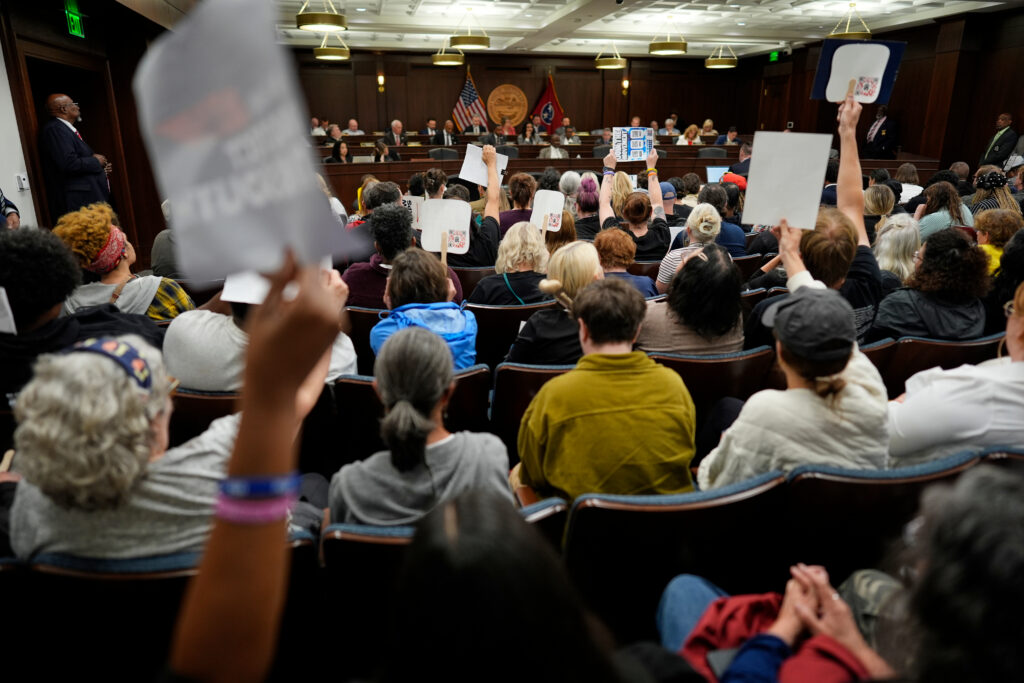
Tennessee Republicans rammed through their gerrymander Thursday, eliminating the state’s only majority-Black district. The new map, which is the first of any state’s to be approved as a direct result of the Supreme Court’s ruling gutting the Voting Rights Act (VRA), now heads to the governor’s desk.
To pass the new map, Tennessee Republicans first repealed a state law that had barred lawmakers from redistricting between censuses for around five decades. They also changed legislative rules to limit public comment and expedite the passage of the repeal and the new map.
Get updates straight to your inbox — for free
Join 350,000 readers who rely on our daily and weekly newsletters for the latest in voting, elections and democracy.
As part of his effort to tilt electoral maps in the GOP’s favor before the midterms, President Donald Trump demanded the redistricting effort in Tennessee last week.
The new map splits Memphis, a majority-Black city that made up most of the state’s 9th Congressional District, between three districts. It also further fractures Nashville, another Democratic stronghold in the state.
The aggressive gerrymander draws out Rep. Steve Cohen (D), Tennessee’s lone Democratic congressman, and will likely secure an all-GOP federal delegation for the Republicans for the first time in state history.
Tennessee Democrats and Black civil rights advocates across the state have denounced the GOP’s gerrymander as an explicit attempt to silence the political voice of Black voters using Jim Crow-era voter suppression tactics.
“Black bodies lay in rivers and in fields all across this country because they dared to speak out for representation and the right to vote,” Sen. London Lamar (D) said before the Senate adopted the map. “This is an absolute power grab.”
With Republicans holding a super-majority in both chambers of the Tennessee General Assembly, Democratic lawmakers could do little to oppose the gerrymander beyond speaking out during debate and proposing dozens of amendments to slow proceedings.
While the House was debating an amendment to the repeal, state Rep. Justin Jones, a Democrat who represents Nashville, handed Republican Majority Leader William Lamberth a Confederate flag printed on a piece of paper.
“Thank you, Mr. Speaker. I just handed Representative Lamberth the Confederate flag saying ‘We will not go back,’ because you are trying to bring us back to the Confederacy,” Jones said.
After the House adopted the map, the chamber erupted with chants of “shame” from protesters.
Republicans defended the map by claiming that only population and politics were considered when the new map was created, not race. They also framed the map as defending Trump’s agenda by boosting the GOP’s chances to hold onto its slim majority in the House.
“Tennessee is a conservative state, and I submit its congressional delegation should reflect that,” State Sen. John Stevens (R) said before the Senate adopted the map. “By passing this map, Tennessee is doing its part to advance common-sense leadership in Washington.”
State Republicans passed the map even though congressional races in the state were underway. Several candidates had already announced their candidacy, qualified for the ballot and started receiving political donations for their campaigns.
Those candidates will now likely have to scramble to run in a new congressional district or end their campaigns, while new candidates will have only one week to qualify to run in a district.
The abrupt map change will likely lead to significant voter confusion. State election rules usually require voters to be notified by mail when their districts or polling places change, but the repeal adopted by Republicans included a provision suspending that requirement.
The Supreme Court’s recent decision on the VRA has ignited several GOP redistricting efforts across the South aimed at eliminating electoral districts drawn to protect the voting power of racial minorities.