Supreme Court Upholds Block to Trump’s Chicago Military Takeover
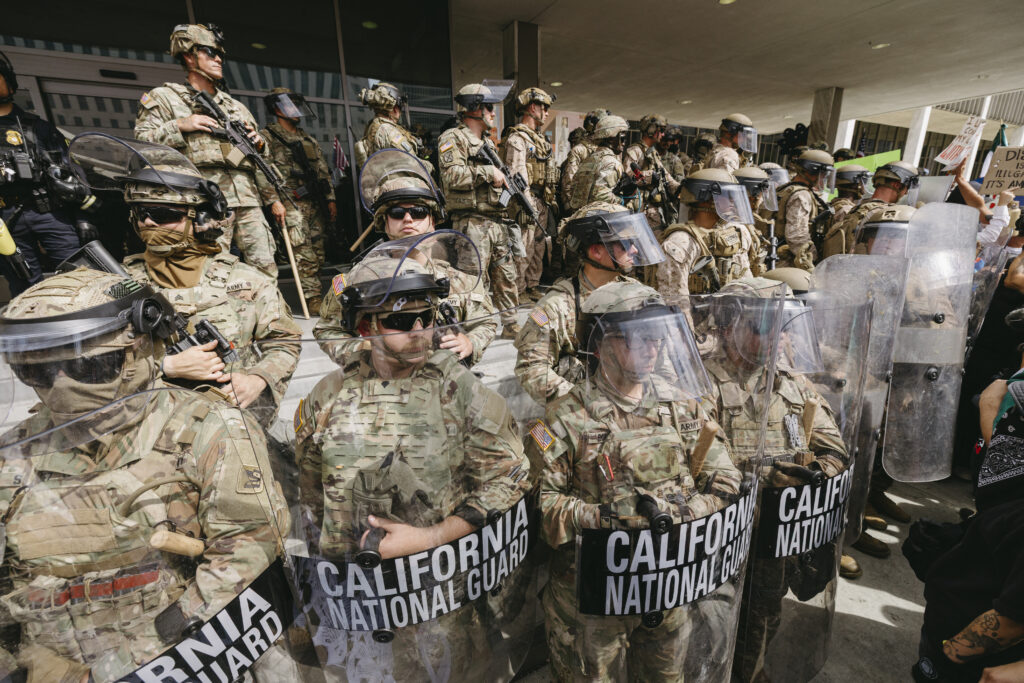
President Donald Trump’s military takeover of Chicago will not go forward after the Supreme Court Tuesday upheld a lower court ruling halting his attempt to send hundreds of National Guard troops to the city.
The court’s long-awaited 6-3 decision deals a significant blow to Trump’s authoritarian goal of exerting military control over cities and integrating soldiers into routine policing. The ruling will likely also undermine his military intervention in Los Angeles and his attempted deployment in Portland, Oregon.
In maintaining the lower court’s decision, the Supreme Court said Trump unlawfully used an archaic statute to federalize hundreds of Illinois Guard troops, who are normally under Gov. JB Pritzker’s (D) control.
Get updates straight to your inbox — for free
Join 350,000 readers who rely on our daily and weekly newsletters for the latest in voting, elections and democracy.
After threatening to send troops into Chicago for months, Trump in early October federalized Illinois and Texas Guard troops and deployed them into the city over the repeated objections of Pritzker and other local and state officials. California Guard troops federalized for his earlier intervention in Los Angeles were also sent to Chicago.
Trump claimed soldiers were needed to protect federal agents conducting aggressive immigration enforcement operations in the city. However, he also regularly associated sending troops with curbing crime in the city, even though federal law generally bars the use of federal military personnel to enforce domestic laws.
Trump federalized the troops under 10 U.S.C. 12406 (Title 10), an archaic and rarely used statute that allows the president to take control of state Guard troops when the country faces foreign invasion, when the U.S. government faces rebellion or when the president is unable to execute laws with “regular forces.”
The Supreme Court Tuesday determined that because the term “regular forces” in Title 10 likely refers to the traditional forces of the U.S. military — such as the Army, Navy and Air Force — Trump did not have authority to federalize Illinois Guard members.
“This interpretation means that to call the Guard into active federal service under §12406(3), the President must be ‘unable’ with the regular military ‘to execute the laws of the United States,’” the unsigned majority opinion reads.
The majority further stated that because the Posse Comitatus Act generally prohibits using the military in civilian law enforcement purposes under normal circumstances, Trump likely would be unable to use the traditional military in Chicago.
The majority further stated that because the Posse Comitatus Act generally prohibits using the military in civilian law enforcement purposes under normal circumstances, Trump likely would be unable to use the traditional military in Chicago.
“At this preliminary stage, the Government has failed to identify a source of authority that would allow the military to execute the laws in Illinois,” the majority said. “The President has not invoked a statute that provides an exception to the Posse Comitatus Act.”
Conservative Justices Samuel Alito, Clarence Thomas and Niel Gorsuch dissented.
Pritzker on social media hailed the court’s ruling as a “big win for Illinois and American democracy.”
“This is an important step in curbing the Trump Administration’s consistent abuse of power and slowing Trump’s march toward authoritarianism,” Pritzker said. “While we welcome this ruling, we also are clear-eyed that the Trump Administration’s pursuit for unchecked power is continuing across the country.”
Almost immediately after Trump announced the Chicago deployment, Illinois sued, alleging the deployment infringed on its right to self-governance. The lawsuit reached the Supreme Court after Trump filed an emergency appeal of the district court’s decision to block the deployment.
Instead of immediately granting or denying Trump’s stay request, the Supreme Court, in an unexpected move, asked Illinois and the Department of Justice (DOJ) to file briefs on the definition of “regular forces.”
In its brief, the DOJ struggled to directly answer the Supreme Court’s question and instead asserted that Trump had broad powers to federalize state Guard troops and courts have no authority to question the president’s ability to deploy them domestically.
The Supreme Court did not address the DOJ’s arguments on courts’ inability to review deployments, perhaps allowing its ruling to speak for itself.
The court’s decision will likely upset several of Trump’s domestic military deployments so far because, with the exception of Los Angeles, Trump hadn’t sent regular military forces to any city in which he’s attempted to deploy National Guard troops. When he deployed thousands of federalized California Guard troops to Los Angeles over the summer, he simultaneously sent hundreds of Marines.
However, the ruling likely will not affect his military interventions in Washington, D.C., and Memphis, Tennessee, which were carried out under different laws.
This story has been updated with additional details throughout.