This Thanksgiving, Trump Has Little to Be Thankful For
 Prefer us on Google
to see more of our voting rights news coverage when you search.
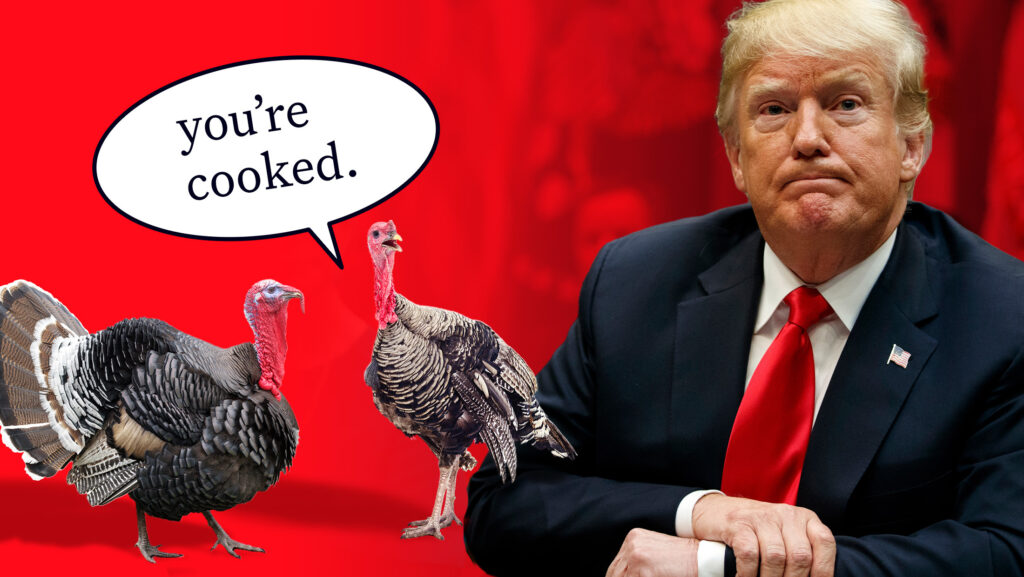
As Donald Trump sat down for Thanksgiving dinner at Mar-a-Lago, he had few reasons to give thanks.
After less than a year spent destroying the federal government, sending troops into Democratic-led cities, violating the rights of immigrants and trying to rig the 2026 elections, momentum is no longer on his side.
The Supreme Court appears poised to axe Trump’s flagship tariffs. His domestic troop deployments and political prosecutions are on shaky legal footing. His plan to gerrymander his way to a GOP victory in the midterms may be backfiring. And his efforts to suppress the Epstein files failed when his usually compliant Republican Party pushed back.
Get updates straight to your inbox — for free
Join 350,000 readers who rely on our daily and weekly newsletters for the latest in voting, elections and democracy.
Even Trump’s relationship with the public is fraying. After much talk about the cost of groceries — an “old-fashioned,” “beautiful” word that the president once defined as “a bag with different things in it” — Americans have grown tired of waiting for prices to drop. Instead, it’s Trump’s polling numbers that are falling.
This year, the only ones in the administration having a good Thanksgiving may be Waddle and Gobble, the two turkeys Trump pardoned earlier this week.
The harder they come…
Trump burst into 2025 full throttle. After taking the oath of office in January, he effectively declared war on the federal government, firing civil servants and upending foreign aid as we know it.
The president sought to rapidly change the country and its government largely through decree. In his first 100 days, he signed 142 executive orders or memorandums — more than any other president in U.S. history.
His aim was to reinterpret the Constitution, vastly expand the executive branch’s power over federal elections and cleave full departments from the federal government without congressional approval.
Under the sway of Stephen Miller and other immigration hardliners, the new administration moved quickly to conduct “mass deportations.”
Across the country, masked Immigration and Customs Enforcement (ICE) agents have detained tens of thousands of people. Despite promises to arrest violent criminals and drug cartels, Trump’s immigration crackdowns have primarily targeted ordinary undocumented immigrants and asylum seekers.
The administration has also run roughshod over due process. In March, the U.S. agreed to pay El Salvador $6 million to imprison hundreds of people — without trial — in its notorious Terrorism Confinement Center. Its illegal removal of Kilmar Abrego Garcia, a Salvadoran asylum seeker, became a prominent early example of the Trump administration’s egregious human rights violations.
In June, Trump began to federalize National Guard troops for deployment in major Democratic-led cities, an attempt to integrate the military into routine policing.
That same month, the president moved to secure Republican control over the country for years to come: He urged Republican-controlled states to redraw their congressional districts and engineer a GOP advantage in the 2026 midterm elections. Several states — Texas, North Carolina, Missouri — scrambled to answer the president’s call.
Taking another page out of the authoritarian playbook, Trump also went after his political opponents.
In September, he ousted the U.S. attorney for the Eastern District of Virginia and appointed his ally Lindsey Halligan to the role. She quickly pressed charges against former FBI director James Comey and New York Attorney General Letitia James, two of the president’s longtime perceived enemies.
…the harder they fall
At the worst moments this year, Trump appeared poised to rewrite American governance and engineer a long-term electoral advantage for his party. But over the past several months, his attack on American democracy has encountered a string of setbacks and outright defeats.
The administration is currently tied up in hundreds of court cases over its most extreme actions. Its aggressive immigration raids have provoked intense pushback in cities like Chicago, Illinois and Portland, Oregon.
Some states — Kansas, New Hampshire, and, initially, Indiana — balked at his calls to gerrymander.
Perhaps most importantly, courts have started to hand down rulings blocking and delaying some of Trump’s most egregious actions and executive orders. Those decisions have been particularly important for slowing Trump’s unprecedented drive for nationwide mid-decade partisan redistricting.
Earlier this month, in a case that predated Trump’s redistricting war, a judge in Utah ruled that a gerrymandered congressional map passed by the Republican-controlled legislature violated a voter-approved constitutional amendment forbidding partisan gerrymanders. She ordered the state to adopt a more fair one. Under this new map, Utah Democrats will have a good shot at winning one of the state’s four congressional seats.
A week later, a panel of three federal judges blocked* Texas from using a new gerrymandered map in the 2026 election. In a scathing opinion, Judge Jeffrey Brown — a Trump appointee, no less — wrote that the map likely represented an illegal racial gerrymander.
That ruling was particularly monumental because the Lone Star State’s decision to redistrict and give Republicans five more safe Congressional seats had set off a gerrymandering arms race across the country.
In direct response to the Texas gerrymander, California legislators decided that they too needed to redraw their map to cancel out Texas’ five new GOP seats. Under state law, they were required to get the voters’ approval. During the Nov. 4 elections — which saw Democrats sweep the polls, winning gubernatorial races in Virginia and New Jersey — California voters overwhelmingly approved their plan. And Virginia is also moving to redraw its congressional map.
After Texas’ loss in court, it appears Trump’s redistricting efforts could be backfiring.
Trump is also losing his battles to send in the military for policing. The Supreme Court is currently considering a technical question about the precise language of the archaic statute Trump used to federalize thousands of National Guard troops for domestic deployments. That suggests justices may issue a ruling that will undermine most of these deployments.
Even those launched under other laws appear to be at risk. On Nov. 18, a Tennessee state judge found that a group of local officials challenging Gov. Bill Lee’s (R) decision to deploy Guard troops to Memphis at Trump’s urging would likely succeed in arguing it violated state law.
Two days later, a federal court rejected Trump’s assertion that he had the right to independently mobilize the D.C. National Guard for routine police work. Instead, the judge found that the deployment of more than 2,000 Guard troops to Washington was unlawful and violated the District’s right to govern itself.
His political prosecutions are also failing. On Monday, a federal judge dismissed without prejudice the DOJ’s cases against Comey and James after finding that Trump and Attorney General Pam Bondi circumvented vacancy laws in appointing Halligan.
The judge ruled that Halligan was serving unlawfully when she sought indictments against Comey and James — making her the fourth Trump-appointed acting U.S. attorney determined to be illegitimate.
Because the statute of limitations on the charges against Comey had expired, the DOJ is unlikely to be able to resurrect its case against him.
That ruling was not just a loss for Trump, but also an embarrassment. Just days earlier, the DOJ admitted that Halligan — an insurance lawyer who had never before prosecuted a case — never actually presented the final indictment used to charge Comey to the grand jury, a revelation that likely made the charges void.
It’s not over yet
Of course, we’re not anywhere near the finish line yet. The midterms are still a year away, and Trump has three more years in office.
There’s still a lot that he and his allies can do to gerrymander up a congressional majority in 2026 and exact retribution on his foes. And that process is already underway.
After the Republican-controlled Missouri legislature redrew its congressional maps at Trump’s behest, voting rights activists started gathering signatures to organize a state-wide referendum on the gerrymander and let voters decide.
Republicans — including the national Republican National Committee — are fighting tooth and nail to prevent the Missouri voters from having their say. They’re trying to disqualify thousands of signatures, sending out threatening mass text messages, and challenging voters’ very right to override the state legislature. Missouri voters* are also fighting back in court — they’ve filed multiple lawsuits arguing mid-decade redistricting violates the state constitution.
After the federal judges rejected Texas’ illegal racial gerrymander, the state appealed. The Supreme Court may soon overturn the lower court’s decision and let Texas use the new map in 2026 — and potentially earn the GOP five more congressional seats. Republicans are also seeking to block California’s new map.
And while Trump’s political prosecutions may be faltering, the administration appears to have a lot more in the works. John Bolton, Trump’s former national security advisor turned frequent critic, is under indictment.
The administration is slinging allegations of mortgage fraud at numerous prominent Democrats and Trump foes. There are signs that the U.S. attorney for the Southern District of Florida may be preparing to open a special grand jury criminal investigation against officials who have attempted to hold Trump accountable over the past decade.
And the DOJ is targeting other Democratic lawmakers and critics, including six members of Congress who recently reminded soldiers that they are obligated to refuse illegal orders.
But, for the moment, the administration’s court losses are piling up. Some of its designs on American democracy are hitting a multitude of obstacles — chief among them public opinion.
Despite his claims of record-high approval ratings, Trump’s actions over the past 10 months have angered a majority of the American public. Aggregate polling numbers indicate that, since turning negative in March, Trump’s numbers continue to nosedive.
Large-scale protests across the country only emphasize his unpopularity. In fact, the nationwide No Kings demonstrations on Oct. 19 were likely the country’s largest single-day protest ever.
The battle isn’t over. But, this Thanksgiving, the only thing Trump may be gobble-gobbling is a heaping plate of defeats.
*The Elias Law Group (ELG) represents some plaintiffs in the Texas and Missouri redistricting cases. ELG Firm Chair Marc Elias is the founder of Democracy Docket.