Fate of GOP’s attack on mail voting in the balance after Supreme Court argument
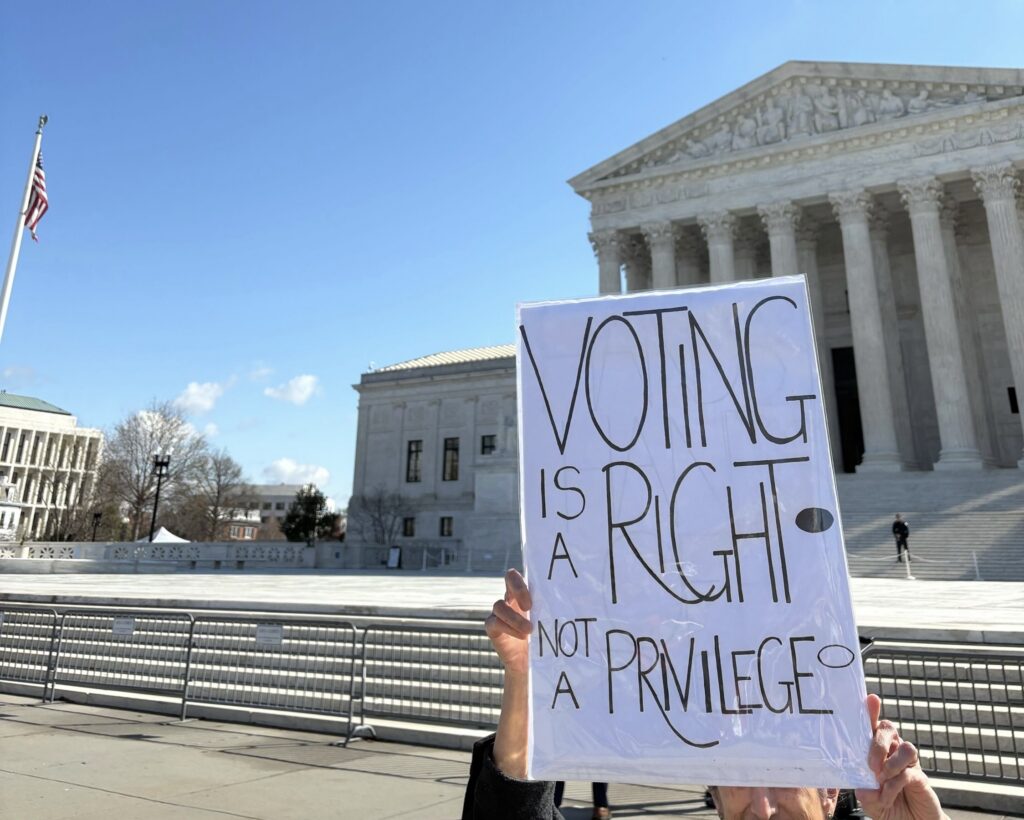
Following oral arguments in Watson v. Republican National Committee (RNC) Monday, the fate of mail-in ballot grace periods remains unclear as the U.S.Supreme Court justices split on the case’s central question: When is a vote actually made — when a voter casts a ballot or when election officials receive it?
Republicans want the court to ban states from accepting mail ballots that arrive after election day, something that 14 states allow.* Doing so could make it much harder for voters to use mail voting.
The Court’s three liberals seemed ready to uphold Mississippi’s law allowing postal votes sent by Election Day to count if they arrive up to five days later. Meanwhile, three conservatives — Justices Neil Gorsuch, Samuel Alito and Clarence Thomas — sounded eager to scrap them. But the remaining three didn’t tip their hands as much.
Justices Amy Coney Barrett and Brett Kavanaugh poked holes in some of the lawyerly logic they heard without revealing their sympathies, while Chief Justice John Roberts said nothing about the arguments themselves.
Get updates straight to your inbox — for free
Join 350,000 readers who rely on our daily and weekly newsletters for the latest in voting, elections and democracy.
“It is clear from today’s oral argument that the Court will be closely divided on this question, and the case could come out either way,” said Rick Hasen, an election expert and law professor at University of California Los Angeles. “Justices Alito and Gorsuch, and to a lesser extent Justice Thomas, pushed Mississippi’s [Solicitor General] with a variety of extreme hypotheticals not consistent with that state or any state’s law, to raise the specter of fraud with late arriving ballots.”
Along with the Libertarian Party of Mississippi, the RNC challenged Mississippi’s grace period for late-arriving ballots in 2024, arguing that the state law is preempted by the Election Day Statutes — three laws Congress passed between 1845 and 1914 that set “the Tuesday next after the first Monday in November… as the day for the election” for federal elections.
The Supreme Court took up the case after the 5th Circuit Court of Appeals reversed a lower decision dismissing the challenge and ruled that the wording of the federal statutes, as understood at the time, meant that ballots must be received by officials by Election Day, and thus grace periods for late arriving ballots are invalid.
If the justices agree with the 5th Circuit, grace period laws for mail ballots in 13 other states (including Washington, D.C.) would be invalidated. That would put tens of millions of voters who rely on mail voting at risk of disenfranchisement. Nearly one in three Americans — about 31%, or roughly 48 million voters — cast their ballots by mail in the 2024 general election. Even with grace periods in place, more than 100,000 ballots were rejected for arriving too late that year.
Another 17 states have grace periods specifically for overseas and military voters, and whether those laws would necessarily also need to be struck down was an issue the Court grappled with Monday.
Mississippi Solicitor General Scott Stewart argued that Congress specified in the 1986 Uniformed And Overseas Citizens Absentee Voting Act (UOCAVA) that ballots mailed from Americans abroad should count so long as they arrive by the state’s deadline for receipt — a date explicitly distinct from Election Day. Since that law, many states adopted specific UOCAVA ballot deadlines and Congress hasn’t acted to make clear that those laws violate its intent.
“UOCAVA is maybe the best example where Congress was told that about a dozen or so states have post-election day ballot receipt laws,” Stewart argued.
Stewart faced off against former U.S. Solicitor General Paul Clement, who represented the RNC, and the current U.S. Solicitor General, D. John Sauer, who joined in challenging Mississippi’s law.
Clement commanded the justices’ attention for nearly an hour, arguing that UOCAVA was an explicit exemption to the rule that ballots must be received by Election Day. He also tried to differentiate between grace periods for late-arriving ballots and early, in-person voting.
“Under our theory, early voting is permissible, largely because it has a different history, and because of this idea that the Election Day is the date where the election is consummated,” Clement said.
Justice Elena Kagan did not buy that argument. “Every time you try to state what your rule is, it seems to me it’s a rule that prevents early voting,” Kagan said. “You’re basically saying there are two things that have to happen, and they have to happen on Election Day, and it’s the casting of the vote and the receipt of the vote.”
Sauer, arguing for the DOJ, also contended that early voting was distinguishable from grace periods. “We agree with both sides that early voting is still acceptable,” he said.
Some other DOJ officials have questioned the practice, which Republicans have criticized. “Election day means Election DAY,” Assistant Attorney General for Civil Rights Harmeet Dhillon posted on social media in reference to Watson. Dhillon was a signatory on the DOJ’s amicus brief.
Despite Kagan’s skepticism, if the Court does decide to strike down late-arriving mail-in ballots, Sauer and Clement’s concessions here might make it harder to sustain a later legal challenge against early voting.
Justice Ketanji Brown Jackson seemed to be appealing to her conservative colleagues on the bench with an argument for judicial humility and federalism, noting repeatedly that Congress has had ample opportunity to explicitly preempt state laws like Mississippi’s, but hasn’t.
“They are obviously aware that there are states that are doing this, and they have not spoken to it. They have not specifically precluded it,” Jackson said.
Jackson added that, at President Donald Trump’s urging, the House is considering a bill — the Make Elections Great Again (MEGA) Act — that would ban mail-in ballot grace periods.
The arguments grew heated at times, at least by the staid standards of the Supreme Court. “I am a little upset — not a little, a lot upset — by many of the statements in your brief quoting historical sources out of context,” Justice Sotomayor scolded Sauer at one point.
Since Trump resumed office, the DOJ has been accused of making false or misleading statements in court multiple times.
*Vet Voice Foundation are respondents supporting petitioner in this litigation and are represented by the Elias Law Group (ELG). ELG Chair Marc Elias is the founder of Democracy Docket.