Callais ruling may also demolish states’ voting rights laws
 Prefer us on Google
to see more of our voting rights news coverage when you search.
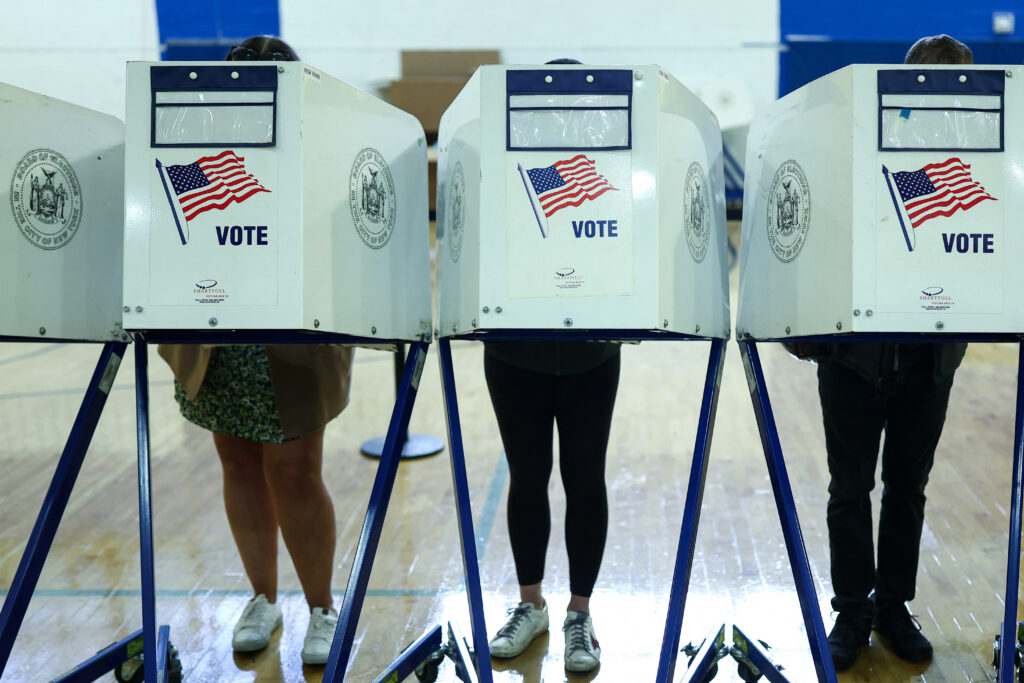
In the wake of the U.S. Supreme Court gutting the Voting Rights Act (VRA) this week, another set of laws is also in danger: state-level statutes that seek to bar racially discriminatory voting practices.
As the GOP and the high court have chipped away at federal voting rights protections in recent decades, several states have responded by passing their own measures to protect minority voting rights.
But those laws could be in jeopardy — if not already defunct — under the new legal order the Supreme Court ushered in Wednesday with its 6-3 decision in Louisiana v. Callais.
Get updates straight to your inbox — for free
Join 350,000 readers who rely on our daily and weekly newsletters for the latest in voting, elections and democracy.
In a social media post Thursday, Maryland Gov. Wes Moore (D) lamented the Supreme Court’s “disastrous” gutting of the VRA and vowed to shield the voting power of protected groups in the state. Maryland’s Voting Rights Act of 2026 went into effect just a day before Callais came down.
“Even if Washington won’t protect your vote, I will,” Moore said.
“Who’s gonna tell him?” Jesus Osete, the No. 2 official at the Civil Rights Division of the U.S. Department of Justice, said in response to Moore, implying that the DOJ interpreted the Supreme Court’s decision as also invalidating state VRAs — and that interpretation could be correct.
Currently, nine states — all Democratic-leaning — have their own VRA laws. The laws have broadly increased minority representation and participation in local government, chiefly by targeting the use of at-large election systems to discriminatorily dilute the voting power of minorities in local races.
Until the Supreme Court effectively eviscerated it this week, Section 2 of the federal VRA barred discriminatory practices in redistricting, including local electoral districts. In practice, however, voters faced significant hurdles in using the federal law to challenge discriminatory local election systems.
For that reason, several states over the past two decades pursued laws to make it easier for voters to enforce their right to have an equal opportunity for representation in local government.
Months before Wednesday’s ruling, Rick Hasen, a voting law expert at UCLA Law, warned that an adverse ruling in Callais “might affect the constitutionality of state Voting Rights Acts.”
Though the court’s decision didn’t explicitly address voting protections enshrined in state law, it and other recent rulings by the Supreme Court under Chief Justice John Roberts could bolster challenges to state VRAs that, so far, have been unsuccessful.
One such challenge played out over the past two years in Newburgh, New York.
There, Black and Hispanic voters sued the town’s at-large system for electing members of the town board, saying it diluted the political power of minorities in violation of the New York Voting Rights Act (NYVRA).
Although it was a defendant in the case, the town initially succeeded in not just challenging the lawsuit, but also the NYVRA on the ground that it violated the 14th Amendment’s Equal Protection Clause. A lower court agreed with the town’s claim and both dismissed the suit and struck down the act.
Other state courts later reversed that lower court decision and affirmed the constitutionality of the NYVRA. Earlier this year, the town agreed to settle the case and switch to ranked-choice voting in compliance with the NYVRA.
But in future cases, parties challenging state VRAs will likely cite Callais, which, like Newburgh’s initial argument, ultimately relies on the 14th Amendment.
“The dissent claims that the Fourteenth Amendment is irrelevant to our analysis,” Justice Samuel Alito wrote in a footnote for the court’s majority opinion. “But the dissent appears to forget—or at least tries to lead readers to forget—that the decision before us is based on the Fourteenth Amendment.”
When paired with Callais, other opinions from Alito, such as his concurrence in Malliotakis v. Williams earlier this year, may preview how he and the court’s other conservatives could rule on a future challenge to a state VRA.
They could conclude that the race-conscious voting remedies in those laws violate the 14th Amendment’s Equal Protection Clause and the Supremacy Clause.
But beyond future challenges, Callais is already affecting state laws.
Anticipating that the Supreme Court would further weaken the federal VRA, Illinois lawmakers proposed a state constitutional amendment that, if passed by voters, would require race to be explicitly considered when drawing districts in the state.
Though the proposal passed the Illinois House last week, the state Senate halted its consideration of the proposed amendment due to concerns that it could be found unconstitutional following Callais.
“I would ask for patience and time for our state’s top legal experts to work through this,” Illinois Senate President Don Harmon told Capitol News Illinois this week. “The worst thing that would happen is if we rushed and there were unintended consequences that undermine people’s voting rights.”