Civil rights groups sue to prevent Trump admin from sending federal agents to intimidate voters
 Prefer us on Google
to see more of our voting rights news coverage when you search.
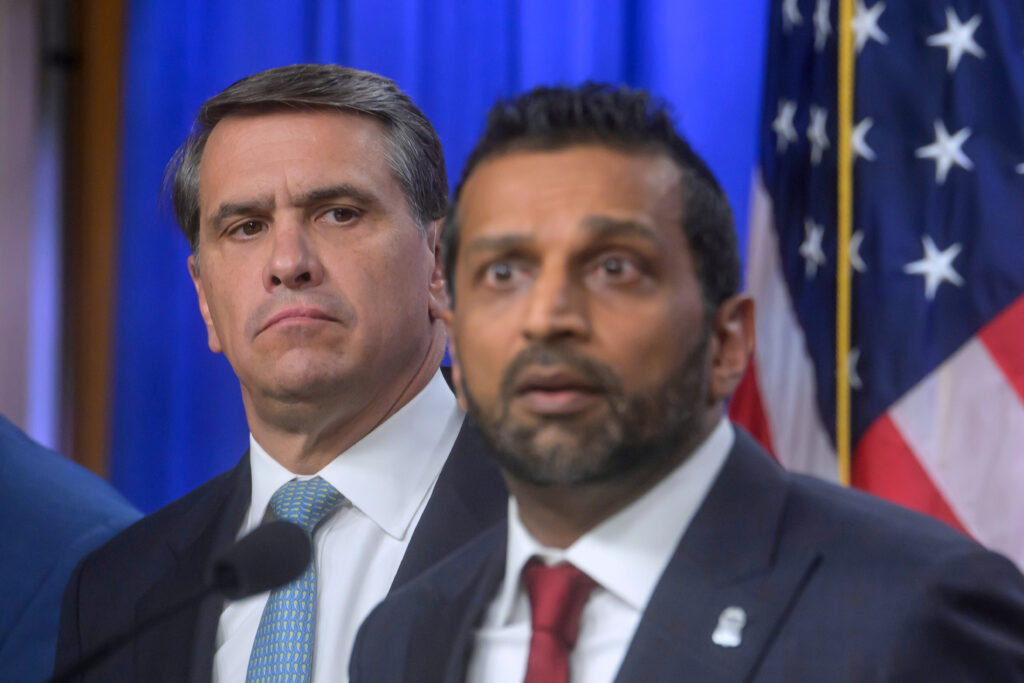
A group of civil rights and labor organizations is asking a federal court to prevent the Trump administration from using federal law enforcement to intimidate voters during the midterm elections.
In a lawsuit filed Friday, the plaintiffs argue that Department of Homeland Security (DHS) Secretary Markwayne Mullin, FBI Director Kash Patel, and Attorney General Todd Blanche have asserted in recent public comments that they have the authority to deploy federal law enforcement near voting sites, a violation of federal law.
The coalition, led by the NAACP and including labor unions, also contends that the administration’s crusade to uncover illegal noncitizen voting — a rare occurrence — and its aggressive immigration enforcement operations, particularly in Minnesota, have created an atmosphere of intimidation around voting.
They are asking for a court order preventing the Trump administration “from deploying agents in a manner that unlawfully intimidates voters or anyone urging or aiding voters.”
Despite the numerous statements made by Mullin, Blanche, Patel, President Donald Trump, and others in the administration, the plaintiffs may struggle to convince the court to grant an injunction now, before any formal orders are issued. Whether a judge agrees that this lawsuit is “ripe” for review or not may depend on whether U.S. District Judge Loren L. Alikhan, a Joe Biden appointee, considers this administration’s willingness to repeatedly skirt, evade, and even outright defy legal restraints and longstanding norms.
“Together, Defendants’ threatening messaging and violent enforcement actions have created a climate in which voters, especially voters of color, are intimidated and fearful of engaging in the democratic process,” the pro-voting groups wrote. “Because of the Administration’s intimidating actions and rhetoric, across the country, Plaintiffs’ members and other voters credibly fear that their participation in this November’s midterm elections will subject them to physical force and increased surveillance by the federal government.”
“Defendants’ conduct has transformed voting and voting-related activities—ordinary acts of civic participation—into sources of anxiety, uncertainty, and fear,” they added. “Defendants’ conduct is chilling Plaintiffs’ participation in the democratic process.”
That, the plaintiffs allege, violates Section 11(b) of the Voting Rights Act (VRA).
Get updates straight to your inbox — for free
Join 350,000 readers who rely on our daily and weekly newsletters for the latest in voting, elections and democracy.
“No person, whether acting under color of law or otherwise, shall intimidate, threaten, or coerce, or attempt to intimidate, threaten, or coerce any person for voting or attempting to vote,” Section 11(b) states.
The provision also extends those same protections to anyone who is “urging or aiding” another individual to vote.
The powers of Section 11(b) aren’t dissimilar to those of the KKK Act of 1871 and the Civil Rights Act of 1957 — both laws passed to protect against voter intimidation — but it was specifically drafted to offer broader protections. For instance, 11(b) does not require proving intent or racial motivation for instances of alleged voter intimidation.
That makes it a more practical legal tool — as is the case here, where the plaintiffs include labor unions seeking to protect their members’ right to vote.
Voter intimidation has taken numerous forms over the past few election cycles, and several lawsuits have used Section 11(b) claims to bring these incidents to light.
In 2022, a Georgia voter who was falsely accused of ballot fraud in the debunked 2020 election conspiracy film 2000 Mules successfully sued the anti-voting group True the Vote and conspiracy theorist Dinesh D’Souza under Section 11(b) claims. Far-right conspiracists Jacob Wohl and Jack Burkman were sued for a 2020 robocall scheme targeting Black neighborhoods to discourage voters from voting by mail. And a far-right group in Arizona was sued in 2022 for sending supporters to watch over ballot drop boxes during that year’s midterm elections.
Over the past year, Trump, senior officials in his administration, and some of his closest allies have all made alarming comments that suggest the president will try to rig the midterm vote. That could involve the Trump administration sending troops or law enforcement to locations near polling sites, seizing ballots and voting equipment, conducting last-minute voter roll purges in key battleground states, or pressuring members of Congress to overturn election results.
Prominent election deniers with ties to the president are also pressuring the president to declare a national security emergency for elections and take control of voting from the states. Voting rights experts and legal scholars have said that such a move would be blatantly unconstitutional, but that hasn’t stopped Trump’s previous efforts to exert unchecked executive power over the country.
If Trump tries any of these tactics to undermine elections this fall, the pro-voting plaintiffs argue it would intimidate voters in violation of Section 11(b) of the VRA.