Democrats, voting advocates mobilize to stop Trump from sending federal agents to polls — or anywhere near them
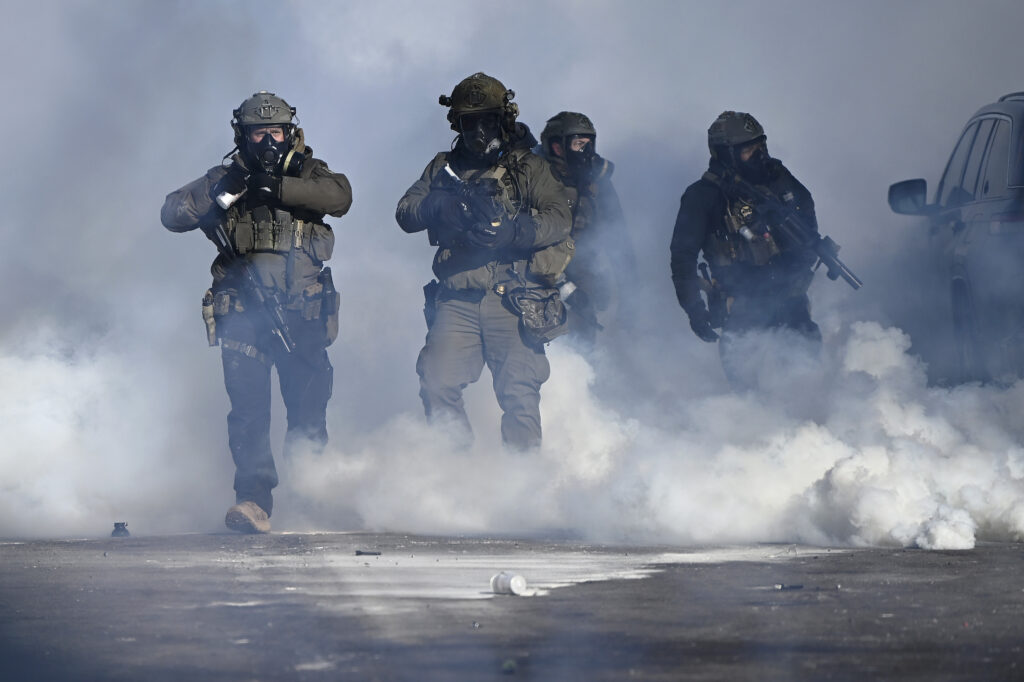
Democrats and voting advocates are going on the offensive against the Trump administration’s threats to send armed federal agents to the polls as voters cast their ballots in the 2026 midterm elections.
Federal law bans armed civil or military officers from voting locations, but administration officials have repeatedly suggested they could still be deployed.
With Election Day just over a month away, Democrats and civic groups have filed two lawsuits that aim to bar federal law enforcement at the polls. Meanwhile, Sen. Tammy Baldwin (D-Wisc.) on Wednesday introduced a bill to restrict them from coming within a quarter-mile of voting sites, and some states have advanced their own protections.
Get updates straight to your inbox — for free
Join 350,000 readers who rely on our daily and weekly newsletters for the latest in voting, elections and democracy.
The Baldwin measure, in particular — though unlikely to pass into law — suggests Democrats are looking not just to head off any attempt to deploy law enforcement to voting sites themselves, but also to focus attention on what may be an even bigger threat to voting access: potential efforts to snarl traffic and create broader disruptions in urban, Democratic-leaning areas that could make it harder for voters to get to the polls in the first place.
Taken together, the lawsuits and legislation amount to a growing campaign to resist one of the Trump administration’s most alarming threats to the election.
Plans to send federal agents to the polls create a “culture of fear that discourages voters from exercising the franchise,” Democrats said in their complaint. “Inevitably, many prospective voters who encounter armed federal agents at their polling site will cancel their plans to vote and go home rather than risking a confrontation.”
When voters learn of such plans, the “suppressive effect will ensue regardless of whether federal agents are actually deployed to that voter’s polling place,” they added. “These concerns are not hypothetical.”
Last week, nine leading civil rights groups and unions led by the NAACP asked a court to block federal agents from the polls, arguing that the administration’s threats “created a climate in which voters, especially voters of color, are intimidated and fearful of engaging in the democratic process.”
They alleged that the administration’s actions violated Section 11(b) of the Voting Rights Act, which outlaws any attempts to coerce, intimidate or threaten a person who is attempting to vote.
On Wednesday, three Democratic organizations, Senate Democratic leader Chuck Schumer and House Democratic leader Hakeem Jeffries made similar arguments in their own suit.
The very threat of such a deployment would chill turnout because “voters need not actually be arrested, questioned, or even approached in order for such threats to intimidate them from exercising the franchise,” they argued.
The same day the Democrats filed, Baldwin introduced her legislation in the Senate. It would prohibit using federal funds to deploy U.S. Department of Homeland Security (DHS) agents or National Guard members within one-quarter mile of any polling location. The bill would also ban checkpoints along any route leading to the polls.
Though it is unlikely to pass, the bill is the first federal proposal in response to the Trump administration’s recent threats.
“President Trump is pulling every lever he has to weaponize the federal government and undermine our elections — and that includes him threatening to send armed federal agents to our polling places,” Baldwin said in a press release. “There is no reason for masked, armed agents to be at polling places like churches, schools, and libraries other than to intimidate eligible voters from making their voices heard.”
California Gov. Gavin Newsom (D) also signed a sweeping set of laws last week that includes a ban on most arrests within 200 feet of polling places on Election Day.
Newsom said in a press release that California’s new laws aims to prevent President Donald Trump from exerting “dictatorial control” over elections.
“We have no bigger task than fighting to protect the right to vote from interference and meddling — the future of democracy is on the line,” Newsom said.
Officials in Democratic-led states are also preparing to prevent the Trump administration from interfering in the vote, including by working with the local officials tasked with running elections on the ground, Maine Secretary of State Shenna Bellows (D) said at a public discussion with other top election officials Wednesday.
“We’re training clerks, we’re training law enforcement, and we’re reassuring clerks that we will be… deployed all across the state on Election Day and we won’t have a clerk going into court alone or trying to throw their body in front of ICE,” she said.
The lawsuits, legislation and state-level preparations come as the Trump administration has repeatedly escalated its rhetoric surrounding federal law enforcement at the polls.
In March, Todd Blanche, who is now the attorney general, dismissed objections to U.S. Immigration and Customs Enforcement (ICE) agents patrolling voting sites. Earlier this month, DHS Secretary Markwayne Mullin argued ICE agents can make election-site arrests, and FBI Director Kash Patel suggested federal officers may “have a presence” at polls.
Federal statute only allows armed personnel at voting sites when necessary to “repel armed enemies of the United States.”
In the lead-up to the midterms, Democrats have sought assurances from the administration that it will follow election law, despite years of claims by Trump that the 2020 election was “rigged.” For many pro-voting groups, the threat of federal deployments is just the latest prong of the right’s efforts to undermine electoral integrity and confidence.
When pressed about his comments, Patel told the U.S. Senate that the FBI would “have election crisis coordinators manned at all 56 field offices,” and that election integrity was of “paramount importance and this FBI is not going to shy away from that effort.”
That was hardly reassuring.
Democrats’ lawsuit specifically took aim at such administration officials’ statements, which the plaintiffs said amounted to a policy to “control the nation’s elections.”
“The Policy falls hardest on voters most likely to fear an encounter with immigration enforcement,” they said in their complaint. “These include naturalized citizens, who may reasonably worry that agents will question their citizenship or eligibility at the polls.”
The chilling effect appears to already be taking hold.
In a recent poll by the University of California, San Diego, only 49% of voters said they believe the midterms will be “fair and free,” and around 40% said they expect to see ICE at the polls.
Nearly half of all Black and Hispanic voters said they fear intimidation at voting sites.
*The Elias Law Group (ELG) represents the plaintiffs in the case filed Wednesday. ELG Firm Chair Marc Elias is the founder of Democracy Docket.