Judge questions DOJ on emergency bid to block California ballot counting: ‘Go out and indict’
 Prefer us on Google
to see more of our voting rights news coverage when you search.
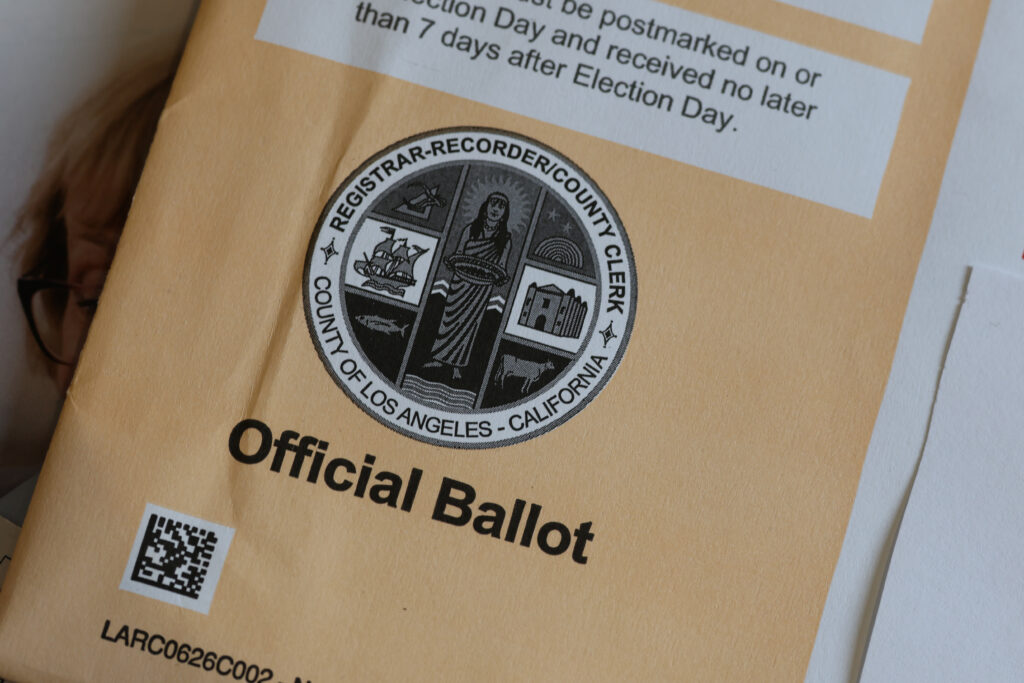
A federal judge demanded to know the precedent for sequestering ballots as he heard arguments from the Department of Justice and California officials on the Trump administration’s emergency bid to force the state to set aside and not tabulate ballots from 20,000 people.
“Give me the case, give me the state,” U.S. District Judge David Carter asked as his first question in a hearing in Los Angeles Tuesday afternoon. The government, represented by Bill Essayli, the top federal prosecutor in L.A., didn’t respond.
Carter, a Bill Clinton appointee, overall seemed disinclined to grant the Trump administration’s request for a temporary restraining order to immediately stop California from processing and counting ballots from 20,000 people it alleges are “likely” noncitizens until citizenship status is confirmed.
“You’ve got a remedy for goodness sake. Go out and indict,” Carter told the DOJ, referring to a federal criminal statute that makes it a misdemeanor for noncitizens to vote in federal elections.
“I’d like you to respond why, in balancing those two interests, this court would cause disenfranchisement where voters would not be counted versus the ability to catch those few who are [noncitizen voters], as you’ve ably done,” he added.
Carter expressed interest in setting another hearing in several weeks focused on expert testimony from both the DOJ and Los Angeles County. He pointed to California’s Dec. 3 election certification date as a deadline by which to resolve the issue.
Carter said he would issue a ruling on Wednesday.
Get updates straight to your inbox — for free
Join 350,000 readers who rely on our daily and weekly newsletters for the latest in voting, elections and democracy.
Essayli had urged the judge to make a ruling immediately from the bench. The DOJ tried to sidestep district court review altogether, noticeably after Carter was assigned the case, but that effort was rebuffed Monday by the 9th Circuit Court of Appeals.
Essayli, the only attorney to speak on behalf of the Trump administration during Tuesday’s hearing, claimed that the federal statute criminalizing individual noncitizen voting preempts a state’s constitutional right to run its own elections.
“What they cannot do is do nothing and proceed to count the votes,” Essayli argued.
California officials have expressed serious doubts about the DOJ’s methodology for flagging the potential noncitizens and how it got the state’s voter roll in the first place. Essayli defended the list but admitted it may not be 100% accurate.
“This is the list we’re most confident in. We’re never going to stand here and tell you everything’s 100%. You have humans involved,” he said. “We’re not going to make that representation to the court.”
Even more, Essayli said the federal government is not equipped to prosecute tens of thousands of voters.
“That’s just not a realistic thing,” he said. “We charged 28 people last week. Primarily, when we bring criminal cases, it’s a form of deterrence. It is not to charge every single person who’s ever committed that crime.”
The state of California and Los Angeles County were joined in court by several voting rights groups and civil rights organizations that oppose the Trump administration’s lawsuit.
Attorneys for the state and Los Angeles County heavily criticized the DOJ for trying to block votes in an active election over what is essentially a policy dispute.
California law already requires a voter to attest under penalty of perjury that they are a citizen, as required by federal law, and has in place a system for challenging ballots. Instead of suing state officials, the attorneys said the DOJ should turn to Congress to change federal law.
“The theory is that California is facilitating unlawful voting by holding elections in accordance with federal standards,” said attorney Michael Cohen. “But by the same token, the state is facilitating drunk driving by maintaining roads. Congress has told the states that attestation under penalty of perjury is sufficient to establish citizenship.”
“The government suggested that’s the state’s position. To be clear, that’s Congress’s position. Congress even considered and rejected requiring documentary proof of citizenship on voter registration forms when formulating the National Voter Registration Act. The idea that Congress’s own judgment is somehow facilitating unlawful conduct under federal law just doesn’t make any sense,” Cohen added.