Tight North Carolina congressional races could hinge on a handful of provisional ballots
 Prefer us on Google
to see more of our voting rights news coverage when you search.
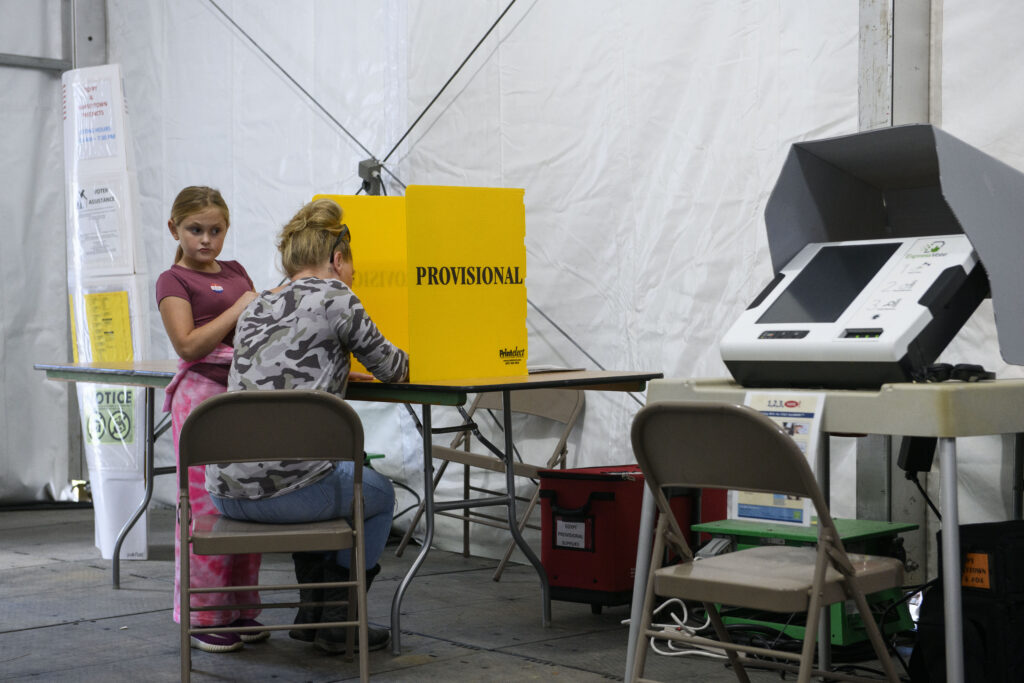
Only a handful of votes separate the candidates in two different U.S. House races in North Carolina. Provisional ballots could prove decisive as both races head to a likely recount.
Races in North Carolina’s 3rd and 5th U.S. House districts are within the state’s 1% margin required to request recounts as two Republican representatives fight to hold their seats against Democrats’ blue wave.
In the 3rd District, Rep. Greg Murphy (R) leads his Democratic opponent Raymond Smith by 80 votes. Rep. Virginia Foxx (R) trails Chuck Hubbard (D) in the 5th District by just 48 votes, according to the latest AP counts Tuesday afternoon. Over the weekend, Foxx called for “nonpartisan election observers” to ensure “election integrity” in vote counting.
Get updates straight to your inbox — for free
Join 350,000 readers who rely on our daily and weekly newsletters for the latest in voting, elections and democracy.
Democrats have already seized control of the U.S. House from Republicans, but whether they add two more seats to their tally could come down to provisional ballots cast by voters who did not have photo identification at the time of voting or required other verification.
Local reports show not all provisional ballots are being counted. Watauga County, in the 5th congressional district, has reported a 23% provisional ballot rejection rate, tossing 79 of these ballots.
It’s up to election officials to determine which provisional ballots count and which do not. The state made it easier to reject ballots this summer when it lowered the threshold for rejecting photo ID exception forms from a unanimous county election board vote to a simple majority. All of the state’s 100 counties have Republican-majority election boards.
The North Carolina State Board of Elections reported that more than 36,000 provisional ballots were cast as of Nov. 4. That’s nearly 10,000 more than the 2022 midterm election, according to the state’s publicly available data.
The increase could be explained by a slew of changes ahead of voting this year, like eleventh-hour restrictions on mail ballots that skyrocketed rejection rates. Thousands of people whose mail ballots were rejected could have voted provisionally.
As with the mail ballot rejections, state data shows counties with the highest rates of provisional ballots include Wake, Mecklenburg and Durham, hitting the largest counties — and Democratic strongholds — the hardest.
“Republicans are underrepresented in provisional ballots — it’s pretty clear,” Western Carolina University Political Science Professor Chris Cooper told Democracy Docket. “And I think that may be because of the registration repair project.”
Democrats made up 43.8% of all voters who cast provisional ballots in the midterm general election, compared to Republicans with 21.1% and unaffiliated voters accounting for 34.5% of the share, according to Cooper’s data analysis.
While the highest share of provisional ballots this election were cast because the voter had no registration record, the biggest change from years past stemmed from a “registration repair” project that required some voters to verify their identities. The second highest share — 17% — of all those who cast provisional ballots had to do so because they were missing identification numbers.
Cooper said Democrats outnumbered other voters in casting provisional ballots because the tool was intended to ensure the state complied with the Help America Vote Act (HAVA). Those who registered to vote before HAVA was passed in 2001 were not impacted, Cooper explained.
Therefore, younger voters who tend to skew Democratic were most affected if they were missing information on their registration records. The partisan slant for provisional ballots would, at face value, indicate Democrats are more likely to win tight races, he said
But not all provisional ballots cast will end up counting, as evidenced in some counties already. In 2020, for example, researchers showed that voters 18-25 had their provisional ballots rejected 80% of the time, compared to 60% for the rest of the state.