Missouri offered to let DOJ inspect its unredacted voter rolls
 Prefer us on Google
to see more of our voting rights news coverage when you search.
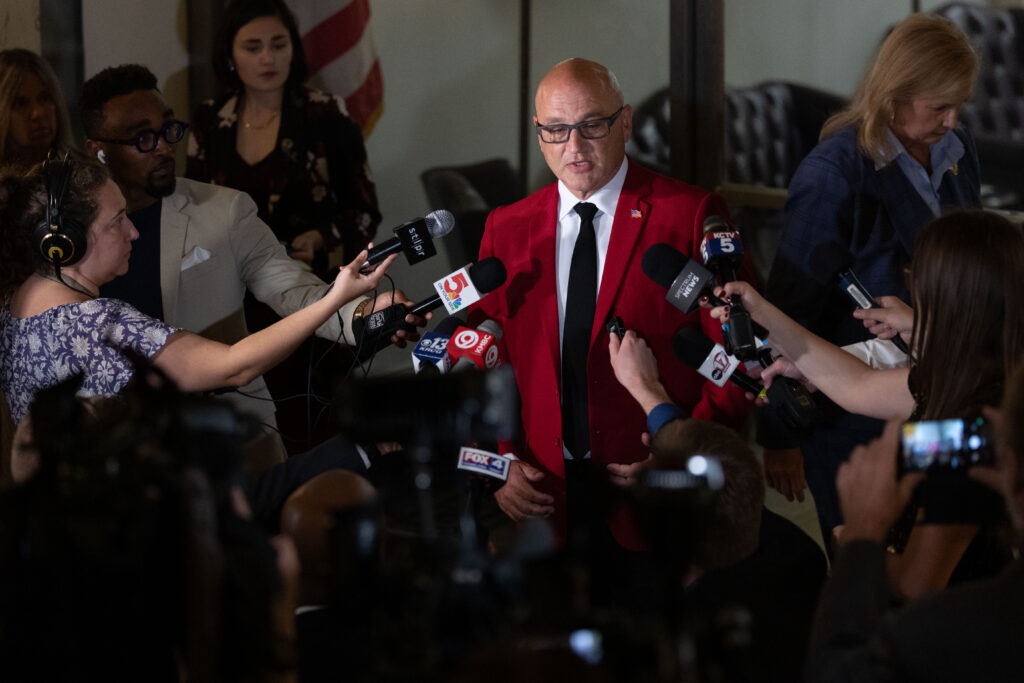
Missouri refused to give the Trump administration a copy of its unredacted voter rolls containing sensitive personal information. Instead, according to newly released records obtained by Democracy Forward,* the state offered Department of Justice officials something more unusual: the chance to take a look in-person.
The records, part of a report released Friday by Democracy Forward on the Trump administration’s efforts to interfere with the midterms, provide the clearest explanation yet for why Missouri escaped the wave of lawsuits the DOJ has filed against 30 states that rejected its demands for private voter files.
Get updates straight to your inbox — for free
Join 350,000 readers who rely on our daily and weekly newsletters for the latest in voting, elections and democracy.
In March, Assistant Attorney General Harmeet Dhillon gave Missouri Secretary of State Denny Hoskins (R) one week to turn over the state’s complete voter registration list, including voters’ birthdates, residential addresses, driver’s license and Social Security numbers.
DOJ said it needed the records to determine whether Missouri was complying with federal voter list maintenance laws.
Hoskins did not comply with the demand.
Instead, as the deadline approached on March 10, the Republican secretary of state proposed a compromise that appears to distinguish Missouri from reluctant states DOJ later sued.
Missouri would allow federal officials to conduct an “in-person audit” of its voter list maintenance system and view sensitive voter information, but DOJ officials could not copy or reproduce the data.
The department would also have to agree in writing not to disclose, share or transmit any sensitive information it viewed. Hoskins offered to conduct the audit in Jefferson City, remotely or even at DOJ’s offices in Washington D.C.
“Missouri can demonstrate compliance without compromising our citizens’ privacy,” Hoskins wrote. “To that end, we invite your team to perform an in-person audit of our list maintenance process.”
The documents, obtained through public-records requests and released Friday, do not show DOJ formally accepting Hoskins’ proposal or explicitly saying it spared Missouri from litigation because of the offer.
But DOJ’s so-called “election integrity” website says that on Sept. 8, 2025, DOJ “inspected” Missouri’s federal election records and that the state “cooperated and provided them.” Still, six months later, Dhillon was still demanding Missouri’s unredacted voter list and threatening that states had a legal duty to produce such records.
Missouri remains one of three states that resisted DOJ’s demand for an unredacted file without being sued. Democracy Forward’s report says it knows of no other state that made the same kind of offer.
As Democracy Docket has reported, ecords showed DOJ applying seemingly inconsistent standards to states participating in its nationwide voter roll crusade.
Kansas and Montana, for example, avoided lawsuits despite saying they provided only publicly available voter information. Oregon, Minnesota, Pennsylvania, Michigan, Idaho, Utah and other states were sued for offering the same information, withholding private identifiers such as driver’s license and Social Security numbers.
DOJ has repeatedly argued in court that those private fields are necessary for the department to independently analyze whether states are properly maintaining their voter rolls. In Michigan, the department described the public version of the voter file as lacking “crucial identifying information.”
Missouri’s arrangement raises a new question about that argument: If DOJ needs possession of an unredacted voter file to conduct its analysis, why was Missouri apparently able to avoid litigation by offering officials only the ability to view the information?
The newly released records suggest that what DOJ publicly described as Missouri having “provided” its records did not mean the department had actually received the complete voter file it was seeking.
Missouri’s response was conciliatory even as it withheld the data. Hoskins emphasized that the state was an early user of the federal SAVE database, praised President Donald Trump’s push for proof-of-citizenship and photo ID requirements and told DOJ that Missouri was eager to demonstrate its list-maintenance practices.
The records also show that confusion over DOJ’s standards was not limited to Missouri.
In Mississippi, Republican Secretary of State Michael Watson’s office questioned whether DOJ had given states conflicting messages about the relationship between turning over voter rolls and using SAVE.
In one exchange, DOJ Voting Section Acting Chief Eric Neff asked whether Mississippi planned to use SAVE, saying he wanted to avoid DHS “doing redundant work.” Watson responded that his understanding was that DOJ was conducting its own separate review and that states had previously been told they could not bypass DOJ’s voter roll request by using SAVE.
“I know states were asking if they could bypass if they were already using the SAVE System and were told they couldn’t and the DOJ led us to believe this was a different effort,” Watson wrote. “Now you are saying you don’t want it to be redundant. I’m quite confused.”
The episode adds another layer to an effort that has already produced dozens of lawsuits and repeated losses for the federal government.
And for Missouri, the new records offer something that had been missing from the public record: a concrete alternative the state offered when it refused to surrender its voters’ sensitive information — one that, so far, appears to have kept it out of court.
*Democracy Docket Founder Marc Elias is the chair of Democracy Forward’s board.