Maryland may actually redistrict this year, after state senate leader shifts tone
Maryland may finally be on course to redraw its congressional map to gain an extra seat for Democrats in the U.S. House, after its state senate leader said he was in favor of redistricting – a prospect that he’s opposed much to the chagrin of his fellow Democrats.
“Maryland must respond as the ground shifts under us,” said Maryland state Senate President Bill Ferguson yesterday in a press statement. “I’m in active conversations with my caucus about a special session and constitutional amendment … with the aim of putting this before Maryland voters in November.”
For months, Ferguson opposed wading into the gerrymandering war that was started last year when Trump implored Texas and other red states to redraw maps to win more GOP seats in Congress.
However, his “ground shift” comment was a reference to the Supreme Court’s recent decision that gutted the Voting Rights Act and allowed Republicans to conduct extreme partisan gerrymanders in their favor – which southern states are currently taking full advantage of.
Get updates straight to your inbox — for free
Join 350,000 readers who rely on our daily and weekly newsletters for the latest in voting, elections and democracy.
Speaking with Maryland NPR affiliate WYPR, which first reported the news, Ferguson said he’s planning a special session after Maryland’s June primaries to discuss new maps. One issue he says must be addressed is adding a new constitutional amendment to allow for a mid-decade redistricting to happen, in light of a previous attempt that was blocked by courts.
A redistricting commission convened by Gov. Wes Moore (D) last November, proposed a new map for this year that would’ve eliminated the state’s one Republican district, currently held by the MAGA-aligned Andy Harris.
A member of the far-right House Freedom Caucus, Harris not only voted against certifying 2020’s presidential election results, but has also spread falsehoods about voter fraud and the January 6 U.S. Capitol riots. He was also reportedly part of a White House meeting held after the 2020 election, where plans for the Jan. 6 events were allegedly discussed.
Eliminating Harris’s district would potentially give Democrats all eight of the state’s seats and an extra seat in the U.S. House of Representatives.
But doing so could also mean splitting some of the districts currently held by African-American representatives, which Ferguson said he’d like to avoid.
“I don’t believe Maryland should limit or dilute the power of the minority voice in Maryland’s congressional delegation,” Ferguson told WYPR. “I think there has to be a way to do it without it diluting minority voices to get to eight Democrats.”
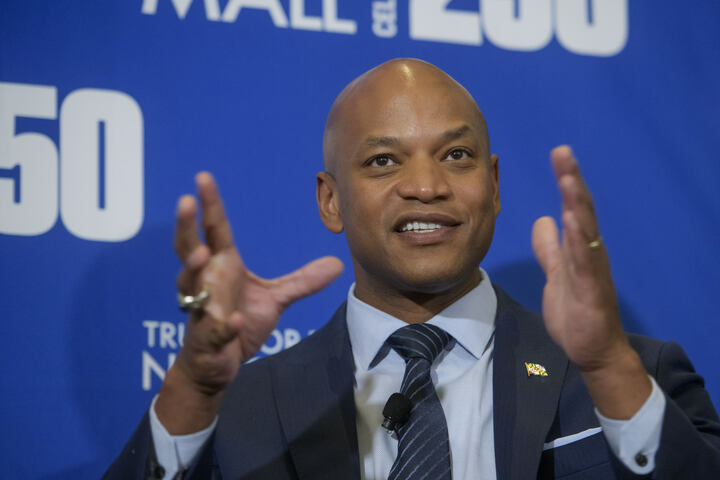
Gov. Moore, who has expressed frustration with Ferguson over his previous oppostion to redistricting, said that he welcomed the senate leader’s change of mind.
“I think [Ferguson’s] statement represents a very welcome shift,” said Moore at an event yesterday, “that he understands the urgency of this moment.”