Mail voting: Judge weighs fate of Trump order as DOJ appeals to Supreme Court
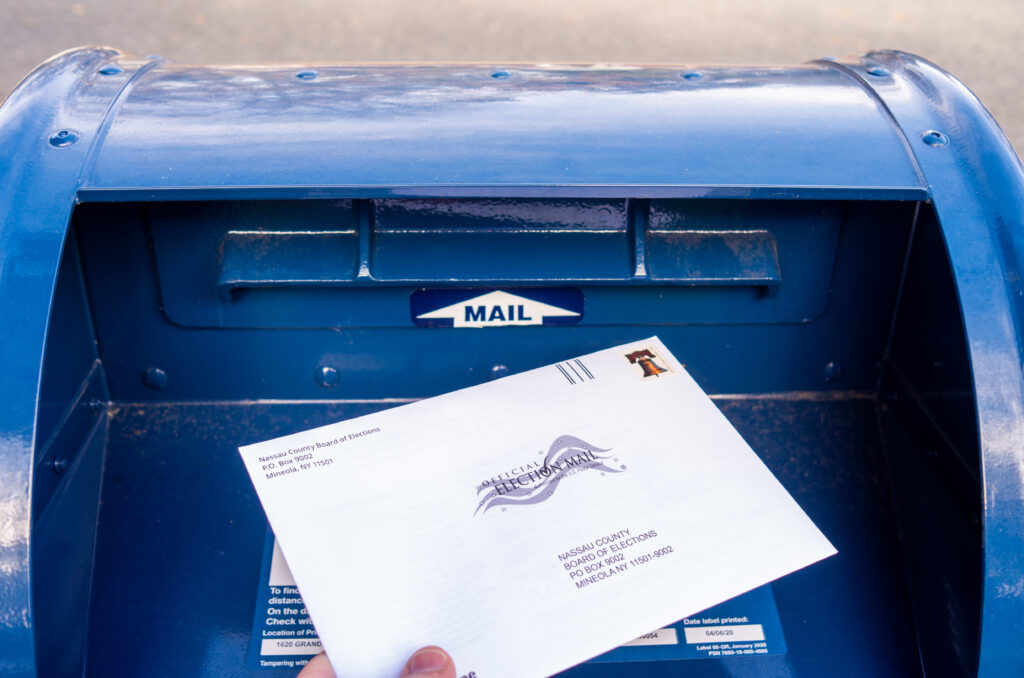
Hello, pro-democracy readers! I’m Natalie Hausmann, Democracy Docket’s News Writer, and I’ll be leading a liveblog Thursday, bringing you up-to-the-minute coverage of all the news on a pivotal day in the legal fight over President Donald Trump’s executive order seeking to restrict mail voting.
At a federal court hearing in Boston Thursday morning, with Democracy Docket National Reporter Jim Saksa in the room, Judge Indira Talwani heard arguments on whether to issue a preliminary injunction blocking Trump’s dangerous mail voting order from being carried out.
The hearing appeared to go well for those challenging the order. Talwani pressed the Department of Justice (DOJ) on its “run out the clock” strategy, and on the authority of the U.S. Postal Service to override state law.
She said she would issue a ruling as quickly as possible. Hours later, the Trump administration asked the Supreme Court to immediately lift her temporary block on USPS’ mail voting rule while the case continues on appeal.
Throughout Thursday, we’ll post updates on the hearing and the broader legal battle over Trump’s order as it reaches a crucial stage.
8:37PM
Schumer blasts Trump’s latest Supreme Court bid to restrict mail voting
Senate Democratic Leader Chuck Schumer (N.Y.) is weighing in on the Trump administration’s latest attempt to revive USPS’ new mail voting restrictions, accusing the president of trying to make it harder for Americans to vote.
“Trump is asking the Supreme Court to take a huge leap to destroy the precious integrity of the American electoral process,” Schumer said Thursday night. “The Court should not accelerate a case that so poisons our democracy.”
Schumer also accused Trump of trying to avoid accountability ahead of the midterms by restricting access to the ballot.
“American voters will pick their leaders — not Donald Trump,” he said.
7:50PM
What could happen next at the Supreme Court?
There are a few ways the Supreme Court could handle the Trump administration’s emergency request — and none would necessarily end the fight.
The justices could deny DOJ’s request, leaving Judge Talwani’s temporary block in place while she considers a preliminary injunction. They could also grant a temporary administrative stay, briefly allowing the rule to take effect while the Court considers the government’s fuller request. Or they could grant a stay pending appeal, lifting Talwani’s current order for a longer period while the litigation continues.
But rememberm Talwani is separately weighing whether to issue a preliminary injunction. If she does, the government could immediately ask the 1st Circuit — and potentially the Supreme Court again — to block that new order.
In other words, even a Supreme Court ruling on the current emergency application may only determine what happens for the next stage of this fast-moving fight, not whether USPS’ mail voting rule ultimately survives.
7:06pm
The Supreme Court is weighing one order as Talwani considers another
The Trump administration’s latest Supreme Court appeal is not about the preliminary injunction Judge Talwani is still considering.
It is challenging a separate, temporary restraining order Talwani issued last week that blocks mandatory enforcement of USPS’s mail voting rule for 14 days. DOJ wants the Supreme Court to lift that temporary block now, even as Talwani weighs whether to replace it with a longer-lasting preliminary injunction.
That means two tracks are moving at once: the Supreme Court is considering whether to pause Talwani’s existing temporary order, while Talwani is deciding whether to issue a new and stronger order against the rule.
The unusual overlap is why the litigation has become so fast-moving — and why the administration could end up back at the Supreme Court again almost immediately if Talwani issues a preliminary injunction.
6:37pm
What can USPS still do while Trump’s anti-mail voting rule is blocked?
Talwani’s temporary restraining order does not completely freeze the Postal Service’s work on its new mail voting system.
The order blocks USPS from requiring states to comply with key parts of the final rule for the November election, including using the new ballot portal and satisfying new envelope and data requirements before ballots are accepted for mailing.
But states can still participate voluntarily. North Carolina, for example, says USPS has already approved its ballot-envelope design, and the Postal Service says it continues to work on the portal while the court fight plays out.
That distinction is now at the center of the government’s emergency appeal. DOJ wants the Supreme Court to restore mandatory enforcement of the rule, while Talwani is considering whether to replace her temporary order with a longer-lasting preliminary injunction.
6:08PM
Watch now: Marc Elias breaks down the legal fight over Trump’s anti-mail voting order
Democracy Docket founder Marc Elias is live now on YouTube discussing the fallout from President Donald Trump’s mail voting executive order and taking questions from viewers.
He is breaking down Thursday’s hearing in Boston, the USPS whistleblower allegations and what could happen next as the legal fight races toward the midterms.
Marc is also discussing what is at stake for mail voters and what courts can still do as Judge Talwani weighs whether to issue a preliminary injunction blocking USPS’s new rule.
5:29pm
Justice Jackson gives pro-voting challengers until Tuesday to respond to Trump’s emergency appeal
Justice Ketanji Brown Jackson has given pro-voting challengers until Tuesday, Sept. 8, to respond to the Trump administration’s emergency request to lift Talwani’s temporary block on USPS’ new mail voting rule.
The administration asked the Supreme Court for both a stay and an immediate administrative stay while its appeal proceeds. Jackson, who handles emergency matters arising from the 1st Circuit, has not yet granted that request.
The briefing schedule comes as Talwani is separately weighing whether to issue a preliminary injunction after Thursday morning’s hearing — a ruling she has said she intends to issue as quickly as possible.
5:16PM
A new Supreme Court win for Trump could be short-lived
There’s an unusual wrinkle in the Trump administration’s latest trip to the Supreme Court: the order it is fighting could soon be replaced by a new one.
DOJ is asking the justices to lift Talwani’s 14-day temporary restraining order (TRO) issued last week which blocked mandatory enforcement of USPS’s mail voting rule. But Talwani is simultaneously considering whether to issue a preliminary injunction after Thursday morning’s hearing.
If she issues that stronger, longer-lasting injunction, it would supersede the temporary order now before the Supreme Court. That means even if the justices quickly lift the TRO, the victory could be fleeting — and the administration could soon find itself seeking emergency appellate relief all over again against Talwani’s new ruling, which could come at any moment.
4:28pm
Trump administration asks Supreme Court to immediately lift Talwani’s TRO
The Trump administration is back at the U.S. Supreme Court, asking the justices to immediately lift Judge Indira Talwani’s temporary restraining order (TRO) issued last week blocking mandatory enforcement of USPS’s new mail ballot rule.
Solicitor General D. John Sauer filed an emergency application Thursday seeking both a stay pending appeal and an “immediate administrative stay” while the Supreme Court considers the request. The government argues Talwani’s order should be treated as an appealable preliminary injunction because ballots are about to begin going out and ordinary appellate review could come too late.
The administration told the Supreme Court that North Carolina is scheduled to begin mailing ballots Friday and Alabama on Sept. 9, arguing that ballots sent while Talwani’s order remains in place cannot later be subjected to the new USPS requirements.
The government is asking the Supreme Court to intervene even though, according to its application, the 1st Circuit had not yet acted on the administration’s pending emergency stay request.
3:20PM
North Carolina says its mail ballot design has been approved by Postal Service
“We believe that we are well-positioned, as our envelopes have already been approved by the Postal Service,” Sam Hayes, the executive director of the state’s election board, just told reporters at a press conference.
That makes the Tarheel State the first to announce that its mail ballot design has been signed off on under the USPS rule. North Carolina has a deadline of Friday to begin mailing ballots to voters — the joint-earliest date in the nation.
Parts of the rule are currently under a temporary restraining order, but states are not barred from moving forward to get their ballots approved. A federal judge Thursday morning heard arguments over whether to impose a preliminary injunction against the rule.
3:02PM
USPS now says it expects its mail ballot portal to be usable by ‘sometime next week.’
That news came in a Department of Justice declaration filed with a federal court Thursday afternoon.
“We continue to make refinements to the Portal, including consideration of changes needed in light of the TRO,” declared Steven Monteith, USPS Chief Customer and Marketing Officer, referring to the temporary restraining order imposed last week by Talwani. “We anticipate being in a position to make the Portal available to users for voluntary use by sometime next week.”
At Thursday morning’s hearing, Judge Talwani said the government hadn’t said enough about how the rule would work and when the portal would be ready. She gave DOJ lawyers a 3 p.m. deadline to add to the record — a deadline they appear to have barely met.
1:50PM
Trump DOJ can’t tell judge whether USPS mail ballot portal is ready to launch
The Trump administration’s own lawyer could not tell the judge Thursday whether its system for carrying out sweeping mail ballot restrictions is ready to launch — the day before the first state to send out mail ballots is set to do so.
Judge Talwani wasn’t having it.
“We’ve been here for a week and you can’t tell me the government is ready to go?” Talwani asked.
12:25Pm
Meanwhile, in a separate challenge to the order…
Democrats are accusing the Trump administration of concealing from a federal judge its efforts to implement key parts of President Donald Trump’s anti-mail voting executive order before November’s midterm elections.
12PM
How could voters be affected?
If Trump’s anti-mail voting order is allowed to take effect, the consequences could impact millions of voters who rely on the postal service to cast their ballots.
About 47 million Americans voted by mail in 2024. A recently disclosed USPS whistleblower report warned that the Postal Service’s new system could result in some voters receiving their ballots late or not receiving them at all.
Mail voting disruptions may not affect every voter in the same way. Older Americans, voters with disabilities and people living in rural areas are among those most likely to depend on mail voting and therefore most likely to feel the effects if Trump’s new restrictions cause delays or disruptions.
In recent elections, Democrats have relied on mail ballots at higher rates than Republicans. 37% of Democrats reported voting by mail, compared with 24% of Republicans in 2024.
11:05AM
At press conference, plaintiffs urge quick ruling
The plaintiffs are giving a press conference outside the courthouse immediately following the hearing.
“In court today, we stood up to the authoritarianism that threatens the bedrock of democracy,” said Celia Canavan, the executive director of the League of Women Voters of Massachusetts.
“Now, it is essential that the court move quickly and decisively to block USPS from carrying out this unconstitutional and illegal rule,” Canavan added.
11:00AM
Hearing is wrapped
The hearing is now over, but our coverage certainly isn’t. Stay tuned for more on-the-ground updates. Judge Talwani is expected to rule this afternoon, and we’ll have all the details on this liveblog and from Jim’s additional reporting.
10:59AM
‘I’m not the final word’: Judge says she won’t be the last to rule on USPS voting restrictions
Nearing the end of the hearing, Talwani notes her forthcoming ruling won’t be the last on USPS’s mail voting restrictions.
“I’m not the final word,” she says, though she adds that she doesn’t want her ruling “bouncing back and forth” between the district court, the 1st Circuit Court of Appeals and the Supreme Court.
“That doesn’t do anybody any good,” the judge says.
10:53AM
DOJ: ‘We concede nothing.’
As arguments wind down, the DOJ is defiant: “We concede nothing,” its counsel says.
Throughout the almost two-hour hearing, the intervenor defendant states did most of the arguing, and the DOJ struggled throughout to demonstrate its own understanding of USPS’s authority and ability to implement the final rule for the midterms.
Correction: This entry and others originally referred to “Texas” when they should have referred to intervenor defendant states. Those states, which include Texas, were represented by Missouri Solicitor General Louis Capozzi.
10:40AM
Red states keep asking court to disenfranchise its own voters
The intervenor defendant states’ attorney has repeatedly told the judge there is no ‘real risk’ of disenfranchisement in Texas counties.
It reiterates that argument when Talwani asks what would happen if 9,999 people could not vote because of an error with one ballot in Harris County — a situation an anonymous USPS whistleblower warned about in a report Tuesday.
“Again, we just don’t see that as a real risk,” the state’s lawyer says.
10:38AM
Update: Talwani says she will try to rule this quickly
Around 90 minutes into the hearing, Talwani says she’s aiming to “get out my decision as soon as possible.”
She adds that the DOJ has until 3 p.m. to supplement the record and clarify the potential effect of USPS’s rule.
Correction: This post originally reported that Talwani said she will try to rule by 3 p.m.
10:32 AM
Talwani: ‘So we’re gonna do a test run on this election?’
Talwani appears flabbergasted at the intervenor defendant states’ assertion that she should issue a preliminary injunction only blocking mandatory compliance with the final rule, so that USPS could still reject some ballots in states that choose to comply. The red states argue this would give the court “real world evidence” of how the rule operates.
Talwani fires back: “We’re not talking about an intellectual puzzle game. We’re talking about people’s right to vote.”
10:30am
Judge says USPS hasn’t explained how exactly its rule would work
In a discussion on the potential impact of USPS’s election mail restrictions, Talwani tells the DOJ and state attorneys that the Postal Service has failed to explain to the court exactly how its rule would work in practice.
Growing increasingly frustrated, the judge says the DOJ didn’t submit a declaration to the court detailing, for example, how many ballots could be potentially affected by USPS’s new requirements. “I have very little from you,” she tells the DOJ and state attorneys.
On the other hand, she notes plaintiffs have warned in several declarations that millions of ballots could go undelivered if USPS forces states to comply with the rule.
10:15AM
Red states argue USPS can adopt rules preempting state law
Talwani pushes back on the intervenor defendants’ claim that Congress allowed USPS to adopt rules on mail ballots to preempt state laws. Voting organizations go further, arguing that only Congress can determine when USPS may not accept a class of mail unless specific conditions are met — which Congress has not done in this case.
10:10AM
Talwani is wise to the government’s delaying strategy
Talwani seems to want to prevent DOJ from drawing things out on appeal if she rules against them. It suggests not only that she’s likely to find for the plaintiffs, but also that she’s very aware that delay is at the heart of the administration’s strategy.
She asks whether, if she rules for the plaintiffs, DOJ will add additional arguments on appeal, not addressed by her. If that happens, she says, the appeals court could send it back down to her, drawing things out further.
“It’s a time question,” Talwani says. “And I think we all understand a time crunch here.”
10:05Am
Judge Talwani says she will not rule from the bench
Talwani says she will not rule from the bench, so we likely should not expect a ruling today. However, she added that she’s committed to “getting something out as quickly as I can.”
Correction: The headline of this post originally reported that Judge Talwani said she will not rule today. In fact, she said she wouldn’t rule from the bench.
10:00AM
Plaintiffs go after DOJ’s ‘cremated remains’ comparison
In an earlier filing, the DOJ compared mail ballots to cremated remains or fake explosive devices, arguing that the postal service is authorized to create rules for delivering sensitive materials.
But a lawyer for the League of Women Voters noted that in those cases, unlike here, Congress had passed a statute authorizing the changes.
“You’re saying, for those two being adopted by rule, they were preceded by statute?” Talwani asked.
“Exactly,” the lawyer responded, before citing the relevant rules and statutes.
9:50AM
DOJ claims pro-voting groups can’t challenge USPS’s rule
Talwani took issue with the DOJ’s argument that a coalition of voting-rights organizations led by the League of Women Voters of Massachusetts lacks standing to challenge USPS’s new mail voting rule.
If the groups don’t have standing, it would likely mean USPS could force states that are not suing to comply with its mail-ballot mandates.
9:45AM
Only one state has said it can comply with order, plaintiffs note
To hammer the case that states will struggle to comply with the order in time to smoothly run their elections, a lawyer for the League of Women Voters notes that the Trump administration has received a declaration from only one state, Alabama, saying that they’re likely to be able to comply.
“It’s really notable that they haven’t gotten statements from others,” says the lawyer.
9:40AM
DOJ (again) argues it can run out the clock for the midterms
Talwani pushed back on the DOJ and red states’ argument that, even after a final rule is published, pro-voters must first seek relief with the Postal Regulatory Commission — an executive adjudicatory branch that has up to 90 days to respond. In other words, the DOJ is arguing that they can run out the clock on parties seeking relief from the impacts of USPS’s mail voting restrictions ahead of the midterms.
9:30AM
Trump DOJ says it will immediately appeal to SCOTUS if judge blocks USPS rule
At the outset of the hearing, Michael Velchik, an attorney with the DOJ’s Civil Division, told Judge Talwani that the department will immediately appeal to the Supreme Court if she grants a preliminary injunction against USPS’s rule.
That appeal would mark yet another emergency stay application from the DOJ in litigation over the rule and Trump’s executive order. Though once considered extraordinary legal relief, Trump’s DOJ has repeatedly asked for, and received, emergency stays from the Supreme Court to vacate or lift lower court orders barring certain actions by the president.
Last week, the Court’s conservative-appointed majority approved the department’s emergency appeal of Talwani’s previous permanent block against Trump’s executive order.
9:15AM
What does the new USPS rule on mail voting actually do?
USPS’s new rule largely does what Trump demanded in his order. It requires state election officials to alter the envelopes they use to send voters mail ballots and assign each envelope a unique barcode to track those ballots.
Most crucially, the rule also requires states to submit a list that includes the names and addresses of all people who requested a mail ballot for the upcoming election.
If state and local election officials don’t comply with those requirements, USPS has said it would refuse to mail ballots to voters in those states and localities.
The Department of Justice and USPS have claimed the rule is simply an attempt to standardize election mail. But voting experts and Post Office officials have argued that, in practice, the requirements give the postal agency newfound authority to control state election procedures and collect information on voters.
9:00am
‘All Rise’
Reporter Jim Saksa is officially in Courtroom 9 of the Moakley courthouse. Here’s the latest from Jim: Roughly 35 people are here in Courtroom 9. The Moakley courthouse looks over Boston Harbor and the view just outside the courtroom here on the 3rd floor would be lovely… if it weren’t a damp, gray morning.
A handful of women from Delta Sigma Theta are here, dressed in the sorority’s red. DST are plaintiffs along with the League of Women Voters Massachusetts. The Black sorority was founded amid the suffrage movement and, while nonpartisan, cares about voting rights.
8:30am
What to know about Trump’s executive order attacking mail voting
USPS’s mail voting restrictions at the heart of today’s hearing directly stem from a sweeping executive order Trump signed in the Oval Office in March.
In the order, he directed USPS to refuse to deliver ballots to voters in states that do not comply with a swath of new demands, including the requirement that election officials give the federal government a list of all voters who intend to vote by mail in the upcoming election.
Trump attempted to justify the restrictions by falsely claiming his political enemies use mail voting to sway elections.
“Cheating on mail-in voting is legendary. It’s horrible,” he said while signing. “Democrats want to use it for cheating.”
It was Trump’s second attempt to control elections by decree. He signed a separate anti-voting order in 2025 that multiple federal courts swiftly blocked.
8:00am
Federal judge to rule in pivotal challenge to Trump’s attack on mail voting
This morning’s hearing may be the most consequential moment yet in the months-long legal fight over Trump’s attempt to restrict mail voting before the midterms. Judge Indira Talwani — who has already blocked the rule twice, calling it “unconstitutional” — will hear combined arguments from 24 Democratic-led states and a coalition of voting rights groups seeking to permanently stop USPS from requiring pre-approved ballot envelopes and voter lists.
With fewer than 70 days until Election Day and a recent whistleblower complaint warning the rule could trigger “mass disenfranchisement,” the stakes for the 46.8 million Americans who voted by mail in 2024 have rarely been higher.