LIVE BLOG: Supreme Court Hears Case That Could Gut the Voting Rights Act
 Prefer us on Google
to see more of our voting rights news coverage when you search.
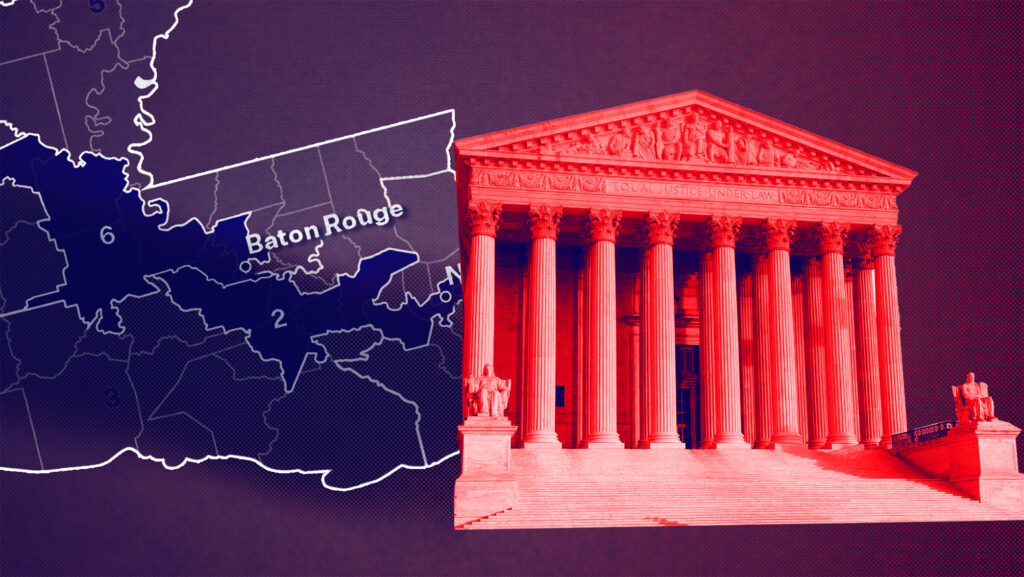
The Supreme Court heard oral arguments in Louisiana v. Callais, a case that could decide the fate of the Voting Rights Act’s most powerful remaining provision, Section 2. The VRA was enacted in 1965 to enforce the 15th Amendment’s ban on racial discrimination in voting. But the justices are weighing a sweeping conservative argument that Section 2 is itself unconstitutional.
The stakes couldn’t be higher. A ruling that strikes down or weakens Section 2 could effectively dismantle the nation’s most successful civil-rights law, giving states broad freedom to draw maps that diminish the voting strength of communities of color. It could also shift the balance of power in Congress, potentially giving Republicans a lasting advantage by enabling the dismantling of minority districts that currently elect Democrats.
Democracy Docket’s live blog coverage is over.
The live coverage of the Louisiana redistricting argument was free for everyone. Support our vital work by becoming a premium member today.
12:40 p.m. ET:
Well, it’s done: Oral arguments in Callais are over, and the Supreme Court is moving on to its next case.
My hot take is that Kavanaugh and Barrett seem ready to say that Section 2’s remedies fail to meet the equal protection clause’s strict scrutiny because of their indefinite duration. Alito seems ready to significantly narrow Section 2. And Thomas seems preoccupied with Robinson v. Callais, suggesting he wants to at least toss out Louisiana’s remedial map. It’s unclear to me where Roberts or Gorsuch might land — although, Gorsuch doesn’t seem to be a big fan of re-writing the Gingles factors to narrow Section 2. That said, it doesn’t seem likely they’ll join the court’s liberals in upholding the VRA, to say the least.
So maybe the ruling will simply toss Section 2, or maybe it’ll all-but-require a showing that discrimination is intentional… or maybe we’re just too pessimistic and we’ll all be pleasantly surprised — shocked even — by a robust defense of the VRA!
I’d bet on the former, not the latter, unfortunately. I wouldn’t be too surprised, however, if we end up with no majority opinion and just a plurality instead, that tosses out Louisiana’s new map.
—Jim Saksa, Reporter
12:38 p.m. ET:
Black voters’ closing argument: Counsel for Black voters uses her rebuttal time to remind the Court that Section 2 was designed to guard against precisely the kind of vote dilution at issue in this case. She emphasizes that although Black residents make up one-third of Louisiana’s population, no Black candidate has been elected to statewide office since Reconstruction.
—Maya Bodinson, Researcher
12:36 p.m. ET:
Overturning precedent in sensitive political context: Janai Nelson urges the court to consider the weightiness of changing years of Section 2 precedent. This is particularly concerning as oral argument happens amid Trump’s redistricting war where red states are conspiring to lock in a GOP advantage.
—Ashley Cleaves, Legal Content Editor
12:35 p.m. ET:
Rebuttal: We’re closing in on the end. Nelson is up again to offer rebuttal. She’s focusing on the impact Section 2 of the VRA has had, warning that gutting it would lead to a resurgence of racial discrimination.
—Jim Saksa, Reporter
12:33 p.m. ET:
Resurgence of discrimination: In her rebuttal, Janai Nelson reiterates that a weakening of Section 2 would lead to a return of discrimination in redistricting.
—Ashley Cleaves, Legal Content Editor
12:32 p.m. ET:
Going long: We’re now two-and-a-half hours into oral arguments that were scheduled for 60 minutes. I don’t know how much to read into that, other than it’s clear this is an extremely weighty issue.
—Jim Saksa, Reporter
12:32 p.m. ET:
The government’s proposed test does not solve the problem of discriminatory effects: Justice Jackson raises the point that under the government’s proposed test, the state could keep presenting the same map. The government’s test wouldn’t solve the history of discrimination and its effects. She mentions current residential segregation that is reflective of the history of slavery in Louisiana.
—Ashley Cleaves, Legal Content Editor
12:30 p.m. ET:
DOJ’s closing argument: “We are not urging Section 2 to be eliminated:” The Justice Department maintains that it is not asking the Supreme Court to strike down Section 2 of the Voting Rights Act. Instead, it is calling for a “clarification” of the Gingles framework used to evaluate Section 2 claims.
—Maya Bodinson, Researcher
12:18 p.m. ET:
No good for Gorsuch: Gorsuch is grilling Mooppan on the DOJ’s arguments for narrowing Section 2. He does not seem to be buying the standard Mooppan is pushing for. “I just don’t know what it means,” he said.
—Jim Saksa, Reporter
12:15 p.m. ET:
Wrapping up: As oral arguments near their close, the Court’s conservative majority appeared poised to significantly weaken Section 2 of the Voting Rights Act — potentially gutting one of the last remaining tools to challenge racial discrimination in redistricting.
—Maya Bodinson, Researcher
12:05 p.m. ET:
The bottom line is get rid of Section 2: Justice Sotomayor hones in on the goal of conservatives. The proposals offered by conservatives would make it harder for minority voters to bring Section 2 claims.
—Ashley Cleaves, Legal Content Editor
12:00 p.m. ET:
Simpatico conservatives: Alito all but says he buys Mooppan’s argument. That would mean a narrowing of the VRA purporting to uphold the court’s precedents in Milligan, Gingles, and other cases.
—Jim Saksa, Reporter
11:50 a.m. ET:
Gingles? We’re talking about Gingles? Gingles? Justice Sotomayor does not seem very interested in the U.S. government’s arguments to tweak the Gingles factors. “We didn’t grant cert on Gingles. And we have said that statutory precedents are entitled to far greater stare decisis protection,” she said. She’s staking out a point that the court has said stare decisis is stronger when dealing with a question of statutory interpretation than when the question is constitutionality. If this court is starting from a point of how to interpret the VRA — rather than whether the VRA or its remedies as-applied violate the 14th or 15th Amendment — then it should be harder (in theory) to aggressively narrow Section 2’s scope.
—Jim Saksa, Reporter
11:48 a.m. ET:
Has the sun set on Section 2? Counsel for the Callais plaintiffs argue that Section 2 of the VRA cannot extend indefinitely into the future. Justice Brett Kavanaugh previously suggested that Section 2’s race-conscious remedies may be time-limited, and the Callais plaintiffs appear to have seized on that opening. However, since its enactment in 1965, Section 2 has never had an expiration date and does not require periodic reauthorization to remain enforceable.
—Maya Bodinson, Researcher
11:46 a.m. ET:
Correction: Below, I said D. John Sauer was going to argue for the Solicitor General’s office. Turns out it’s principal deputy solicitor general Hashim Mooppan. Silly me! Mooppan is arguing for a narrowing of Section 2.
—Jim Saksa, Reporter
11:41 a.m. ET:
We tried that already: Kagan notes that what Aguiñaga and Greim are pushing for would be to add an intentionality requirement to racial discrimination under the VRA… which the Supreme Court did back in 1980, which lead to Congress amending Section 2 to explicitly ban discrimination in effect. And Congress did that, Kagan adds, under the power the 15th Amendment provided to “enforce this article by appropriate legislation.”
—Jim Saksa, Reporter
11:37 a.m. ET:
Callais plaintiffs said proof of intentional discrimination should be required: If SCOTUS does not eliminate VRA districts entirely, the Callais plaintiffs are pushing to make Section 2 claims more difficult to prove. But since 1986, SCOTUS has consistently held that discriminatory voting practices can be struck down under Section 2 even without proof of intentional discrimination, so long as their effects dilute the voting power of minority voters.
—Maya Bodinson, Researcher
11:35 a.m. ET:
Section 2 isn’t about “stereotyping”: Justice Kagan asks why Louisiana is claiming that enforcing Section 2 requires “stereotyping” voters. She says that, in fact, the factors needed to prove a Sec. 2 violation are about racially polarized housing, and racially polarized voting. That’s just data, she argues.“I guess I don’t see where stereotyping comes into that.”
—Zachary Roth, Managing Editor
11:28 a.m. ET:
Next up: Edward Greim is now arguing on behalf of the “non-African American” plaintiffs in Callais. The Court split up oral arguments against the current map three ways: the State of Louisiana, the plaintiffs, and the Department of Justice, represented by Solicitor General D. John Sauer. In theory, each was supposed to be given just 10 minutes, but if the Justices have questions, then the lawyers can keep responding.
—Jim Saksa, Reporter
11:27 a.m. ET:
Callais plaintiffs: Our Constitution is “color-blind.” Counsel for the Callais plaintiffs argued that our Constitution is color-blind and therefore the statutes enforcing it should be as well. But this claim is difficult to square with the Fourteenth and Fifteenth Amendments, which were not enacted in a race-neutral manner—they were explicitly designed to combat racial discrimination and protect the rights of newly freed Black Americans.
—Maya Bodinson, Researcher
11:22 a.m. ET:
Kavanaugh raises concerns about representation if majority-minority districts are dismantled: Justice Kavanaugh noted that, to date, Black candidates in Louisiana have been elected only from majority-minority districts and asked what would happen if those districts were dismantled. Louisiana downplayed the concern, responding, “There has been a lot of ‘sky is falling’ in this case.”
—Maya Bodinson, Researcher
11:21 a.m. ET:
Is identifying racial discrimination a compelling interest: Justice Jackson says the answer is “obviously yes.” She argues the interest is in identifying and remedying the effects of racial discrimination.
—Ashley Cleaves, Legal Content Editor
11:20 a.m. ET:
Temporality again: Kavanaugh asks Aguiñaga why the Supreme Court shouldn’t provide some advanced notice before overturning Section 2, as Nelson suggested (if the court insists on applying a durational limit here).
Aguiñaga argued that previous VRA cases provided that notice, suggesting that the court’s statements condemning racial discrimination in voting in them should now be used to justify gutting the law Congress passed to prevent racial discrimination in voting.
—Jim Saksa, Reporter
11:17 a.m. ET:
Louisiana supports a Gingles remodel, but with concerns: Louisiana says it supports any tweaks to the Gingles analysis that brings clarity to Section 2 analysis. However, that could come with a new wave of litigation.
—Ashley Cleaves, Legal Content Editor
11:15 a.m. ET:
Louisiana urges SCOTUS to reject any role for race in redistricting—even when remedying racial discrimination: Counsel for Louisiana argues that Section 2 cannot survive strict scrutiny because compliance with the Voting Rights Act is not a compelling reason to draw majority-minority districts.
—Maya Bodinson, Researcher
11:13 a.m. ET:
We’ve covered this already: Kagan has no time for Louisiana’s arguments here. “Each of the propositions that you’re putting forward here — that Section 2 has to be limited in some way, … that it doesn’t authorize race based redistricting as a remedy, and that we need to fundamentally overhaul the Gingles threshold inquiry — was rejected, I don’t know, three years ago, two years ago by a majority of this Court”
—Jim Saksa, Reporter
11:09 a.m ET:
Does racism still exist? Louisiana doesn’t seem to think so: Counsel for Louisiana argues that Section 2 of the VRA is no longer necessary, claiming that Black voters rely solely on the state’s past history of discrimination to justify their claims. Louisiana appears to be building on Justice Brett Kavanaugh’s earlier suggestion that Section 2’s race-conscious remedies might be time-limited—a theory that echoes the Supreme Court’s 2013 decision in Shelby County v. Holder, which struck down Section 5 of the VRA on similar grounds.
—Maya Bodinson, Researcher
11:06 a.m. ET:
Thomas doesn’t like Robinson: Thomas asks Aguiñaga now about the underlying case that led to Louisiana redrawing its maps to add a second majority-minority district. It seems like he’s teeing up some kind of opinion of his own — we will have to wait to see if it’s a concurrence or dissent — taking issue with Robinson v. Landry.
—Jim Saksa, Reporter
11:05 a.m. ET:
Louisiana cannot outrun its history of racial discrimination: The Louisiana Solicitor General says that the totality of circumstances analysis defeated the state in Robinson.
“We can never outrun the bad era of poll taxes, of grandfather clauses, of literacy tests. I think we’re always going to lose across the board on that kind of analysis,” he said, adding, “Robinson focused on how bad was Louisiana in the 1930s, 40s, 50s, 60s.”
—Ashley Cleaves, Legal Content Editor
10:59 a.m. ET:
Kagan takes on Louisiana: Kagan points out to Louisiana Solicitor General Benjamin Aguiñaga that the “government mandated racial balancing” he says violates the 14th Amendment is being done in response to a “specific, proven incident of racial discrimination” by the state – that it matters that this race-based government action is to fix ongoing discrimination.
Kagan goes on to attack the temporality argument that Kavanaugh and Barrett seem to be toying with: “This is not a Shelby County thing where Congress had acted 50 years ago and conditions on ground changed, with no way to respond. What Gingles does and Section 2 do is: They ask about current conditions. They ask whether current conditions show vote dilution violative of Section 2. Is there racial residential segregation now, is there racial polarized voting now?”
—Jim Saksa, Reporter
10:57 a.m. ET:
Why did Louisiana switch sides? Justice Thomas asks the lawyer for Louisiana why it switched sides in this case from the first argument. An excellent question.
—Marc Elias, Founder
10:50 a.m. ET:
Was the Robinson decision a compelling interest? Justice Barrett asks if the state had a compelling interest even though they believed the Robinson court was wrong in finding a VRA violation. Nelson says it’s still compelling that it was upheld by two courts. Justice Jackson adds that achieving an equal electoral system is THE compelling interest.
—Ashley Cleaves, Legal Content Editor
10:45 a.m. ET:
Kavanaugh comes back to temporality: Kavanaugh brought up Nelson’s colloquy with Justice Jackson, where they suggested the court should defer to Congress on the question of the VRA’s remedies. In strict scrutiny analysis of the use of race in a 14th Amendment situation, the Supreme Court has said that “narrowly tailored” remedies shouldn’t last forever. Kavanaugh dismisses Nelson’s argument that the court should defer to Congress here, because “With the 14th amendment, we’re not supposed to defer to Congress.” So, how does the court ensure this remedy doesn’t extend forever?
Nelson responds that, again, there should be not durational limits to Section 2 — the court should defer to the political branch, Congress, here. But if the court is going to insist on durational limits, then it should look at their decisions in affirmative action cases, where Justice Sandra Day O’Connor in an 2003 opinion said affirmative action shouldn’t still be in place 25 years from then, and that Roberts could later strike down affirmative action in college admissions. Nelson said that would provide a “runway” and “advanced notice” that would allow Congress to respond.
—Jim Saksa, Reporter
10:43: a.m. ET
Breathing room to remedy their own discrimination: Nelson reframes Justice Roberts’ retort that states have “breathing room to intentionally discriminate on the basis of race.” Adding that they have leeway to remedy their own discrimination in redistricting.
—Ashley Cleaves, Legal Content Editor
10:41 a.m. ET
Black voters reject comparison to affirmative action: Counsel for Black voters drew a sharp line between Section 2 of the Voting Rights Act and affirmative action in college admissions, emphasizing that Section 2 permits race-conscious redistricting only when necessary to remedy specific, proven instances of racial discrimination.
—Maya Bodinson, Researcher
10:39 a.m. ET:
Losing Section 2 as a key tool would be “catastrophic,” Nelson says. “If you take Louisiana as an example, every member who is black was elected from an opportunity district,” she adds. “Every justice in Louisiana has been elected through a VRA opportunity district and nearly all legislative representatives elected through VRA opportunity districts.”
“Lousiana alone is an example of how important it is to have Section 2 continue to be enforced to create these opportunities,” Nelson says.
—Ashley Cleaves, Legal Content Editor
10:35 a.m. ET:
Paving the way for “Alito Treatment”? Justice Samuel Alito has picked at the nitty gritty of VRA jurisprudence, questioning Nelson about the Gingles factors developed by the court in a 1986 case. Ahead of oral arguments, Prof. Rick Hasen of UCLA Law suggested Alito might do what he did in 2021 Brnovich v. DNC, and write a convoluted opinion that ultimately narrows Section 2 into near oblivion.
—Jim Saksa, Reporter
10:33 a.m. ET:
Black voters: If Louisiana relied on race more than necessary, the flaw is with the specific map—not with Section 2 itself. Counsel for Black voters argue the remedy would be to redraw the map, not to upend decades of Section 2 jurisprudence.
—Maya Bodinson, Researcher
10:27 a.m. ET:
Jackson to the rescue? After Kavanaugh and Barrett’s questions about the temporal argument, Justice Jackson jumps in to try to suggest that, unlike the preclearance sections struck down in Shelby County, Section 2 does not have a time limit and doesn’t need one, because there’s no time limit on the protection of the 15th Amendment.
—Jim Saksa, Reporter
10:26 a.m. ET:
Kavanaugh and Barrett sound skeptical about preserving the VRA: Justice Kavanaugh states as a fact that the Supreme Court has required durational limits of the use of race. Asks what the time limit is for the end of the framework for the use of race in VRA Section 2. Justice Barrett also asks about the time limit that should apply.
This means all three potential “swing” justices start with skeptical questions. It is still early in the argument, but to prevail, proponents of the existing VRA test need two of those three justices to agree.
—Marc Elias, Founder
10:25 a.m. ET:
Justices probe Louisiana’s claim of partisan motives in redistricting: Several Justices questioned counsel for Black voters about Louisiana’s argument that its redistricting choices were based on protecting incumbents and partisan advantage. Counsel for Black voters cautioned that accepting this rationale “would swallow Section 2 whole.”
—Maya Bodinson, Researcher
10:22 a.m. ET:
Wiggle room? Roberts notes that Nelson has said repeatedly that race played “an outsized role” in the drafting of the original maps, and asks “What’s the proper size? Is there wiggle room?” He’s poking around for a way to narrow Section 2, it seems like.
—Jim Saksa, Reporter
10:20 a.m. ET:
Black voters: Section 2 is necessary to address current racial discrimination. Counsel for Black voters argue that Section 2 remains necessary to remedy current racial discrimination. She points out that the Robinson record already proved ongoing racial discrimination and vote dilution in Louisiana, including extreme racially polarized voting in recent elections and cracked Black communities.
—Maya Bodinson, Researcher
Alito: “Is seeking partisan advantage an objective that the legislature may seek?:” Counsel for Black voters respond, “Not if it comes at the cost of equal protection principles and the 15th amendment’s prohibition on race discrimination in voting.”
—Maya Bodinson, Researcher
10:18 a.m. ET:
A troubling beginning? The Chief Justice asks the second question (after Justice Thomas) and notes that Alabama v. Milligan was limited to applying existing precedent. He doesn’t expand on this, but if the suggestion is that this case is about changing that precedent, it is a troubling beginning to the day.
—Marc Elias, Founder
Black women at the forefront of protecting democracy: Janai Nelson is one of six Black women to ever argue a case before the nation’s highest court. Today, she will be the sole defender of the crown jewel of the civil rights era.
—Ashley Cleaves, Legal Content Editor
10:10 a.m. ET:
Possible curveball: Justice Clarence Thomas has opened up questioning of Janai Nelson, the lawyer defending the map, questioning how we got here. The new map, at issue here, was drawn after a court said Louisiana’s old map would likely violate the VRA in a preliminary injunction hearing. Thomas questioned that there was never a full merits hearing leading to the remedial map – suggesting, perhaps, he might be interested in ignoring the question here entirely and just rule that a map can’t be redrawn on a preliminary injunction.
—Jim Saksa, Reporter
10:00 a.m. ET:
One thing I’m interested to see: Will the Justices consider, at all, the impact that weakening or striking down the key defense against racial gerrymandering will have on partisan gerrymandering?
Callais presents a huge threat to minority voting power, and that matters regardless of partisanship. But it also presents a huge threat to Democrats, and to any notion of fair elections. If they don’t have to worry about the VRA, it’s clear that GOP-led states will draw districts that further tilt the scales in their favor, creating the very real chance that Democrats will win a comfortable majority of the congressional vote next year, but Republicans will still control Congress. (And the recent spate of Trump-driven gerrymandering by red states, of course, makes that even more likely.) At that point, it’s pretty hard to say we have fair elections.
But with SCOTUS already having decided in 2019 that partisan gerrymandering isn’t something that the federal courts can get involved in, I’m not hopeful that the issue will even be mentioned today.
—Zachary Roth, Managing Editor
9:30 a.m. ET:
What I’ll be listening for: Once oral arguments get started shortly after 10 a.m., I’ll be paying particular attention to questions from two justices in particular: Chief Justice John Roberts and Brett Kavanaugh. Both conservatives were part of the majority in a similar case two years ago, Milligan v. Allen, that upheld Section 2 of the VRA. But Kavanaugh suggested in his concurrence there he was open to hearing other arguments, not raised in Milligan, for overturning Section 2. And Roberts penned the case that struck down the VRA’s “preclearance” sections. I’m especially curious to see if Roberts will try to finagle some middle ground between fully tossing out the VRA and maintaining the status quo — some kind of narrowing of the current doctrines that might appease the other conservatives, like Justice Clarence Thomas, who seem to be champing at the bit to be done with the VRA altogether.
—Jim Saksa, Reporter
9:00 a.m. ET:
Back at the podium: When SCOTUS first heard oral arguments in Callais in March — before ordering a rehearing on Section 2’s constitutionality — J. Benjamin Aguiñaga, Louisiana’s Solicitor General, noted this in his final remarks: “With all due respect, we’d rather not be back at the podium this fall defending a new map against a new challenge. This Court’s cases promise breathing room. We operated in that breathing room in drawing District 6.”
Well, he’s back today, this time arguing for the other side, which is kind of doubly ironic given how he finished that thought: “And if this court holds otherwise, then respectfully, I don’t know what this Court’s voting cases mean. We ask you to reverse.”
—Jim Saksa, Reporter