Supreme Court declines to hear Arkansas case, further weakening Voting Rights Act
 Prefer us on Google
to see more of our voting rights news coverage when you search.
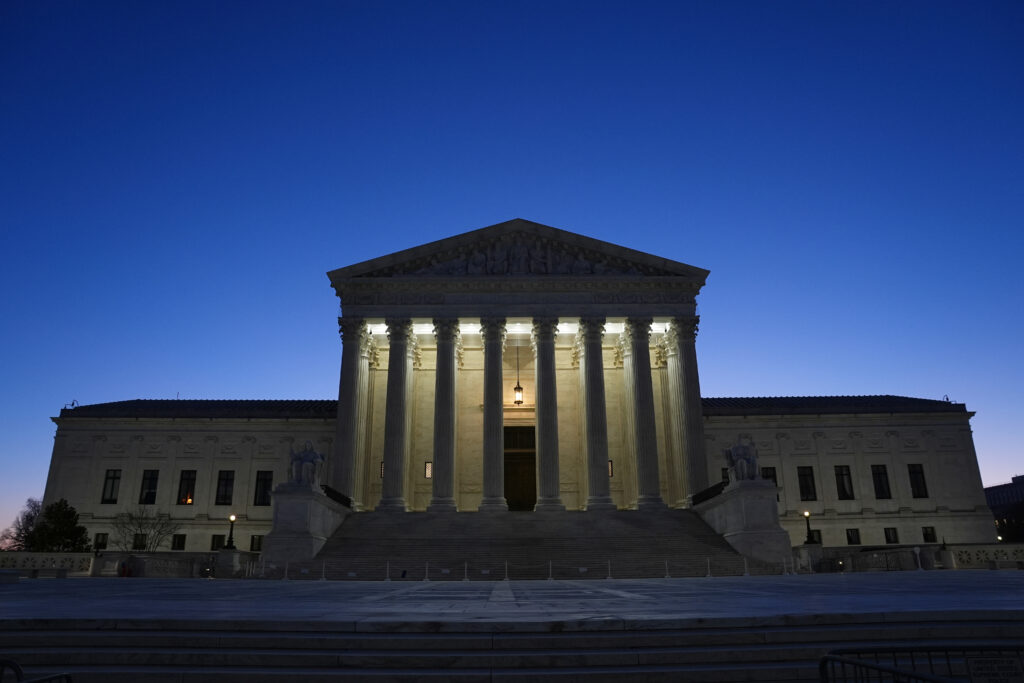
The U.S. Supreme Court declined Monday to hear a lawsuit challenging Arkansas’ law that criminalizes helping more than six voters cast ballots. The decision leaves the law in effect and means that individuals in seven states are barred from suing to enforce a provision of the Voting Rights Act (VRA) aimed at protecting voters with disabilities or who face language barriers.
And it may indicate that the court intends to weaken yet another part of the landmark voting law.
Last July, the 8th Circuit Court of Appeals held that voters and private organizations can no longer sue under Section 208 – the VRA provision protecting the right of voters with disabilities or language barriers to receive assistance at the polls.The court held that the provision includes no private right of action, meaning only the U.S. Department of Justice may enforce it.
The ruling upheld an Arkansas law limiting how many voters one person can assist and requiring poll workers to maintain a list of names and addresses of anyone helping others at the polls.
By denying certiorari, the Supreme Court leaves the 8th Circuit’s ruling in place in seven states: Arkansas, Iowa, Minnesota, Missouri, Nebraska, North Dakota and South Dakota. Not only will Arkansas’ law stand, but individuals seeking to block similar statutes in those states will be unable to do so under the VRA’s Sec. 208.
Get updates straight to your inbox — for free
Join 350,000 readers who rely on our daily and weekly newsletters for the latest in voting, elections and democracy.
The Supreme Court came out the opposite way in another 8th Circuit case involving the right of private individuals to enforce the VRA last year. In Turtle Mountain Band of Chippewa Indians v. Jaeger, the court granted plaintiffs’ request to pause an 8th Circuit decision finding there was no private right of action under Sec. 2 of the VRA — the provision barring racially discriminatory laws that was recently eviscerated by the conservative justices in Louisiana v. Callais.
The court later remanded that case down for further litigation in light of Callais. That suggests the Supreme Court may ultimately allow the private right of action to remain in place for the recently denuded Sec. 2 while finding it does not exist for Sec. 208.
Since President Donald Trump returned to office, the DOJ’s Civil Rights Division has been decimated and its focus has shifted entirely away from enforcing voter-protection statutes to attacking states’ authority to administer elections and pushing socially divisive litigation.
Even before that switch, though, private actors brought the vast majority of lawsuits enforcing the VRA. Some studies calculated that more than 90 percent of VRA Sec. 2 cases have been brought by private plaintiffs.