Indiana House Committee Advances Map, Despite Racial Gerrymandering Allegations
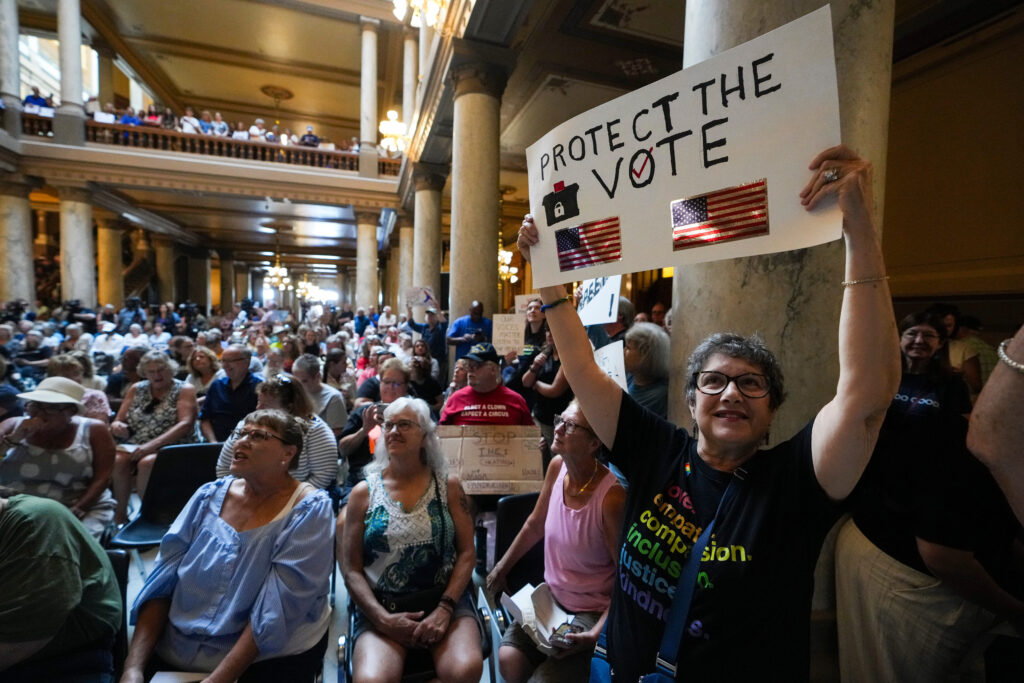
An Indiana House committee voted 8-5 Tuesday to approve a new GOP-backed congressional map, advancing the measure over the objections of Democrats and members of the public who called the plan a racial gerrymander that unlawfully dilutes the voting strength of Indianapolis minority communities.
The proposed map could eliminate both congressional districts in the state currently held by Democrats.
The committee vote is the latest result of President Donald Trump’s national push for Republican-controlled states to conduct unprecedented, mid-decade redistricting to tilt the 2026 midterm elections in the GOP’s favor.
Get updates straight to your inbox — for free
Join 350,000 readers who rely on our daily and weekly newsletters for the latest in voting, elections and democracy.
That campaign has already yielded new maps in Texas, Missouri and North Carolina.
Indiana’s legislature initially pushed back at Trump’s calls for a gerrymander. But after the president explicitly called out Republicans who opposed the measure — and they started receiving threats and facing harassment — state Senate leader Rodric Bray (R) announced that they would hold a vote.
Indiana lawmakers convened Monday to consider the redistricting proposal. According to comments House Speaker Todd Huston made to reporters, their proposed map was created together with the National Republican Redistricting Trust, run by leading GOP mapmaker Adam Kincaid, who also drew the Texas gerrymander.
But the GOP strategy now looks different than in past gerrymanders — including Texas, according to Luis Fuentes-Rohwer, a law professor at Indiana University Bloomington.
“They’re acting as if the Voting Rights Act does not exist,” he told Democracy Docket. “Either they don’t care, or they expect Section 2 to be gone.”
And they might be on to something. The Supreme Court appears poised to eviscerate Section 2, which prohibits racial discrimination in voting, in the coming year.
New strategy
It remains unclear whether the Indiana legislature has the votes necessary to pass the gerrymander. But the GOP’s approach is now notably different than in past redistricting battles.
When Texas Republicans redistricted this summer, they claimed their gerrymander had been vetted by outside attorneys for compliance with the federal Voting Rights Act (VRA).
Earlier this month, a federal court blocked their map, stating that the GOP likely could not have produced it without engaging in an illegal racial gerrymander. The Supreme Court is expected to rule on the map in the coming days.
Three months later in Indiana, the GOP no longer bothered to address questions about the VRA.
Pressed by Democratic lawmakers as to whether the Indiana map complied with that law, state Rep. Ben Smaltz (R), the bill’s author, simply said he had “no idea about that question at all.”
When Democrats asked whether adhering to the VRA was an important part of drawing the map, Smaltz again pleaded ignorance. “We did not look at any other information other than what created political advantage,” he said.
Democrats reject the idea that the Indiana GOP was unaware of race. State Rep. Cherrish Pryor, an Indianapolis Democrat, has blasted the map for dividing Marion County – the state’s most populous, racially diverse county – into four congressional districts.
But when Pryor asked Smaltz what legal grounds he had for drawing a racial gerrymander, Smaltz pointed to Rucho v. Common Cause, a 2019 U.S. Supreme Court case that effectively made partisan gerrymanders legal.
That ruling held that “drawing maps in a partisan way or in any way is entirely up to the states,” Smatlz claimed, adding that he was “not aware of” any legal requirement to avoid diluting minority votes.
State Rep. Matt Pierce (D) asked Smaltz whether he was aware the proposed map would likely remove the only minority congressman from the Indiana delegation.
“I think that a Republican candidate that runs in that district would have an advantage,” Smaltz responded.
It’s up to the courts to decide whether the plan complies with the law, the Republican state representative concluded.
He also insisted the proposal was motivated by Republicans’ need to counter Democratic gerrymandering in blue states over the past decade – an argument national Republicans are increasingly leaning on as Trump’s redistricting arms race spreads to more states.
Democrats pointed out that it is difficult to justify Republicans’ concerns about blue state gerrymandering, given that the GOP controls both chambers of Congress and the White House.
Public disagreement
During public comment, Indiana voters also expressed disagreement with the new map, slamming Republicans for caving to Trump and giving the public less than 24 hours’ notice to come to the capitol.
Marcel Duplantier, an Indianapolis attorney, told lawmakers the plan “drips with contempt for Hoosiers and treats the law like a build-your-own-pizza menu.”
Breanna Jones said Indiana voters want legislators to focus on important issues like health care, not redrawing the congressional map.
“We didn’t ask for redistricting,” Jones said. “And we don’t want it.”
Indianapolis resident Max Hittle said he liked to think Indiana was better than states that have done mid-decade redistricting.
“What this bill is doing is disenfranchising thousands of our citizens. That’s simply not the right thing to do,” Hittle said.
But all these concerns may be beside the point, according to law professor Fuentes-Rohwer.
Indiana Republicans “are looking for Republicans to form the districts and nothing else,” he told Democracy Docket. “They call that politics, not race.”