Missouri Supreme Court hears challenges to GOP gerrymander
 Prefer us on Google
to see more of our voting rights news coverage when you search.
The Missouri Supreme Court heard oral arguments Tuesday in three challenges to a Republican gerrymander that aims to not only flip a congressional seat to the GOP, but also to overcome an attempted veto by Missouri voters.
The stakes in the cases are high.
If the court rules in favor of the GOP redistricting plan — designed to dismantle a Kansas City seat long-held by Democrats — it would mark the final nail in the coffin of Missourians’ nine-month battle to stop the state from using the map in 2026.
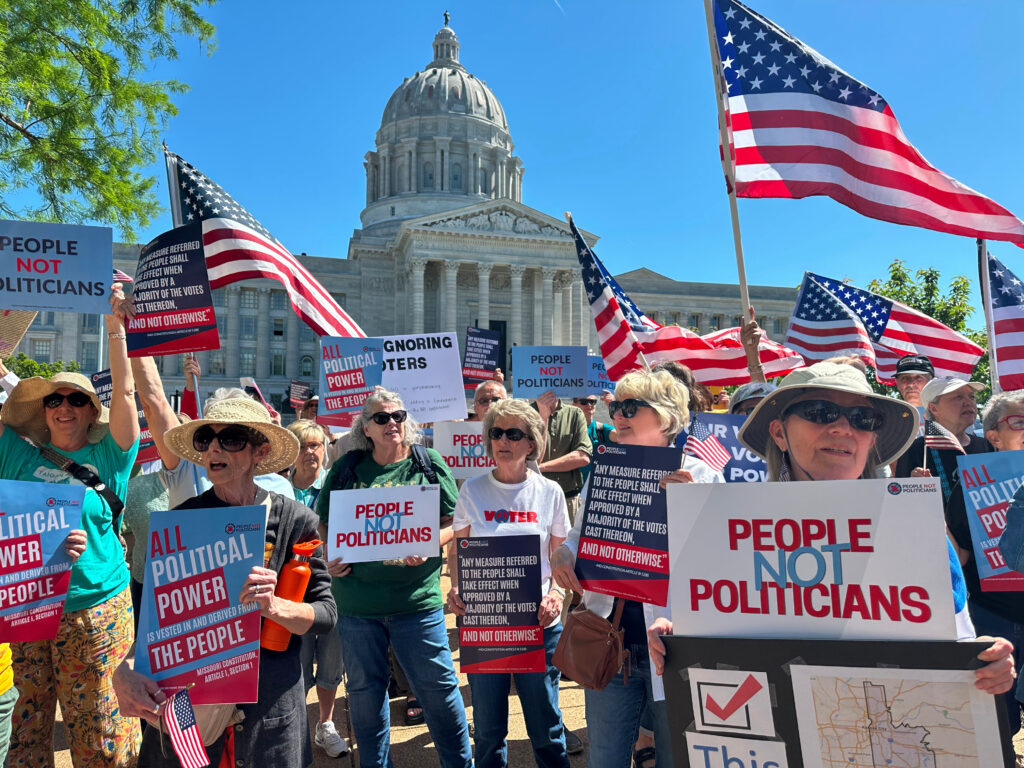
Protesters gathered outside at the Missouri Capitol Tuesday during the hearing, demanding judges block the map for the current election.
One of the three cases concerns a provision in the Missouri Constitution giving voters the right to veto state legislation by holding a referendum election. Voters quickly gathered the necessary signatures to hold the referendum last fall, but — in defiance of 100 years of precedent in Missouri — state leaders refused to suspend the new map to allow voters to weigh in.
In March, a lower court judge ruled against voters, saying the new map is in effect pending the Secretary of State’s certification of the referendum. Now, the state’s highest court will have the final word on the case.
The plaintiffs are asking for a final ruling by May 26, a state deadline for officials to give notice of the upcoming primary election.
Get updates straight to your inbox — for free
Join 350,000 readers who rely on our daily and weekly newsletters for the latest in voting, elections and democracy.
Brianna Lennon, the election administrator for Boone County, argued in an amicus brief that it is unprecedented for Missouri state officials to refuse to suspend a matter that’s been referred to the voters for a referendum — and it has led to confusion for election officials, who aren’t sure whether to proceed using a map that is being challenged by voters.
“Allowing the August primary to be conducted using districts that are likely to be stayed upon the referendum’s certification — which could occur a matter of weeks before the August primary — will result in chaos, confusion, and unnecessary expense,” Lennon wrote.
Besides the referendum, the Missouri Supreme Court also heard arguments* Tuesday on the legality of the map itself and its districts.
This isn’t the first time Missouri has made it this close to an election without a final answer on its congressional district lines. In 2022, a map wasn’t signed into law until May 18.
But this time around, the cases could hardly be more consequential: The new map is part of President Donald Trump’s nationwide push to Republican-led states to gerrymander their maps to favor the GOP ahead of the 2026 midterms.
Referendum battle
Missourians have been fighting for months to use their right to put the gerrymander to a statewide vote. The state constitution unambiguously declares that the people “reserve power to approve or reject by referendum any act of the general assembly,” with only a few exceptions related to health, safety and budget appropriations.
Despite state Republicans’ aggressive attempts to obstruct the referendum campaign, voters ultimately gathered and turned in more than 300,000 petition signatures. Enough of those signatures have been verified by local officials for the Secretary of State to place the referendum on the ballot.
Despite that, Missouri Republicans argued that the new map has already gone into effect, forcing voters to file a lawsuit asking the courts to confirm that the map is paused until the referendum is held.
Instead, Circuit Judge Brian Stumpe dismissed voters’ claims in a Mar. 27 ruling, finding that the new gerrymandered map is not suspended pending the “mere” submission of the referendum petition.
“Regardless of whether this Court grants or denies Plaintiffs’ requested relief, Plaintiffs will retain the same ability to approve or reject [the map] at the ballot box in the next general election, assuming the referendum is certified as sufficient, they will suffer no damage,” the judge wrote, despite the fact that using a challenged map in the 2026 election would indeed constitute damage.
On Tuesday, Missouri Solicitor General Louis J. Capozzi III argued that legislation cannot be suspended at the time signatures are submitted because those signatures could later turn out to be fraudulent — even though that’s precisely how Missouri officials have followed the state’s referendum law for more than a century.
Jonathan Hawley, an attorney with the firm Perkins Coie representing the voters in the case, argued that concern is already addressed because the state has criminal penalties for fraudulent signatures. He argued that the court cannot deny voters their ability to approve or reject legislation before it becomes effective.
“It would be no different than a law that allowed a bill to take effect before the governor had the opportunity to exercise the veto right. That would be plainly unconstitutional, as well, and for the same fundamental reason,” Hawley said. “The referendum right is the people’s veto. It is their check on the legislative power, and bills cannot go into effect until they have the opportunity to approve them once the referendum is invoked.”
Judge Zel M. Fischer jumped in, asking Hawley the only question posed by the court Tuesday.
“What’s wrong with waiting until the Secretary (of State) complies with his mandatory duty to determine whether the petitions were sufficient or insufficient?” Fischer asked.
Hawley’s response was clear: “It would dilute the referendum right, if not destroy it altogether. Because the purpose of that right is to give the people the opportunity to approve legislation before it goes into effect. And as this court has stated and more, the referendum does not exist to allow the people to weigh in on bills that have already gone into effect.”
Hawley closed by imploring the court to uphold the people’s referendum right.
“This is not the first time that the state has tried to manipulate the referendum right and deprive the people of their share of the legislative power. Each time that has happened, this court has ruled for the people,” Hawley said. “And so we urge, if the referendum right is still worth protecting, then the state’s new position must be rejected.”
Disputed district lines
The Missouri Supreme Court also heard arguments in a case brought by two groups of plaintiffs challenging the map itself.
They claim that the map does not comply with the state constitution’s compactness requirement because it divides Kansas City into three distinct voting districts with unequal populations in order to dilute the voting power of Black communities.
Previously, on March 12, a lower court ruled that the new map could stand.
Kathleen Hunker, Principal Deputy Solicitor General, said Tuesday that the plaintiffs’ arguments amounted to “micromanagement of the General Assembly’s redistricting authority.” And she argued that, if the court rules against the state, it should leave the 2025 map in place for the current election cycle.
“Any relief should wait until after the upcoming election. It is a basic tenet of election law that when an election is close at hand, the rules of the road should be clear and settled,” Hunker said, arguing that granting relief now would be disruptive to active campaigns, harming candidates and voters.
But Abha Khanna, an attorney with the Elias Law Group, pushed back, arguing the court cannot leave the 2025 map in effect — because it has never been in effect.
“The status quo right now — from all available evidence, in trial until today — is that the 2022 undoubtedly constitutional map remains in place,” Khanna said, “and that the only thing that would be disruptive would be the imposition of a brand new, unprecedented and unlawful 2025 map.”
*The Elias Law Group (ELG) is representing plaintiffs in the Healey case challenging the compactness of the map. ELG Firm Chair Marc Elias is the founder of Democracy Docket.
This story has been updated.