Louisiana gerrymander: Panel advances GOP map axing majority-Black seat
 Prefer us on Google
to see more of our voting rights news coverage when you search.
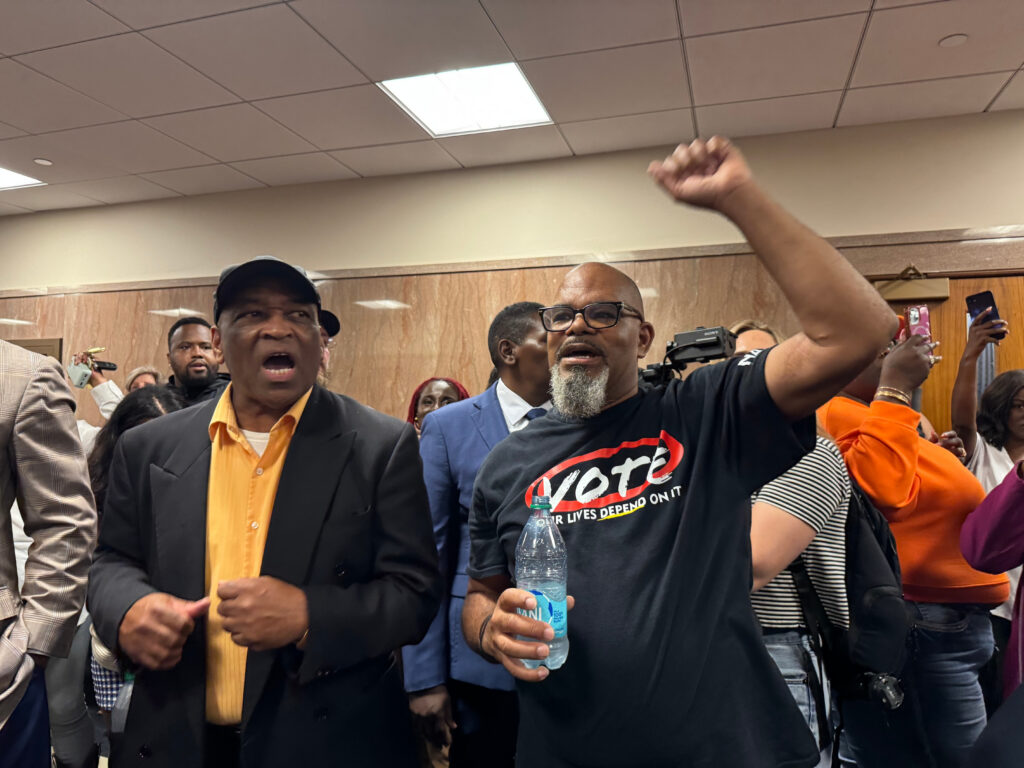
In the darkness before dawn, a Louisiana senate panel voted to eliminate one of the state’s two majority-Black congressional districts and gift the seat to Republicans.
At 4:30 a.m. Wednesday, the Louisiana Senate and Governmental Affairs Committee voted 4-3 down party lines to advance a bill to the floor that would draw out the majority-Black U.S House seat currently held by Rep. Cleo Fields (D). The new map would pack Black Louisiana’s into one district and pit Fields against fellow Democrat, Rep. Troy Carter. The proposal now advances to the Senate floor for consideration.
The U.S. Supreme Court’s recent ruling in Louisiana v. Callais incinerated the Voting Rights Act, sparking a round of Republican redraws ahead of the 2026 midterms.
A day after the Supreme Court handed down its decision in Callais, Louisiana Gov. Jeff Landry suspended the primary elections for the U.S. House, even though 42,000 absentee ballots had already been cast for the May 16 contest. Primaries for other offices are still moving ahead as scheduled, and votes already cast for House races will simply be ignored, said Louisiana Sec. of State Nancy Landry, who is not related to the governor.
The proposal is expected to get a vote on the floor of the Louisiana Senate Thursday. The Louisiana House will then up the measure next week. The bill must pass both before the legislative session ends June 1.
Get updates straight to your inbox — for free
Join 350,000 readers who rely on our daily and weekly newsletters for the latest in voting, elections and democracy.
The Senate and Government Affairs Committee launched the process to redraw the state’s congressional map last week with a public hearing, where the plan’s opponents decried both the “emergency” process and its goal: eliminating a majority-Black district.
As the session began in Senate Committee Room F — one of the smallest hearing rooms in the capitol, Louisiana Illuminator reporter Piper Hutchinson said on X — state Sen. Gary Carter (D) asked the committee’s chairman, Sen. Caleb Kleinpeter (R), about the status of the ongoing election.
“Can you tell me whether or not those ballots that have already been cast, whether or not those ballots are going to be counted?” asked Carter, who is Rep. Carter’s nephew.
“No, I cannot,” Kleinpeter said, responding similarly to Carter’s other questions about the number of votes already cast and whether they would be discarded.
After roughly two minutes of Carter’s inquiries, Kleinpeter recessed the hearing for a few minutes. Upon its resumption, Carter finished his questions and said the committee should call Sec. of State Landry to testify before moving ahead.
Carter later yelled at the bill’s author, Sen. Jay Morris (R), insinuating that the redistricting was motivated by racism. On Monday, Carter took to on the Senate floor to say he lost his temper and apologize. Carter also stepped down from the Senate and Governmental Affairs Committee and was replaced by state Sen. Royce Duplessis (D) on the panel.
The Shreveport Times reported that Morris received death threats following Friday’s hearing.
Outside the committee room, protesters chanted “shut it down.” The protests continued for hours as the committee continued to hear from members of the public, almost all of whom opposed the redraw. After recessing Friday night, the committee returned Tuesday afternoon for more debate and the vote.
Facing increasingly dire polling figures last summer, President Donald Trump urged GOP-led states to gerrymander their congressional districts to boost the party’s chances in the upcoming midterm elections. Texas, Missouri, Ohio and Florida all quickly complied. Democrats limited their gains by drawing new maps of their own in California, but their attempt in Virginia was blocked by the state supreme court last week.
Following the Callais decision, Louisiana joined Alabama and Tennessee in moving to scrap majority-Black districts represented by Democrats ahead of November’s elections. Shortly before the senate committee convened Tuesday, lawmakers in South Carolina voted against a redraw there, with some Republicans worried the proposed map would backfire.
The bill would also authorize $2,934,660 for notifying the state’s 2,964,303 voters at an estimated cost of $0.99 per mailer. It would not allocate any additional funds for reprinting ballots, remailing absentee and military voter ballots, broader voter education efforts, or other election administration costs caused by suspending an already ongoing primary election to redraw the congressional map.
The committee formally considered four different proposals, three alternates offered by Morris and one from Democratic state Sen. Ed Price, which essentially would have adopted the current map with two majority-Black seats that Democrats can win. The committee rejected Price’s proposal. All of the bills were introduced in March, well before the Court released its ruling.
Five lawsuits have been filed challenging the decision to suspend the primaries and rush a redistricting through the legislature.
The current U.S. House map was created in 2022 after a district court held that the prior map violated the VRA and directed the creation of a second majority-Black district, to better align with Louisiana’s racial demographics.
But the Supreme Court’s decision in Callais held that such racially-motivated mapmaking is unconstitutional. While the ruling did not require Louisiana to immediately replace its map, the Court did grant plaintiffs’ request to expedite sending an order down to the district court, making a quick redraw more likely, despite the ongoing litigation.
If enacted, the new map would be essentially identical to the map Louisiana originally enacted in 2021.
Landry’s decision to suspend the primaries led two Baton Rouge residents to file a recall petition; they will need to collect 500,000 signatures in the next 180 days to get the measure on the ballot.