Harmeet Dhillon Was an Outspoken Advocate for the Right of States to Run Elections. Then She Took a Top Job at Trump’s DOJ
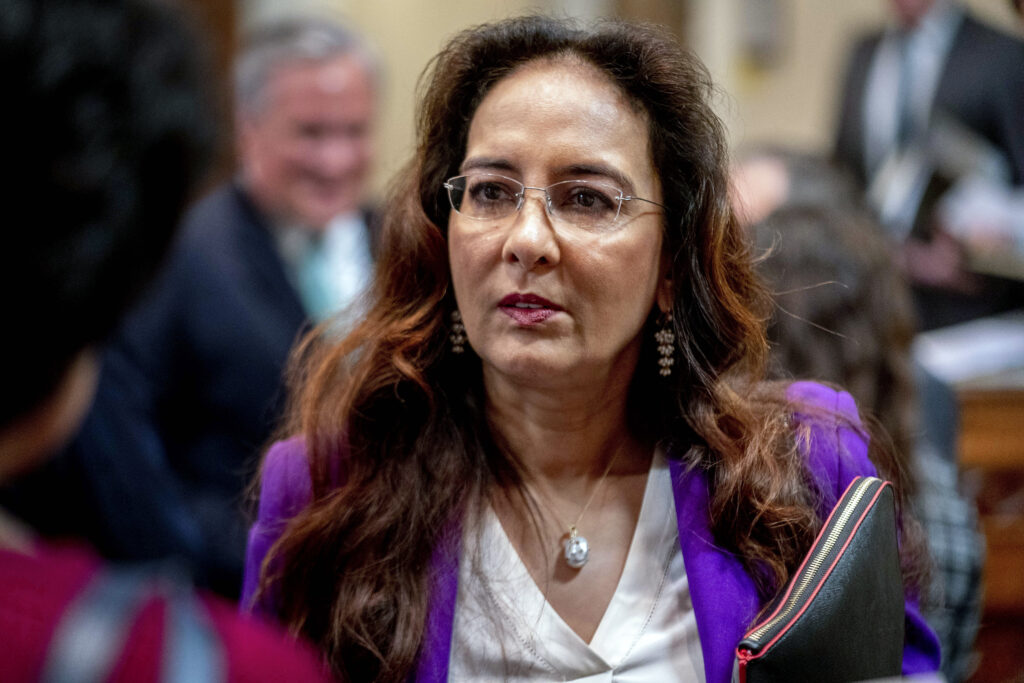
As a Republican lawyer, Harmeet Dhillon frequently insisted that the federal government has “little to say” about how states run their elections.
“Efforts by the federal government to override state authority — to my mind — are completely unconstitutional,” she said about a Biden administration effort to expand access to voter registration.
Now, as head of the Civil Rights Division at the U.S. Department of Justice (DOJ), Dhillon claims the feds have “sweeping” authority to seize state voter rolls.
Dhillon is at the center of an unprecedented federal campaign to force states to turn over millions of voters’ most sensitive personal information — an unparalleled effort that now involves lawsuits filed by Dhillon and DOJ against more than 18 states. The lawsuits rely on an expansive, and unprecedented interpretation of civil rights law to argue that the attorney general has near-limitless authority to seize election records and that courts’ only role is to enforce those demands.
Get updates straight to your inbox — for free
Join 350,000 readers who rely on our daily and weekly newsletters for the latest in voting, elections and democracy.
Of course, Dhillon’s abrupt flip-flop is far from unique. When former President Joe Biden issued an executive order in 2021 encouraging federal agencies to offer expanded voter registration service, Republicans joined Dhillon in denouncing it as an unconstitutional power grab that trampled states’ rights. Yet many of the same officials and groups have since, like her, embraced aggressive federal intervention by the Trump administration — including an executive order, sweeping anti-voting legislation in Congress, and DOJ legal threats that pressure states to change election laws or surrender voter records.
Still, Dhillon’s many public statements on the importance of states being allowed to run their own elections offer an especially striking demonstration of how seemingly inviolable principles can quickly be jettisoned when their political impact is reversed.
And the consequences of this volte face are not abstract.
If the DOJ prevails, millions of voters could see their most sensitive data transferred to federal officials with minimal judicial oversight and little transparency about how the information will be stored, shared or used. Election officials, Democratic and Republican, stress that such centralization risks data breaches, political misuse and a chilling effect on voter participation — concerns Dhillon herself once raised when arguing against federal involvement in elections.
A DOJ spokesperson did not immediately respond to a request for comment about Dhillon’s changing stance on the question of states’ authority to run elections.
For years, as the founder and director of a right-wing law firm, Dhillon was one of the loudest conservative voices arguing that states — not the federal government — have near-exclusive authority to run their elections.
Following the 2020 election, Dhillon repeatedly argued in social media posts and other forums that the Constitution leaves election law almost entirely in the hands of the states — and that federal officials, including the DOJ and the courts, should largely stay out.
“This is naked politics and violence against the Constitution,” Dhillon wrote in response to a 2021 lawsuit filed by DOJ, under the Biden administration, challenging a restrictive Georgia voting law. “States set their voting laws, and the federal government has nothing to say about it absent very rare circumstances.”
Days later, reacting to a Supreme Court decision that made it harder to challenge discriminatory election laws, Dhillon celebrated what she described as a sharp rebuke to federal — including DOJ — oversight.
“This reasoning makes crystal clear that absent very few circumstances not present here, states make election laws and the DOJ/courts have little to say about it,” she wrote.
Dhillon repeatedly argued that even the courts — the same ones she is currently asking to compel states on her behalf — lacked authority to intervene in how states run elections.
“State legislatures are the ONLY constitutionally sanctioned bodies that can ‘expand’ anything having to do with our voting laws,” Dhillon wrote in a post replying to Democracy Docket founder Marc Elias. “Courts cannot do this. And states aren’t buying the garbage you’re selling.”
Dhillon’s calls for near-total state control over elections only intensified with time.
In 2023, Dhillon urged the GOP-led Georgia legislature to re-assert exclusive state legislative control over how elections are funded and administered, and to slam the door on any outside interference.
“Shut it down!” she wrote. “State legislatures need to take back their control of our elections, as the Constitution provides!”
Dhillon has expanded on her argument in more depth.
In a 2022 interview with the conservative think tank Foundation for Government Accountability (FGA), Dhillon spoke against Biden’s executive order expanding voter access. She framed state control of elections as a core feature of the constitutional system, not a matter of political preference, and supported FGA’s lawsuit against the DOJ for attempting to implement the order.
She warned that federal involvement in election administration — even when framed as assistance — crossed a constitutional line.
“The United States Constitution sets forth that it is only the state legislatures that can set the rules of how elections are run in the states,” Dhillon said. “Efforts by the federal government to override state authority — to my mind — are completely unconstitutional and forbidden by our constitutional scheme.”
At the time, Dhillon cast federal election oversight not merely as unnecessary, but as actively harmful to public trust. She argued that when voters believe Washington is interfering in elections, confidence collapses and participation inevitably suffers.
“Where you don’t know what the government is doing to fiddle with the outcome of those elections, a lot of citizens will choose to stay home,” Dhillon said. “That is a suppression of the vote by citizens who are concerned.”
That same year, at a Hillsdale College Constitution Day speech (later published in Imprimis), Dhillon argued that the federal government’s role in election administration was intentionally narrow — and rooted in historical circumstances that had long since passed.
“Our Constitution’s elections clause gives states the primary duty of regulating the time, places, and manner of elections for federal office,” Dhillon wrote. “The DOJ’s role is very limited in this regard.”
She acknowledged that federal intervention was once necessary to dismantle Jim Crow-era voter suppression — but claimed that authority did not extend indefinitely.
“[The DOJ] has the power to administer the Voting Rights Act, a power that was once necessary to push back on Jim Crow laws,” Dhillon wrote. “But the era of Jim Crow is long gone, and it shouldn’t be up to a politicized DOJ to dictate what election integrity looks like.”