Attorney General Blanche says taking state voter rolls case to Supreme Court is a ‘possibility’
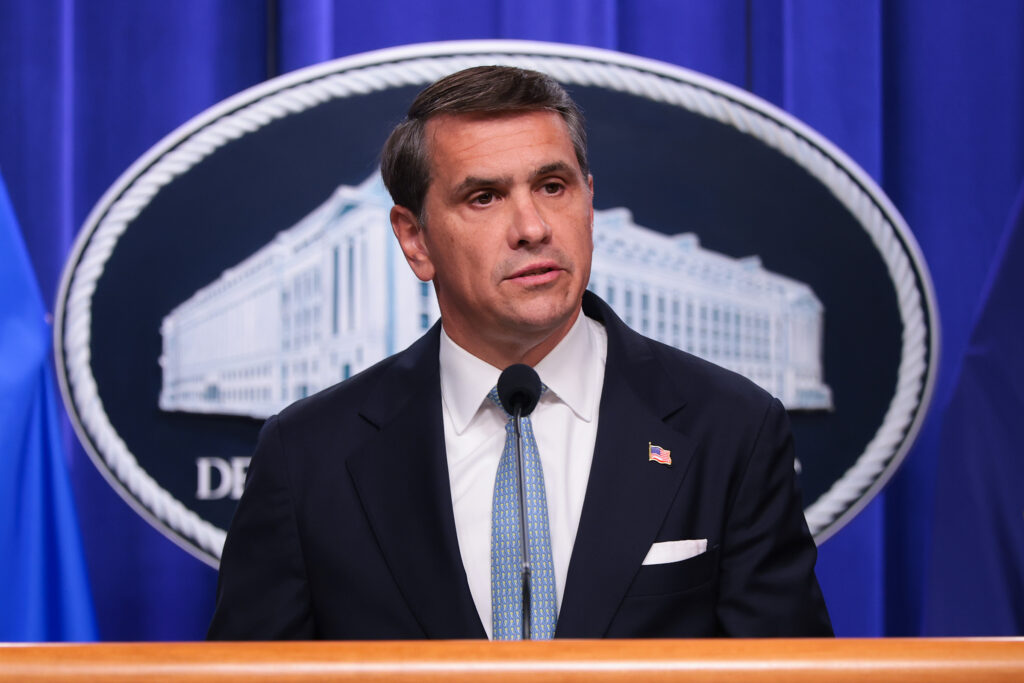
The attorney general says it’s a “possibility” that he will go to the U.S. Supreme Court if necessary, for the Trump administration’s crusade to take control of state voter rolls.
The newly confirmed head of the Department of Justice (DOJ) Todd Blanche made the comment on Sunday’s Meet the Press. Host Kristin Welker asked Blanche if he was willing to take his voter roll fight to the high court after a string of close to two dozen losses in lower federal courts.
“We’ll see what happens,” said Blanche. “Absolutely, it’s a possibility.”
Soon there may be nowhere else to go but up for Blanche’s DOJ, which on Friday suffered its 22nd district court loss in its campaign to make states hand over their unredacted voter rolls – this latest one from its lawsuit against Nevada.
Get updates straight to your inbox — for free
Join 350,000 readers who rely on our daily and weekly newsletters for the latest in voting, elections and democracy.
The DOJ has sued 30 states overall in this campaign, a federal intrusion into state’s constitutional authority over elections. No judge has sided with the Trump administration yet. The Justice Department claims it needs the private voter records to verify its false claims of noncitizen voter fraud, so it can kick people off the rolls.
When Welker asked if Blanche should give up this fight, given the long string of court losses, Blanche said, “we’re not going to stop.”
“We’re relying on a statute passed by Congress that allows us, in the right circumstances, to review and get those voter rolls,” said Blanche. “So, no, we’re not going to stop doing what I think every American should expect us to do.”
The statute that Blanche is referring to is from the Civil Rights Act, which the DOJ believes gives them the authorization to collect states’ voter records to see if they comply with federal election laws. However, almost every judge from each of DOJ’s 22 court losses has explicitly said that the Civil Rights Act statute does not provide this authorization or access to the federal government.
This has been the agreed position by judges appointed by both Democrat and Republican administrations. The DOJ also lost on this argument with the Sixth Circuit Court of Appeals court in June, and on Friday, the full panel of that appeals court refused to rehear the case.
An appeals court judge noted the irony of the Trump administration using the Civil Rights Act of 1960 to gain unfettered access to states’ private records in efforts to purge names from voter lists.
“Back then, the government used this power to ensure that everyone who had the right to vote could freely exercise that right,” U.S. Sixth Circuit of Appeals Judge Andre Mathis wrote in the June ruling against the DOJ. “But today, the government invokes Title III for an inverse purpose—to ensure that some people have not voted.”
Blanche also said on Meet the Press that he can’t guarantee that anyone who attacked the Capitol on January 6 won’t receive taxpayer-funded awards if they file claims against the government. It was a reference to Trump’s controversial “anti-weaponization fund,” which Blanche said was dead before he was finally confirmed as attorney general earlier in August.
He also refused to pledge on the Sunday show that the Justice Department will always act independently of the White House. A huge concern among elections experts, voting rights advocates, and even some Republicans, is that Blanche might be more than willing to carry out unconstitutional demands from Trump, such as deploying ICE or armed military to the polls on Election Day.
“Well, there’s a big difference between saying we will always do our job and investigate any case and act independently of the White House,” said Blanche. “No, I’m not going to pledge that, and no attorney general should ever pledge that.”
Attorney generals take oaths to uphold, protect and serve the Constitution, and have historically been expected to act independent of the president.