22 courts have rejected Trump DOJ’s voter roll crusade. DOJ says they’re all just wrong
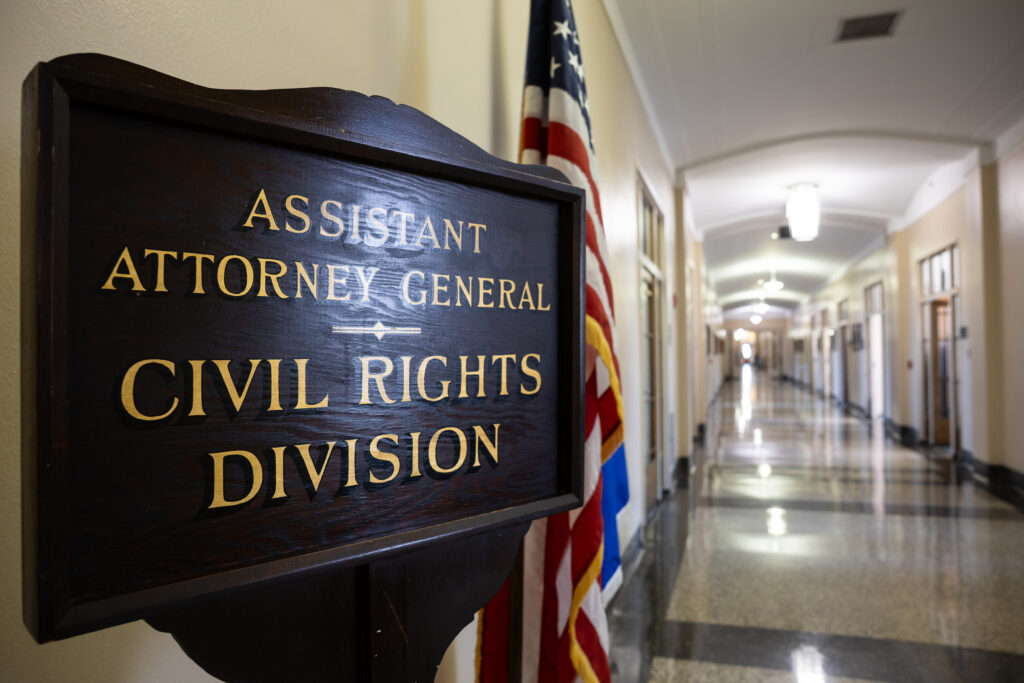
After 21 federal district courts and one federal appeals court panel slapped down the Trump administration’s attempt to grab states’ unredacted voter rolls, the Justice Department’s response has been remarkably consistent: we understand civil rights-era voting law better than all these judges.
The department keeps advancing essentially the same legal theory from courthouse to courthouse even as judges appointed by presidents of both parties have rejected it, often for the same reasons. And as the pile of losses grows, DOJ has shown little interest in recalibrating its approach.
That attitude was unusually explicit this week in Washington state.
Get updates straight to your inbox — for free
Join 350,000 readers who rely on our daily and weekly newsletters for the latest in voting, elections and democracy.
During a hearing over DOJ’s demand for Washington’s complete voter database, U.S. District Judge Kymberly Evanson noted the department’s extraordinary losing streak and asked whether there was anything meaningfully different about the case before her.
“By my count, this is the 20th court to address this exact issue,” Evanson said. “Is there any meaningful basis on which to distinguish this case from the many other district courts and the Sixth Circuit Court of Appeals across the country that have dismissed the government’s complaints or denied their motion to compel?”
“No, your Honor,” DOJ attorney Raymond Yang replied. “Relevant facts are similar to all the other cases.”
His explanation for why Washington should nevertheless rule differently was simple: All the other courts got it wrong.
Yang said judges around the country had “misconstrued the text, context, structure, history, and original understanding of Title III” of the Civil Rights Act of 1960.
That has increasingly become the department’s answer to a remarkable judicial consensus.
At the center of the cases is DOJ’s attempt to use Title III — a law enacted during the Jim Crow era to prevent states from destroying election records — to force states to hand over live statewide voter registration databases containing information such as full birthdates, driver’s licenses and Social Security numbers.
Again and again, courts have rejected DOJ’s argument that those databases qualify as records that “come into” election officials’ possession under the statute. Judges have reasoned that the phrase applies to records that election officials receive – such as voter registration applications – rather than constantly changing databases the states themselves create.
Courts in Michigan, Arizona, Wisconsin, Maine, Maryland, New Hampshire, Pennsylvania, New York, Virginia, Connecticut, New Jersey, Illinois, Colorado, Kentucky and Washington, D.C., have rejected DOJ’s interpretation on that ground. Others have separately concluded that DOJ’s demands failed to provide the “basis and purpose” Title III expressly requires.
A three-judge panel of the Sixth Circuit Court of Appeals also ruled against DOJ’s attempt to obtain Michigan’s rolls. DOJ has asked the full appeals court to reconsider that ruling.
DOJ has not responded to the setbacks by materially modifying its interpretation.
Just this week, the department filed nearly identical letters in its Ninth Circuit appeals from losses in California and Oregon, acknowledging yet another batch of rulings against it before explaining why those judges were also mistaken.
DOJ called the courts’ interpretation of Title III “narrow” and said it “circumvents congressional intent.” It called the judges’ reasoning about the law’s preservation requirements “erroneous.” And it described a court’s interpretation of the law’s demand requirements as “unnecessarily formalistic.”
In other words, as the precedent against DOJ has accumulated, the department has not substantially changed its theory. It has accumulated more courts to accuse of misunderstanding it.
New incident, same old argument
That does not mean DOJ never adjusts its presentation.
When politically useful or alarming state-specific incidents emerge, the department has sometimes bolted them onto lawsuits that were already underway — without changing the underlying legal theory.
In Minnesota, for example, DOJ filed a document in April titled “Notice of Additional Basis” after news reports that one noncitizen had allegedly registered and cast a ballot in the 2024 election.
The department argued that because Minnesota had allegedly “failed to remove an ineligible individual,” DOJ “must verify that no such other individual is registered to vote.”
The lawsuit itself, however, had already been filed. The incident did not create a new statutory theory authorizing DOJ to obtain Minnesota’s voter database. It attempted to supply a more sympathetic factual backdrop for the same one.
DOJ took a similar approach in New Jersey.
After Gov. Mikie Sherrill (D) disclosed in July that a software error had improperly registered roughly 6,600 people who had indicated they were not U.S. citizens, DOJ filed another document titled “Notice of Additional Basis.”
But once again, DOJ did not change its central legal claim: Title III supposedly entitled the federal government to New Jersey’s complete voter database.
The judge dismissed the case anyway, saying the incident had “no bearing” on the ruling.
These “additional basis” filings illustrate how DOJ has attempted to refurbish its cases around the edges while leaving the core argument intact. A new controversy may become another reason the department says a court should give it the data. It does not resolve the threshold question courts keep answering against DOJ: Does the law actually authorize the department to demand the database in the first place?
DOJ just keeps doubling down
The Washington hearing showed how stubbornly far the department is willing to carry its interpretation.
When Evanson asked whether DOJ believed Title III could require Washington to retain registration applications going back as far as 100 years if those voters remained eligible in the latest federal election, DOJ said yes.
When she asked whether the department had to provide an actual factual basis for demanding a state’s sensitive voter information, DOJ again said no.
“No, your Honor,” Yang replied, arguing that a legal basis and general statement of purpose should be sufficient.
And when the judge asked why DOJ needed sensitive identifiers such as Social Security numbers to evaluate Washington’s voter-list maintenance, the department first responded that federal law required the state to maintain the information. After Evanson pointed out that this did not explain why DOJ needed to possess it, the government shifted to a more specific theory involving whether Washington properly assigns federally required identification numbers.
Those arguments have yet to persuade a single court.
DOJ’s remaining voter roll cases have dwindled to roughly nine states, including Delaware, Washington, Georgia, Hawaii, Nevada, Utah, Minnesota, Idaho and Vermont, with some proceedings effectively waiting for appeals courts above them to weigh in.
The landscape is now dramatically different from when DOJ began filing the lawsuits last year.
Its theory is no longer novel and untested. Judges around the country have tested it repeatedly, and the department has lost repeatedly.
Still, DOJ’s position remains essentially what Yang told the Washington court this week.
The facts are not meaningfully different. The argument is not meaningfully different. DOJ simply believes all the courts that rejected it are wrong.