Georgia GOP votes to keep QR code ballots, but adds extra hand recounts
 Prefer us on Google
to see more of our voting rights news coverage when you search.
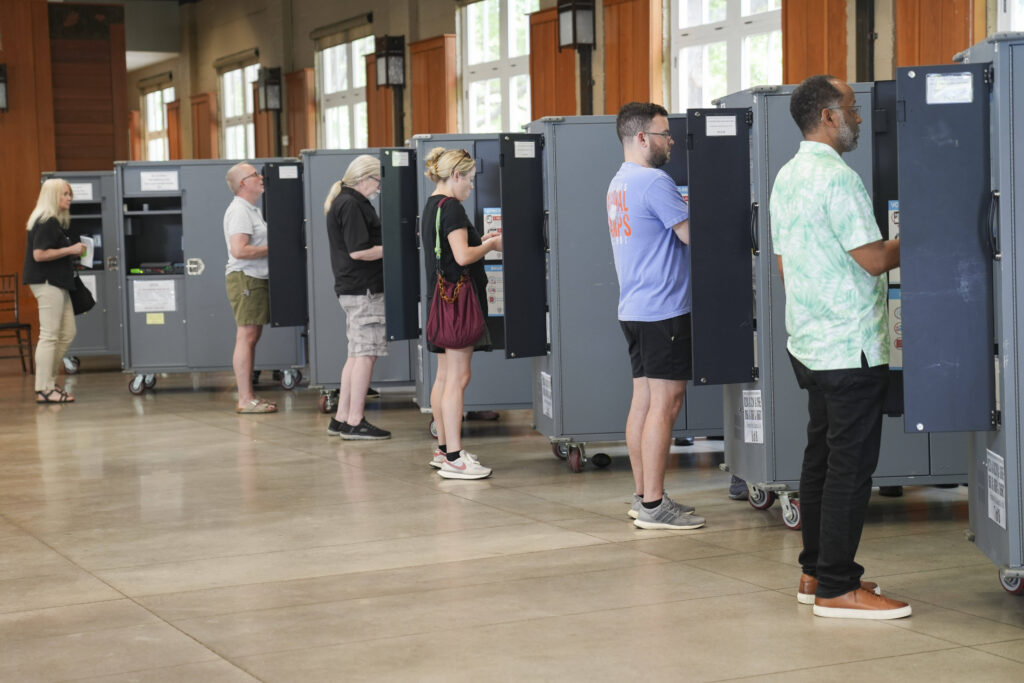
Georgia Republicans advanced a bill Saturday that allows the state to continue using QR code-scanned ballots until a new system is selected in 2028.
But in a last-second twist, state Republicans added an amendment that would require counties to conduct hand recounts for the top two races of every election before the state can certify the votes.
The lawmakers’ vote to remain in the QR code ballot system, will spare voters and election officials some chaos in determining this year’s election outcomes, if the bill is ultimately signed into law.
Still, Democrats are concerned that the amendment on manual recounts could unnecessarily gum up the vote tabulation process, undermining voter confidence.
Get updates straight to your inbox — for free
Join 350,000 readers who rely on our daily and weekly newsletters for the latest in voting, elections and democracy.
“This could substantially delay the certification process,” Georgia Minority Whip Sen. Kim Jackson (D) told Democracy Docket. “There will undoubtedly be discrepancies between the machine count and the hand count, because you have humans who are doing the work. But the way this amendment was written is that if there is a discrepancy, then the votes must be certified essentially based on the hand count.”
The vote took place during a special general assembly session that Kemp called to resolve issues around how the state will process ballots after July 1, which is the date lawmakers chose to begin a ban on the QR-code ballot system Georgia has used since 2020. Kemp also called the special session to begin mid-year redistricting plans, to minimize minority districts, but lawmakers scrapped those plans earlier this week, under pressure from voting rights activists.
Jackson said that Republicans left Democratic lawmakers out of the drafting of the bill and the new amendment. She told Democracy Docket that Democrats came prepared with their own amendments, but the Republican majority closed debate before any of them could be heard. Democrats didn’t know about the new hand recount amendment until this morning when the session started, Jackson said.
“Over the last several weeks, Democrats were not included in any discussion about this bill,” said Georgia Sen. Jaha Howard (D) during today’s legislative hearing. “I noticed that the Democrats were only allowed to see the bill the moment they walked into committee, where there was a small group of men who for weeks were hammering out the details. And now, in a matter of a couple of days, here it is on the Senate floor with no debate.”
The bill passed 33 to 19 out of the state Senate, with no Democrats voting for it. It now goes to the state House of Representatives where it can be further amended. If the House adds no changes then it will head to Gov. Brian Kemp’s desk. Jackson said she and other Senate Dems are already conferring with House Dems about adding amendments.
Lawmakers voted in 2024 to end the QR code ballot system after President Donald Trump and other rightwing activists peddled fabrications, saying the digital voting machines were hacked and defrauded Trump of winning the 2020 election.
Under the current system, voters pick their candidates on a digital touchscreen machine, which then produces a paper ballot receipt with a unique QR code that is scanned to record the voters’ choices. Republican lawmakers and election deniers have been pushing for a switch to a system where voters mark ballots by hand – with an inkpen, for instance.
While there’s no evidence that Georgia’s touchscreen machines have ever been hacked or produced fraud (one voting machine company, in fact, successfully sued to dispel such rumors) election conspiracists have argued lately that voters can’t read QR codes to tell if their votes were recorded correctly. However, the QR-coded ballot receipts also include a list of the choices voters select, spelled out in plain language.
Georgia lawmakers pushed to extend the July 1 deadline for ending the QR code system during their regular session earlier this year, but Republican state Senate leaders declined to bring it up for a vote. The result was that Georgia’s election system has been in limbo, stuck in a system the state paid more than $100 million for, but would be legally prohibited from using after July.
If the special session bill becomes law, Georgia will be able to use the QR code ballots through 2027.
In the meantime, the bill creates a committee that will study voting systems and provide recommendations for the future ballot-tabulating infrastructure used in 2028 and beyond. The Election Equipment Specifications and Standards Committee will have nine members, chosen in equal parts by the governor, the Speaker of the House, and members of the state’s Senate Committee on Assignments.
One person the bill explicitly forbids from participating in this committee is the state’s elections chief.
The Secretary of State “shall have no role or authority in the selection, certification, or procurement of such new uniform system, including, but not limited to, the preparation of any requests for proposals, requests for qualifications, or other solicitations to potential vendors of election equipment to be used as a part of such uniform system.”
The bill does allow the new election equipment committee to “seek advisement” from the Secretary of State’s elections director, as well as from the executive director of the State Election Board, the Georgia Association of Voter Registration and Election Officials, disability experts and cybersecurity experts.
It’s worth noting that it was dubiously accredited “cybersecurity experts” and election conspiracists currently on the State Election Board who threw Georgia’s elections system into question in the first place, by spreading myths about its voting machines.
State Sen. Josh McLaurin, the Democratic nominee for Lieutenant Governor this November, said at today’s hearing that those election conspiracies led to the current voting system chaos, and accused Republicans of causing more disarray with the new hand recount amendment.
“We’re now amending the bill to add superfluous layers of election process manual recounts for races, that do not enhance the integrity or security of these elections relative to the cost they will impose on election administrators,” said McLaurin. “And why? Because of election denial. Because we can’t let go of the 2020 election result, two presidential cycles ago, and one man’s fragile ego. Donald Trump’s ego is the reason why Republicans have been committed to adding layers and layers of unnecessary process and doubt and questioning to election processes throughout the state.”
Sen. Jackson said at the hearing that the hand recounts will not only take longer for final results, but will make it more expensive for county officials.
“A party that talks about being a conservative party is adding an incredible amount of expenses on top of every single county by requiring them to have to hand count these ballots,” said Jackson. “It’s just messy, and it throws our election process into grave uncertainty, which I actually think may be the point.”