Federal appeals court won’t fully block student IDs for voting in New Hampshire
 Prefer us on Google
to see more of our voting rights news coverage when you search.
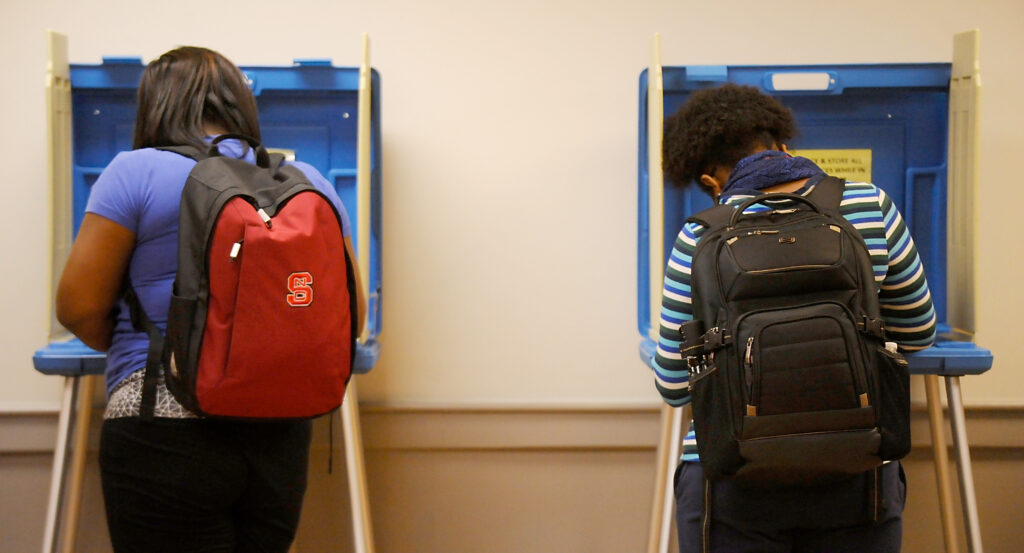
A federal appeals court ruled to keep in place a lower court decision that barred the state from fully enforcing a prohibition on election officials accepting student IDs for voting.
But the 1st Circuit Court of Appeals’ order, released Wednesday, also did not overturn the lower court’s decision to uphold the broader ban on student IDs for voting.
In practice, that means that although student IDs are not an accepted form of voter identification on their own, election officials across the Granite State can still consider them as evidence of a person’s identity when registering to vote or voting in the midterms.
“We applaud the First Circuit’s ruling today, which blocks the state of New Hampshire’s attempt to suppress further the vote of young people on the eve of the November 2026 election,” a lawyer representing the Coalition for Open Democracy (COD), which sued New Hampshire over the ban, said in a statement.
“The decision will provide young eligible voters with the opportunity to register and to rightfully exercise their right to vote in this pivotal election, even if they cannot afford or cannot access another form of ID. We are committed to defending this ruling and will continue to challenge HB 323 so that students can again be sure that their New Hampshire-issued student IDs will be accepted when they vote.”
In April, Gov. Kelly Ayotte (R) signed into law HB 323, which eliminated student IDs as an acceptable form of identification for obtaining a ballot. New Hampshire Secretary of State David Scanlan (R) then sent a directive to local election officials that they could no longer accept student IDs to prove a voter’s identity, including under the state’s safety-valve provision, which lets voters present other evidence to prove their identity when voting.
Get updates straight to your inbox — for free
Join 350,000 readers who rely on our daily and weekly newsletters for the latest in voting, elections and democracy.
COD sued the state in August to block the ban for the Sept. 8 primary election. But U.S. District Judge Joseph Laplante denied the motion for a preliminary injunction, citing the Purcell principle — a legal doctrine stating that courts should not change voting rules too close to an election because it could confuse voters and officials. However, Laplante also allowed the possibility that his considerations would be different ahead of the general election.
Then, on October 2, the judge ruled that, while the student ID ban could stand, Scanlan had exceeded his authority in issuing guidance to election officials fully banning them from accepting student IDs for voting. Laplante said Scanlan’s directive was likely unconstitutional under the First, 14th and 26th Amendments.
Though Wednesday’s order helps students who hope to use their school ID when voting or registering to vote, they still face a barrage of barriers to the ballot box.
New Hampshire has some of the most restrictive voting laws in the country. The state has no early voting period, imposes severe restrictions on mail voting, and makes it difficult for students to establish residency.