Supreme Court ruling derails 28 lawsuits defending minority voting rights, Democracy Docket research finds
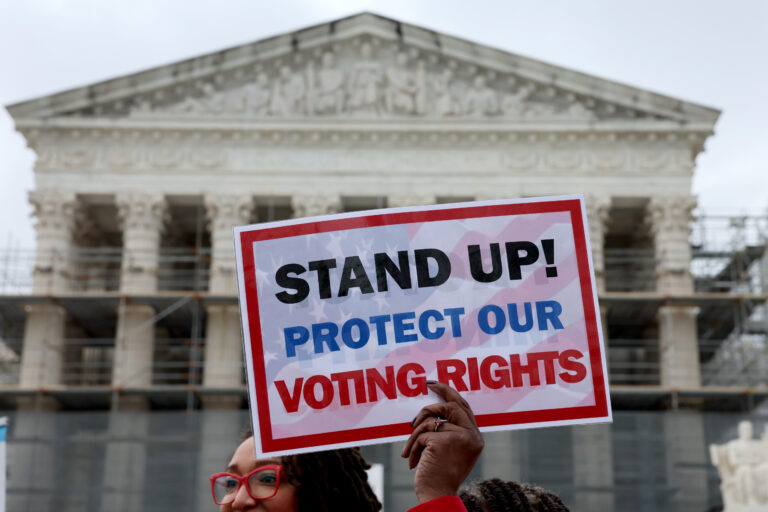
For more than six decades, the Voting Rights Act (VRA) restricted racial gerrymanders and banned racial discrimination in voting.
Then, on Wednesday, the U.S. Supreme Court (SCOTUS) issued a ruling in Louisiana v. Callais gutting the landmark civil rights legislation’s critical Section 2 and delivering a crippling blow to voting rights.
The ruling opens the door for even more Republican gerrymanders and the dismantling of majority-minority voting districts aimed at ensuring that Black and brown Americans’ voices are heard.
The effects will be felt almost immediately.
According to exclusive research by Democracy Docket, the Supreme Court’s ruling will likely derail at least 28 pro-voting lawsuits that aim to stop state legislatures from drawing electoral maps that dilute the voting power of racial minorities.
Get updates straight to your inbox — for free
Join 350,000 readers who rely on our daily and weekly newsletters for the latest in voting, elections and democracy.
The maps in question include virtually every type of non-presidential vote held in the United States: congressional and state legislative races, state supreme court elections, and even city council contests.
And the legal challenges to them have been — and will continue to be — primarily concentrated in the South, where America’s legacy of segregation and racial discrimination still casts the longest shadow over voting rights.
In fact, many of the cases were paused as courts waited for SCOTUS to give the final word on Callais. Now, pro-voting prospects in those cases look extremely poor.
Congressional maps
In Alabama, voters and non-profit organizations are challenging the state’s current congressional map, arguing that it violates Section 2 of the VRA by diluting the voting strength of Black Alabamians. That case — Allen v. Milligan — is currently pending before the Supreme Court.
Last year, Alabama urged the court to review a district court ruling finding that the map indeed violated Section 2. The state questioned whether the district court’s application of Section 2 complied with the Constitution.
Alabama currently has two majority-Black congressional districts as a result of pro-voting litigation. In an agreement approved by the court, the parties resolved to continue using the current map until the state adopts a new redistricting plan in 2030.
But after SCOTUS’s Callais ruling, that order is unlikely to hold up in court. That means Alabama’s historically Black 2nd congressional district — represented by Rep. Shomari Figures, a Black Democrat — will probably be eliminated.
And it may happen quickly. After the Callais ruling, Republicans across the state took to social media asking Gov. Kay Ivey (R) to call a special session to redraw Alabama’s congressional map.
In Georgia, a similar case — Pendergrass v. Raffensperger — is playing out. Pro-voting plaintiffs claim that the state’s 2020 congressional map dilutes the voting strength of racial minorities and denies them an equal chance to participate in the political process.
They argued that the state legislature should have created an additional majority-Black district in the Atlanta metropolitan area under the VRA because Black Georgians in that area vote cohesively as a bloc and are numerous and compact enough to form an additional district.
In 2023, a federal judge struck down the map for violating Section 2 and ordered the legislature to redraw it for the 2024 election cycle.
The case is now on appeal in the 11th Circuit. But the Callais decision likely means that future congressional maps could break up all three Black-majority districts across the Atlanta metro area.
State and local maps
The Callais ruling will also affect elections for a variety of state and local offices. These races often go under the radar, but they’re crucial for ensuring that minority voters have responsive ground-level representation.
In 2022, pro-voting plaintiffs in Mississippi filed a lawsuit on behalf of Black voters challenging the districts used for electing justices to the state’s nine-member Supreme Court. They alleged that those districts diluted the voting strength of Black Mississippians in violation of Section 2.
Last August, a district court ruled in favor of plaintiffs and ordered the state legislature to draw a new, compliant map. Mississippi appealed the ruling to the 5th Circuit, but the case — White v. State Board of Election Commissioners — has been paused pending the Supreme Court’s resolution of Callais.
Since both Democrats and Republicans have long expected SCOTUS to gut Section 2, Mississippi Gov. Tate Reeves (R) defied the court order to draw a new map and scheduled a special session for 21 days after the Callais ruling. That means the Mississippi legislature will convene on May 20 to draw a new map after failing to redistrict in the regular 2026 session.
And this time, they won’t be reined in by the VRA.
The Callais decision came just a day after the district court judge held a hearing to determine which remedial map she would select in light of the legislature’s failure to adopt one on its own. SCOTUS’s new standard will complicate any remedy considered by the court.
The Callais ruling will also have a dangerous impact on the composition of state legislatures — the bodies that produce and adopt congressional and state legislative maps. That bodes poorly for minority voters.
In 2022, pro-voting plaintiffs in Louisiana filed a lawsuit — Nairne v. Ardoin — arguing that the state’s legislative maps diluted the voting strength of Black voters by “packing” and “cracking” them into certain districts.
A trial court subsequently found the map violated Section 2, and the 5th Circuit affirmed the decision. However, a district court paused the official redraw pending SCOTUS’s decision in Callais.
The Callais ruling will also impact electoral maps further down the ballot.
In 2024, five Black members of the metropolitan council in Louisiana’s East Baton Rouge Parish, filed suit to challenge the Baton Rouge city council’s map under Section 2. In Dunn v. East Baton Rouge Parish, they alleged that the council’s white majority passed a map that packed almost 70% of the parish’s Black voters into three districts while creating seven majority-white districts. The case was paused at the district court level pending resolution in Callais.
The Callais ruling leaves nearly two dozen other cases across the country in limbo.
Section 2 challenges to congressional maps are still being litigated in North Carolina and Texas. Georgia, Louisiana, Alabama, Mississippi, North Carolina, and Texas also face challenges to their state legislative maps under Section 2. Callais will also impact local commission boards in Georgia.
Only two of the roughly 28 cases likely derailed by Callais are located outside the South: a challenge to judicial districts in Indiana and a challenge to state legislative districts in North Dakota.