DOJ lawsuit ‘ignores the realities of election administration,’ says Los Angeles County
 Prefer us on Google
to see more of our voting rights news coverage when you search.
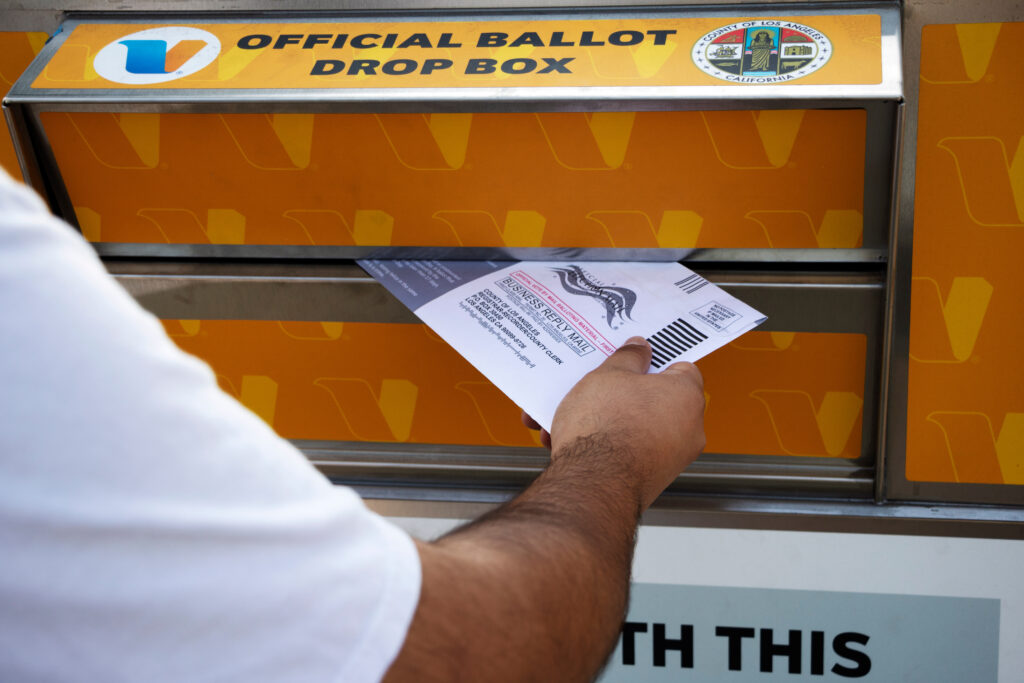
The U.S. Justice Department’s (DOJ) demand that Los Angeles County impound the ballots of some 20,000 voters the Trump administration believes are noncitizens not only has no legal basis, but would be impossible to carry out, the county said in a court brief filed Friday night.
“It ignores the realities of election administration,” the California county said “And it asks for something no court can order, because no election official can perform it. Full stop.”
L.A. county filed the brief to oppose the DOJ’s request for a court order requiring it to begin segregating the ballots while a federal appeals court considers the case.
The DOJ sued L.A. County on Oct. 15 after it declined to comply with the department’s demands that it set aside and not count more than 20,000 ballots, while the voters’ citizenship status is investigated.
The lawsuit marked a sharp escalation in the administration’s attempts to exert federal authority over elections, despite the U.S. Constitution granting the executive branch no control over election administration.
As L.A. County’s filing notes, the DOJ’s scheme would inject chaos in local election administration and undermine voters’ confidence in the system.
Get updates straight to your inbox — for free
Join 350,000 readers who rely on our daily and weekly newsletters for the latest in voting, elections and democracy.
Beyond that, the county’s brief mainly emphasizes the impracticality of what the DOJ is asking it to do — particularly since early voting is already underway. There are nearly 6 million registered voters in L.A. County, and hundreds of thousands of mail ballots have already been processed. Trying to locate and then segregate 20,000 ballots would be a logistical nightmare for election officials, the brief states.
“It asks the Court to withhold the ballots of those on the list, to preserve the possibility of excluding those ballots if an investigation the Executive concedes it cannot finish before the election ends eventually substantiates its suspicions,” L.A. County argued. “The order the Executive seeks is not merely burdensome; it is logistically impossible. Every vote-by-mail ballot has already been printed and mailed. Once a returned ballot’s signature is verified, the ballot is separated from its envelope and commingled with others, and cannot lawfully be traced to the voter.”
The DOJ is asking the federal district court for an injunction and a temporary restraining order to force the county to do this anyway. A hearing has been scheduled for Oct. 27, but the department has already asked a federal appeals court to weigh in.
On Saturday, the civic organizations SIREN and Mi Familia en Acción* moved to intervene in opposition to the DOJ’s demand for an appeal.
“The U.S. Department of Justice’s motion presents an entirely fictitious emergency, in an appeal DOJ has no right to pursue, in a dangerous and meritless action that should never have been brought,” the organizations said in their proposed response.
The DOJ is basing its argument on Section 611 of the U.S. Code’s Title 18, which forbids noncitizens from voting. But the county points out that this criminal statute “says nothing about how ballots are mailed, verified, or counted, and nothing about holding ballots while federal investigators work through a list.”
“Refusing to comply or cooperate with an unlawful request is not the same as impeding citizenship investigations,” the brief reads.
L.A. County argues that the request is likely unlawful because it would require the county to violate several federal election laws, notably the National Voter Registration Act, which forbids sweeping election changes and systematic purges within 90 days of an election — during what’s known as the “quiet period” — to avoid voter confusion.
“Setting aside registered voters’ ballots until an open-ended federal review ends accomplishes the same exclusion the quiet period exists to prevent,” the brief reads. “A purge does not escape the statute by being called a ballot hold.”
Still, the brief states, L.A. County election officials “diligently investigated” whether they could fulfill the DOJ’s demands, all legal questions aside, and found that there was no “feasible path forward” to pull it off while an election is underway.
“There are technological hurdles, training hurdles, and physical hurdles,” the brief reads. “This is an incredibly complex system involving thousands of workers and changes of this magnitude simply cannot be effectively completed overnight without jeopardizing the effectiveness of the system as a whole.”
Performing that kind of ballot detention, the county argued, would prevent it from “processing and tabulating ballots for certification at the County level, and ultimately delay certification of statewide results.”
During past elections, the Trump administration and other Republicans have repeatedly and falsely claimed that such delays in announcing election results in California are evidence of voter fraud.
The DOJ waited until the election started to make these demands despite having the voter data it based its list of 20,000 names on for months, the county also argued. As noted in the brief, Trump administration officials contacted California election administrators in July to advise them to look into possible registered noncitizens based on that data.
“Having failed to finish its investigation before voting began, the Executive now asks voters and election officials to bear the cost of its delay and risk voter disenfranchisement resulting from incomplete, unverified, or inaccurate data,” the brief states.
*The Elias Law Group (ELG) represents the proposed intervenors in this case. ELG Firm Chair Marc Elias is the founder of Democracy Docket.