Democrats promise to give SAVE America Act ‘death it deserves’ in Senate
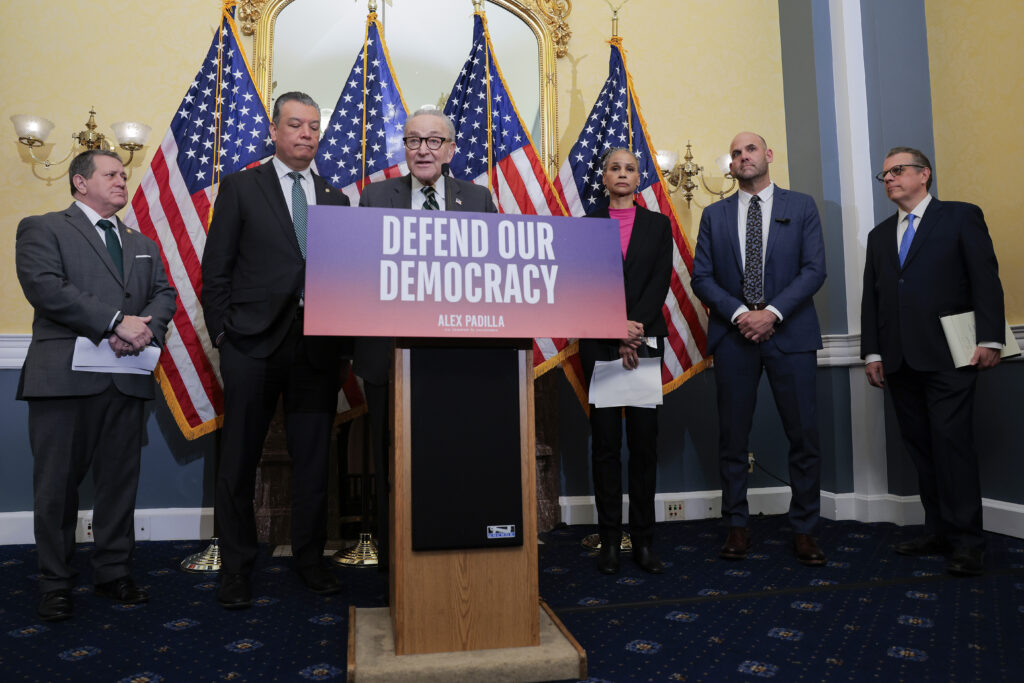
As the SAVE America Act heads to the Senate floor, Democrats Tuesday vowed to kill the sweeping anti-voting bill pushed by President Donald Trump and Republicans, which experts say would undermine millions of Americans’ right to vote if it became law.
Democratic lawmakers decried the draft legislation and the danger it poses to voting rights during two press conferences Tuesday.
“This is really one of the most pernicious pieces of legislation that I’ve ever seen,” Senate Minority Leader Chuck Schumer (D-N.Y) said. “The SAVE [America] Act would make it easier to buy an AR-15 than to register to vote.”
Get updates straight to your inbox — for free
Join 350,000 readers who rely on our daily and weekly newsletters for the latest in voting, elections and democracy.
Senate Republicans are expected to take up the bill Tuesday or Wednesday, though their attempt to pass it is likely doomed by the 60-vote threshold required to get past the filibuster.
But the debate itself will offer Democrats a chance to defend free and fair elections and take a stand against legislation so extreme it failed to muster significant support in the Senate until Trump declared it his top priority.
“We’re not going to let it pass. We’re going to fight it tooth and nail,” Sen. Alex Padilla (D-Calif.) said in a press conference Tuesday. “We’re prepared to stay here all day and all night, or multiple days and multiple nights, and even multiple weeks if necessary to make sure the SAVE [America] Act suffers the death it deserves.”
Though it may die in the Senate, the fact that 217 Republican representatives passed the bill in the House last month and that Senate Republicans are now bringing it to the floor for debate amounts to an unprecedented threat to voting rights.
If the SAVE America Act were passed, it would mark the first time in U.S. history that Congress restricted the vote, according to Michael Waldman, president and CEO of the Brennan Center for Justice.
“Congress, when it has gotten involved, has worked to expand the vote, to stop abuse of power,” Waldman said. “If this law passes, it would be the most restrictive voting bill ever passed by Congress. To turn back the clock rather than advancing our democracy — that has not happened before.”
“This bill is part of a concerted campaign by the Trump administration to undermine the election,” he added.
Facing historically low approval numbers, Trump has made the SAVE America Act his top legislative priority, believing that it will give Republicans an insurmountable advantage in the upcoming midterms and all future elections.
“I tell you what, Republicans have to win this one,” Trump said of the fight over the bill last month. “We’ll never lose a race. For 50 years, we won’t lose a race.”
Trump has framed the bill as a do-or-die attempt to save the country and presented any opposition to it as un-American. In reality, the bill would drastically restrict the right to vote for people across the political spectrum by mandating draconian requirements for registering to vote, staying registered and ultimately casting a ballot.
The bill would mandate prospective voters to show documentary proof of citizenship before registering — an extreme requirement in a country that has no single, mandatory national identity card for citizens. That would essentially require people to possess a passport or a birth certificate to vote, which tens of millions of Americans cannot afford or easily access.
The proof of citizenship requirement alone would make registering to vote especially difficult for the millions of Americans whose last names do not match those on their passports or birth certificates, such as the approximately 69 million women who took their spouse’s last name when they got married. Updating documents takes time and costs money.
“We’re talking about 25% of the entire voting population being forced to pay what’s essentially a paperwork tax just to exercise a fundamental right to vote,” Celina Stewart, CEO of the League of Women Voters, said.
Because people of color would be disproportionately affected, “these are modernized poll taxes,” she added.
The legislation would also impose strict photo identification requirements for casting a vote in federal races. However, it prohibits common forms of ID, such as those issued by colleges and universities — a move meant to make it harder for students to vote.
Even though the president has no authority to administer elections under the U.S. Constitution, the bill would directly involve the executive branch in maintaining voter registration rolls by requiring all states to turn over their voter data to the Department of Homeland Security (DHS).
“If I went up and down the streets of Rochester and knocked on doors and said, ‘How comfortable do you feel about the Department of Homeland Security having all your voter information, your voter file, the history of when you voted, where you live?’ I don’t think there would be many takers at this moment,” Rep. Joe Morelle (D-N.Y.) said.
DHS has “nothing to do with elections,” he added. “The 50 states determine how they’ll conduct elections, and frankly, for the most part, do it well.”
“If DHS is supposed to be doing anything, it’s to be partnering with state and local governments to prevent cyber attacks on our elections, but they’re failing and withdrawing from even that responsibility,” Padilla said.
If Trump has his way, the bill will also include a ban on no-excuse mail voting — a key way to cast a ballot in rural communities — and provisions unrelated to voting that would restrict the rights of transgender people.
Morelle slammed Republicans for pursuing the bill based on long-debunked, far-right claims that noncitizens are voting in elections in significant numbers.
“It’s all predicated on and premised on a falsity, and they keep continuing to say it,” he said.
In a separate presser Tuesday, Sen. Maria Cantwell (D-Wash.), election officials and voting rights advocates from across the country warned that the bill would create widespread disenfranchisement and unleash chaos on election systems just months before the midterms
“I cannot emphasize enough the Herculean effort that the SAVE America Act would present for election officials across this country, particularly on three key points: funding, personnel and timeline,” Karen Brinson Bell, former executive director of the North Carolina State Board of Elections said. “Many of the most disruptive and expensive provisions to this bill go into effect immediately upon enactment with no runway for implementation or preparation.”
Advocates also pointed to real-world cases of eligible voters’ ballots being discarded in states that have implemented similar anti-voting measures.
Elisabeth Warner, communications director for League of Women Voters of Ohio, pointed to Ohio House Bill 458 — a sweeping 2023 election law that imposed strict ID requirements to vote and curtailed email voting access — as a preview of the kinds of barriers the SAVE America Act would create nationwide.
“In 2020, about 1,200 Ohio provisional ballots were rejected due to lack of ID. In 2024, that number was more than 7,000,” she said. “Changing all these rules at once has been bewildering for voters. All of this is just the warm-up to the SAVE America Act. The horrors of this bill are many.”
“The problem isn’t that the wrong people are voting. The problem is that not enough people are voting,” Greg Kimsey, an experienced election official in Washington state, added. “The SAVE America Act would increase the cost of elections without providing any funding for those increased expenses. This is nothing more than a very clumsy attempt to create chaos in this year’s elections.”
Cantwell issued a broader warning about what’s at stake in the battle over the anti-voting legislation.
“The hallmark of a democracy is free and fair elections,” Cantwell said. “And when you start to undermine that, you are truly undermining our power as a democracy.”
To ratchet up pressure on his allies in Congress, Trump has endorsed blocking any other legislation until the SAVE America Act is passed and has threatened GOP holdouts. In a post Tuesday morning, Trump said he wouldn’t endorse any Republicans who vote against it.
“Only sick, demented, or deranged people in the House or Senate could vote against THE SAVE AMERICA ACT,” Trump wrote.